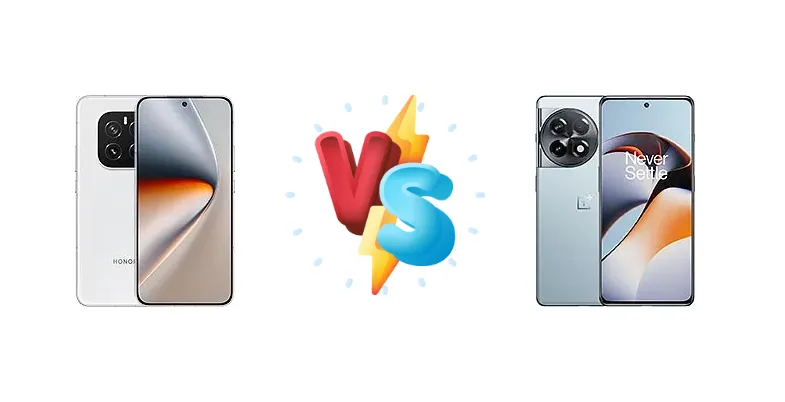
The Honor GT 2 Pro and OnePlus 11R represent compelling options in the upper-midrange to flagship Android space. The GT 2 Pro arrives with the latest Qualcomm Snapdragon 8 Elite Gen 5, built on a 3nm process, while the 11R leverages the proven Snapdragon 8+ Gen 1. This comparison dissects their key differences, focusing on performance, charging, and overall user experience to determine which device delivers the best value.
🏆 Quick Verdict
For users prioritizing raw processing power and future-proofing, the Honor GT 2 Pro takes the lead thanks to its Snapdragon 8 Elite Gen 5. However, the OnePlus 11R offers a remarkably similar experience for a potentially lower price, coupled with slightly faster 100W charging, making it the more sensible choice for budget-conscious gamers and everyday users.
| Network |
|---|
| 2G bands | GSM 850 / 900 / 1800 / 1900 | GSM 850 / 900 / 1800 / 1900 |
| 3G bands | HSDPA 800 / 850 / 900 / 1700(AWS) / 1900 / 2100 | HSDPA 850 / 900 / 1700(AWS) / 2100 |
| 4G bands | LTE | 1, 3, 4, 5, 8, 28, 34, 38, 39, 40, 41 |
| 5G bands | SA/NSA | 1, 3, 5, 8, 28, 40, 41, 77, 78 SA/NSA |
| Speed | HSPA, LTE, 5G | HSPA, LTE (3CA), 5G |
| Technology | GSM / HSPA / LTE / 5G | GSM / CDMA / HSPA / LTE / 5G |
| | - | CDMA 800 |
| Launch |
|---|
| Announced | Not announced yet | 2023, February 07 |
| Status | Rumored | Available. Released 2023, February 21 |
| Body |
|---|
| Build | Glass front (Giant rhino glass), aluminum frame, fiber-reinforced plastic back | Glass front, glass back (Gorilla Glass 5), plastic frame |
| Dimensions | - | 163.4 x 74.3 x 8.7 mm (6.43 x 2.93 x 0.34 in) |
| SIM | Nano-SIM + Nano-SIM | Nano-SIM + Nano-SIM |
| Weight | - | 204 g (7.20 oz) |
| Display |
|---|
| Protection | Giant rhino glass | - |
| Resolution | 1224 x 2800 pixels (~447 ppi density) | 1240 x 2772 pixels, 20:9 ratio (~451 ppi density) |
| Size | 6.83 inches, 110.5 cm2 | 6.74 inches, 109.2 cm2 (~90.0% screen-to-body ratio) |
| Type | LTPO AMOLED, 1B colors, 144Hz, 4320Hz PWM, HDR Vivid, 1600 nits (HBM), 6000 nits (peak) | Fluid AMOLED, 1B colors, 120Hz, HDR10+, 1450 nits (peak) |
| Platform |
|---|
| CPU | Octa-core (2x4.6 GHz Oryon V3 Phoenix L + 6x3.62 GHz Oryon V3 Phoenix M) | Octa-core (1x3.0 GHz Cortex-X2 & 3x2.5 GHz Cortex-A710 & 4x1.80 GHz Cortex-A510) |
| Chipset | Qualcomm SM8850-AC Snapdragon 8 Elite Gen 5 (3 nm) | Qualcomm SM8475 Snapdragon 8+ Gen 1 (4 nm) |
| GPU | Adreno 840 | Adreno 730 |
| OS | Android 16, MagicOS 10 | Android 13, upgradable to Android 15, OxygenOS 15 |
| Memory |
|---|
| Card slot | No | No |
| Internal | 256GB 12GB RAM, 512GB 12GB RAM, 512GB 16GB RAM, 1TB 16GB RAM | 128GB 8GB RAM, 256GB 16GB RAM, 512GB 18GB RAM |
| | - | UFS 3.1 |
| Main Camera |
|---|
| Features | LED flash, HDR, panorama | Color spectrum sensor, LED flash, HDR, panorama |
| Single | - | 16 MP, f/2.4, 24mm (wide), 1/3.09", 1.0µm |
| Triple | 50 MP, f/2.0, (wide), 1/1.56", 1.0µm, PDAF, OIS
50 MP, f/2.4, (telephoto), 1/2.0", 0.8µm, PDAF, OIS, 3x optical zoom
50 MP, f/2.0, 122˚ (ultrawide), AF | 50 MP, f/1.8, 24mm (wide), 1/1.56", 1.0µm, multi-directional PDAF, OIS
8 MP, f/2.2, 120˚ (ultrawide), 1/4.0", 1.12µm
2 MP (macro) |
| Video | 4K@24/30/60fps, 1080p@30/60/120/240fps, gyro-EIS, OIS, HDR Vivid | 4K@30/60fps, 1080p@30/60/240fps, gyro-EIS |
| Selfie camera |
|---|
| Features | HDR | HDR |
| Single | 50 MP, f/2.0, 22mm (wide) | 16 MP, f/2.4, 24mm (wide), 1/3.09", 1.0µm |
| Video | 4K@30/60fps, 1080p@30/60fps, gyro-EIS | 1080p@30fps |
| Sound |
|---|
| 3.5mm jack | - | No |
| 35mm jack | No | No |
| Loudspeaker | Yes, with stereo speakers | Yes, with stereo speakers |
| | - | 24-bit/192kHz audio |
| Comms |
|---|
| Bluetooth | 5.4, A2DP, LE, aptX HD, aptX Adaptive | 5.3, A2DP, LE, aptX HD |
| Infrared port | Yes | Yes |
| NFC | Yes | Yes |
| Positioning | GPS (L1+L5), BDS (B1I+B1c+B2a), GALILEO (E5a+E5b), QZSS (L1+L5), NavIC (L1+L5), GLONASS | GPS (L1+L5), GLONASS (G1), BDS (B1I+B1c+B2a), GALILEO (E1+E5a), QZSS (L1+L5) |
| Radio | No | No |
| USB | USB Type-C, OTG | USB Type-C 2.0 |
| WLAN | Wi-Fi 802.11 a/b/g/n/ac/6/7, dual-band, Wi-Fi Direct | Wi-Fi 802.11 a/b/g/n/ac/6, dual-band |
| Features |
|---|
| Sensors | Fingerprint (under display, ultrasonic), accelerometer, proximity, gyro, compass | Fingerprint (under display, optical), accelerometer, gyro, proximity, compass |
| Battery |
|---|
| Charging | 90W wired
5W reverse wired | 100W wired |
| Type | Si/C Li-Ion 8500 mAh | Li-Po 5000 mAh |
| Misc |
|---|
| Colors | Black, White, Gold | Galactic Silver, Sonic Black, Solar Red |
| Models | - | CPH2487 |
| Price | - | About 600 EUR |
| SAR | - | 1.16 W/kg (head) 0.61 W/kg (body) |
Honor GT 2 Pro
- Cutting-edge Snapdragon 8 Elite Gen 5 processor
- Potentially superior thermal efficiency due to 3nm process
- Advanced ISP for improved image processing
- Potentially higher price
- 90W charging is slower than the OnePlus 11R
OnePlus 11R
- Faster 100W wired charging
- Potentially more affordable price
- Proven Snapdragon 8+ Gen 1 performance
- Older 4nm process may result in more thermal throttling
- Less powerful CPU compared to the Snapdragon 8 Elite Gen 5
Display Comparison
While display specifications aren't provided, both phones likely feature high refresh rate AMOLED panels. However, the Honor GT 2 Pro’s chipset could drive a higher resolution or refresh rate more efficiently. The Snapdragon 8 Elite Gen 5’s advanced ISP may also contribute to more accurate color reproduction. The OnePlus 11R, benefiting from OnePlus’ display tuning expertise, will likely offer a vibrant and well-calibrated viewing experience, but may not reach the same peak brightness as the GT 2 Pro.
Camera Comparison
Camera details are absent, but we can infer based on brand positioning. Honor typically focuses on versatile camera systems, while OnePlus emphasizes natural image processing. The Snapdragon 8 Elite Gen 5’s advanced ISP in the GT 2 Pro will likely enable superior image processing capabilities, including better low-light performance and dynamic range. The OnePlus 11R’s camera system will likely be very good, but may not match the GT 2 Pro’s potential for computational photography advancements. Sensor size and OIS implementation will be crucial differentiating factors, but are currently unknown.
Performance
The core difference lies in the chipsets. The Honor GT 2 Pro’s Snapdragon 8 Elite Gen 5 (3nm) boasts a custom Oryon CPU architecture with a 2x4.6 GHz prime core and 6x3.62 GHz performance cores, promising significant gains over the OnePlus 11R’s Snapdragon 8+ Gen 1 (4nm). The 8+ Gen 1 utilizes a 1x3.0 GHz Cortex-X2 prime core and 3x2.5 GHz Cortex-A710 performance cores. The 3nm process of the Snapdragon 8 Elite Gen 5 translates to improved thermal efficiency, potentially reducing throttling during sustained workloads like gaming. While the 8+ Gen 1 is a capable performer, the GT 2 Pro should exhibit superior multi-core and single-core performance, especially in optimized applications. Both likely utilize LPDDR5X RAM, but the GT 2 Pro’s chipset may offer faster memory access speeds.
Battery Life
The OnePlus 11R’s 100W wired charging is a clear advantage, promising faster 0-100% charge times compared to the Honor GT 2 Pro’s 90W charging. While battery capacity isn’t specified, the Snapdragon 8 Elite Gen 5’s improved efficiency could offset a potentially smaller battery in the GT 2 Pro, resulting in comparable real-world battery life. The 5W reverse wired charging on the GT 2 Pro adds a convenient feature for topping up accessories, but is unlikely to be a primary use case for most users.
Buying Guide
Buy the Honor GT 2 Pro if you demand the absolute latest in mobile silicon and are willing to pay a premium for the Snapdragon 8 Elite Gen 5’s potential performance gains, especially in demanding applications and future game titles. Buy the OnePlus 11R if you prioritize a balanced experience with excellent performance, fast 100W charging, and a potentially more attractive price point, making it ideal for gamers and power users who don’t necessarily need the bleeding edge.
Frequently Asked Questions
❓ Will the Snapdragon 8 Elite Gen 5 in the Honor GT 2 Pro noticeably improve gaming performance compared to the OnePlus 11R?
Yes, the Snapdragon 8 Elite Gen 5’s Oryon CPU architecture and 3nm process should deliver a measurable performance uplift in demanding games, particularly those optimized for the latest Snapdragon features. Expect higher frame rates and smoother gameplay, especially in graphically intensive titles. However, the difference may not be dramatic in all games.
❓ How much faster is the 100W charging on the OnePlus 11R compared to the 90W charging on the Honor GT 2 Pro?
While the exact difference varies based on battery capacity (which isn't specified), the 100W charging on the OnePlus 11R will likely charge the phone from 0-100% approximately 10-15 minutes faster than the Honor GT 2 Pro. This is a significant advantage for users who frequently need to quickly top up their battery.
❓ Does the Snapdragon 8 Elite Gen 5 in the Honor GT 2 Pro run hotter than the Snapdragon 8+ Gen 1 in the OnePlus 11R during prolonged gaming sessions?
Theoretically, the Snapdragon 8 Elite Gen 5’s 3nm process should result in better thermal efficiency and less heat generation. However, real-world performance depends on the phone’s cooling system. The Honor GT 2 Pro *should* exhibit less throttling, but a well-designed cooling solution in the OnePlus 11R could mitigate the 8+ Gen 1’s heat output.