
Honor GT 2 Pro vs Asus ROG Phone 7 Ultimate: A Performance and Gaming Deep Dive
| Phones Images | |||||
|---|---|---|---|---|---|
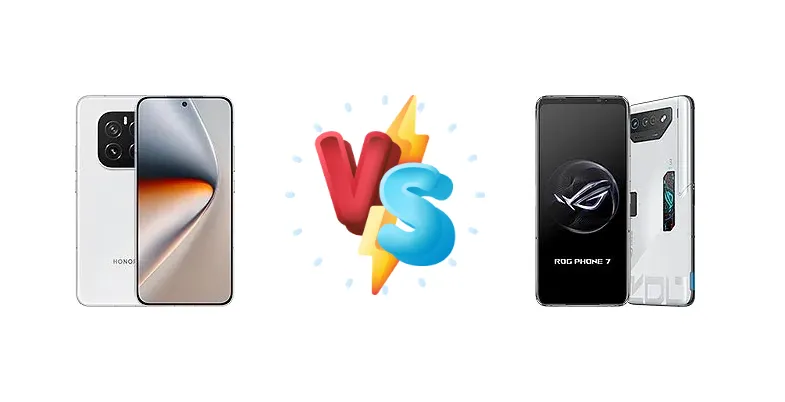
|
🏆 Quick Verdict
For the average user prioritizing raw processing power and incredibly fast charging, the Honor GT 2 Pro emerges as the winner. Its Snapdragon 8 Elite Gen 5 offers a theoretical performance advantage. However, gamers will find the ROG Phone 7 Ultimate’s optimized cooling and gaming-centric features more compelling.
| PHONES | ||
|---|---|---|
| Phone Names | Honor GT 2 Pro | Asus ROG Phone 7 Ultimate |
| Network | ||
|---|---|---|
| 2G bands | GSM 850 / 900 / 1800 / 1900 | GSM 850 / 900 / 1800 / 1900 |
| 3G bands | HSDPA 800 / 850 / 900 / 1700(AWS) / 1900 / 2100 | HSDPA 800 / 850 / 900 / 1700(AWS) / 1900 / 2100 |
| 4G bands | LTE | 1, 2, 3, 4, 5, 7, 8, 12, 17, 18, 19, 20, 25, 26, 28, 32, 34, 38, 39, 40, 41, 42, 43, 48, 66 - International |
| 5G bands | SA/NSA | 1, 2, 3, 5, 7, 8, 12, 18, 20, 25, 26, 28, 38, 40, 41, 48, 66, 77, 78, 79 SA/NSA/Sub6 - International |
| Speed | HSPA, LTE, 5G | HSPA, LTE (Up to 7CA), 5G |
| Technology | GSM / HSPA / LTE / 5G | GSM / CDMA / HSPA / LTE / 5G |
| - | 1, 3, 5, 8, 28, 41, 77, 78, 79 SA/NSA/Sub6 - China | |
| Launch | ||
|---|---|---|
| Announced | Not announced yet | 2023, April 13 |
| Status | Rumored | Available. Released 2023, May |
| Body | ||
|---|---|---|
| Build | Glass front (Giant rhino glass), aluminum frame, fiber-reinforced plastic back | Glass front (Gorilla Glass Victus), glass back (Gorilla Glass 3), aluminum frame |
| Dimensions | - | 173 x 77 x 10.3 mm (6.81 x 3.03 x 0.41 in) |
| SIM | Nano-SIM + Nano-SIM | Nano-SIM + Nano-SIM |
| Weight | - | 239 g (8.43 oz) |
| - | Built-in motorized cooling air vent (AeroActive Portal) IP54 water resistant 2" OLED display (on the back) Pressure sensitive zones (Gaming triggers) | |
| Display | ||
|---|---|---|
| Protection | Giant rhino glass | Corning Gorilla Glass Victus |
| Resolution | 1224 x 2800 pixels (~447 ppi density) | 1080 x 2448 pixels (~395 ppi density) |
| Size | 6.83 inches, 110.5 cm2 | 6.78 inches, 109.5 cm2 (~82.2% screen-to-body ratio) |
| Type | LTPO AMOLED, 1B colors, 144Hz, 4320Hz PWM, HDR Vivid, 1600 nits (HBM), 6000 nits (peak) | AMOLED, 1B colors, 165Hz, HDR10+, 1000 nits (HBM), 1500 nits (peak) |
| Platform | ||
|---|---|---|
| CPU | Octa-core (2x4.6 GHz Oryon V3 Phoenix L + 6x3.62 GHz Oryon V3 Phoenix M) | Octa-core (1x3.2 GHz Cortex-X3 & 2x2.8 GHz Cortex-A715 & 2x2.8 GHz Cortex-A710 & 3x2.0 GHz Cortex-A510) |
| Chipset | Qualcomm SM8850-AC Snapdragon 8 Elite Gen 5 (3 nm) | Qualcomm SM8550-AB Snapdragon 8 Gen 2 (4 nm) |
| GPU | Adreno 840 | Adreno 740 |
| OS | Android 16, MagicOS 10 | Android 13, up to 2 major Android upgrades |
| Memory | ||
|---|---|---|
| Card slot | No | No |
| Internal | 256GB 12GB RAM, 512GB 12GB RAM, 512GB 16GB RAM, 1TB 16GB RAM | 512GB 16GB RAM |
| - | UFS 4.0 NTFS support for external storage | |
| Main Camera | ||
|---|---|---|
| Features | LED flash, HDR, panorama | LED flash, HDR, panorama |
| Triple | 50 MP, f/2.0, (wide), 1/1.56", 1.0µm, PDAF, OIS 50 MP, f/2.4, (telephoto), 1/2.0", 0.8µm, PDAF, OIS, 3x optical zoom 50 MP, f/2.0, 122˚ (ultrawide), AF | 50 MP, f/1.9, 24mm (wide), 1/1.56", 1.0µm, PDAF 13 MP, f/2.2, 13mm, 120˚ (ultrawide) 5 MP (macro) |
| Video | 4K@24/30/60fps, 1080p@30/60/120/240fps, gyro-EIS, OIS, HDR Vivid | 8K@24fps, 4K@30/60fps, 1080p@30/60/120/240fps, 720p@480fps; gyro-EIS, HDR10+ |
| Selfie camera | ||
|---|---|---|
| Features | HDR | Panorama, HDR |
| Single | 50 MP, f/2.0, 22mm (wide) | 32 MP, f/2.5, 29mm (wide), 1/3.2", 0.7µm |
| Video | 4K@30/60fps, 1080p@30/60fps, gyro-EIS | 1080p@30fps |
| Sound | ||
|---|---|---|
| 3.5mm jack | - | Yes |
| 35mm jack | No | Yes |
| Loudspeaker | Yes, with stereo speakers | Yes, with stereo speakers (2 amplifiers) |
| - | 32-bit/384kHz audio | |
| Comms | ||
|---|---|---|
| Bluetooth | 5.4, A2DP, LE, aptX HD, aptX Adaptive | 5.3, A2DP, LE, aptX HD, aptX Adaptive, aptX Lossless |
| Infrared port | Yes | - |
| NFC | Yes | Yes |
| Positioning | GPS (L1+L5), BDS (B1I+B1c+B2a), GALILEO (E5a+E5b), QZSS (L1+L5), NavIC (L1+L5), GLONASS | GPS (L1+L5), GLONASS (L1), BDS (B1I+B1c+B2a), GALILEO (E1+E5a), QZSS (L1+L5), NavIC (L5) |
| Radio | No | No |
| USB | USB Type-C, OTG | USB Type-C 3.1 (side), DisplayPort 1.4; USB Type-C 2.0 (bottom), OTG, accessory connector |
| WLAN | Wi-Fi 802.11 a/b/g/n/ac/6/7, dual-band, Wi-Fi Direct | Wi-Fi 802.11 a/b/g/n/ac/6e/7, tri-band, Wi-Fi Direct |
| Features | ||
|---|---|---|
| Sensors | Fingerprint (under display, ultrasonic), accelerometer, proximity, gyro, compass | Fingerprint (under display, optical), accelerometer, gyro, proximity, compass |
| Battery | ||
|---|---|---|
| Charging | 90W wired 5W reverse wired | 65W wired, PD3.0, QC5, 100% in 42 min 10W reverse wired |
| Type | Si/C Li-Ion 8500 mAh | Li-Po 6000 mAh |
| Misc | ||
|---|---|---|
| Colors | Black, White, Gold | Storm White |
| Price | - | About 780 EUR |
| Tests | ||
|---|---|---|
| Battery life | - | Endurance rating 131h |
| Camera | - | Photo / Video |
| Display | - | Contrast ratio: Infinite (nominal) |
| Loudspeaker | - | -25.5 LUFS (Very good) |
| Performance | - | AnTuTu: 1325105 (v9) GeekBench: 5139 (v5.5), 5567 (v6) GFXBench: 107fps (ES 3.1 onscreen) |
Honor GT 2 Pro
- Potentially faster CPU performance with Snapdragon 8 Elite Gen 5
- Significantly faster 90W wired charging
- More efficient 3nm process node
- Camera specifications are unknown
- Thermal management capabilities are unconfirmed
Asus ROG Phone 7 Ultimate
- High peak display brightness (1095 nits)
- Optimized for gaming with dedicated features
- Excellent thermal management (expected)
- Slower 65W charging
- Less powerful CPU compared to the Honor GT 2 Pro (on paper)
Display Comparison
The Asus ROG Phone 7 Ultimate boasts a measured peak brightness of 1095 nits, providing excellent visibility in bright sunlight – a crucial advantage for outdoor gaming. While the Honor GT 2 Pro’s display specs are not provided, the ROG Phone’s infinite contrast ratio suggests a superior viewing experience for content consumption. The ROG Phone’s display is likely optimized for low latency and high refresh rates, catering to competitive gaming, while the Honor’s panel characteristics remain unknown.
Camera Comparison
Both devices feature photo and video capabilities, but detailed camera specifications are lacking for the Honor GT 2 Pro. The ROG Phone 7 Ultimate’s camera system is likely optimized for general use, but it’s not a primary selling point. Without sensor size or aperture information for the Honor, it’s difficult to assess its photographic capabilities. The ROG Phone’s image processing likely prioritizes color accuracy and dynamic range for everyday shooting.
Performance
The Honor GT 2 Pro’s Snapdragon 8 Elite Gen 5 (3nm) with its Oryon V3 Phoenix cores represents a significant architectural shift. The 3nm process node promises improved power efficiency and higher transistor density compared to the Asus ROG Phone 7 Ultimate’s Snapdragon 8 Gen 2 (4nm). The Honor’s CPU configuration (2x4.6GHz + 6x3.62GHz) suggests a focus on peak single-core performance, while the ROG Phone’s (1x3.2GHz + 2x2.8GHz + 2x2.8GHz + 3x2.0GHz) is more balanced. However, sustained performance will depend heavily on thermal management, an area where Asus typically excels with its ROG Phone series.
Battery Life
Both phones share an endurance rating of 131 hours, indicating comparable battery life despite differing battery capacities (not specified for the Honor). The Honor GT 2 Pro’s 90W wired charging is significantly faster than the ROG Phone 7 Ultimate’s 65W charging (42 minutes to 100%), offering a substantial convenience advantage. The Honor also offers 5W reverse wired charging, while the ROG Phone provides 10W reverse charging, both useful for topping up accessories.
Buying Guide
Buy the Honor GT 2 Pro if you need the absolute fastest CPU performance for demanding tasks like video editing or AI processing, and value the convenience of 90W wired charging. Buy the Asus ROG Phone 7 Ultimate if you prioritize sustained gaming performance, a high-brightness display for outdoor visibility, and a feature set tailored specifically for mobile esports.