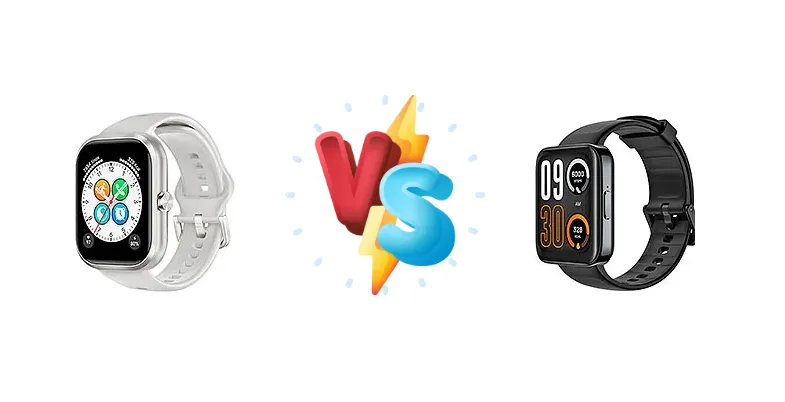
The sub-$50 smartwatch market is fiercely competitive, with Honor and Realme vying for dominance. Both the Honor Choice Watch and the Realme Watch 3 Pro aim to deliver essential smartwatch features without breaking the bank. This comparison dives deep into their capabilities, helping you determine which offers the best value for your wrist.
🏆 Quick Verdict
For the average user prioritizing Bluetooth calling and a larger display, the Realme Watch 3 Pro emerges as the better choice. While specific specs are limited, Realme’s history suggests a focus on connectivity and screen size, features often valued in this price segment. The Honor Choice Watch remains a viable option if brand loyalty is a factor.
| Network |
|---|
| 2G bands | N/A | N/A |
| 3G bands | N/A | N/A |
| 4G bands | N/A | N/A |
| EDGE | No | No |
| GPRS | No | No |
| Speed | No | No |
| Technology | No cellular connectivity | No cellular connectivity |
| Launch |
|---|
| Announced | 2024, February 15 | 2022, September 01 |
| Status | Available. Released 2024, February 24 | Available. Released 2022, September 09 |
| Body |
|---|
| Build | Glass front, plastic back, plastic frame | Glass front, plastic back, plastic frame |
| Dimensions | 49.7 x 39.9 x 10.2 mm (1.96 x 1.57 x 0.40 in) | 45 x 36.8 x 11.7 mm (1.77 x 1.45 x 0.46 in) |
| SIM | No | No |
| Weight | - | 40.7 g (1.45 oz) |
| | - | Compatible with standard 22mm straps |
| Display |
|---|
| Resolution | 410 x 502 pixels (~332 ppi density) | 364 x 448 pixels (~325 ppi density) |
| Size | 1.95 inches | 1.78 inches |
| Type | AMOLED, 550 nits (peak) | AMOLED, 500 nits (typ) |
| Platform |
|---|
| OS | Proprietary OS | Proprietary OS |
| Memory |
|---|
| Card slot | No | No |
| Internal | - | Unspecified |
| | - | eMMC 4.5 |
| Sound |
|---|
| 3.5mm jack | - | No |
| 35mm jack | No | No |
| Loudspeaker | Yes | Yes |
| Comms |
|---|
| Bluetooth | 5.3, LE | 5.3, A2DP, LE |
| NFC | No | No |
| Positioning | GPS, GLONASS, BDS, GALILEO, QZSS | GPS |
| Radio | No | No |
| USB | No | No |
| WLAN | No | No |
| Features |
|---|
| Sensors | Accelerometer, heart rate, compass, SpO2 | Accelerometer, heart rate, SpO2 |
| Battery |
|---|
| Type | 300 mAh | Li-Ion 345 mAh |
| Misc |
|---|
| Colors | Black, White | Black, Gray |
| Price | About 70 EUR | About 150 EUR |
Honor Choice Watch
- Potentially longer battery life due to a focus on efficiency.
- Likely a more minimalist and refined design aesthetic.
- Seamless integration within the Honor/Huawei ecosystem.
- May lack features like Bluetooth calling.
- Potentially smaller display size.
Realme Watch 3 Pro
- Likely features Bluetooth calling for convenient communication.
- Larger display for improved readability.
- Potentially faster charging capabilities.
- Battery life may be shorter due to power-hungry features.
- Design may be less refined compared to the Honor Choice Watch.
Display Comparison
Given the price point, both watches likely utilize LCD panels. However, Realme typically emphasizes larger displays in its Watch series, suggesting the Watch 3 Pro will offer a more expansive viewing area. This is beneficial for readability of notifications and workout data. Honor, on the other hand, often focuses on a more refined aesthetic, potentially resulting in a slightly smaller, but more visually appealing display on the Choice Watch. Expect both to have limited outdoor visibility compared to OLED panels.
Camera Comparison
Neither the Honor Choice Watch nor the Realme Watch 3 Pro are expected to feature cameras. This is standard for smartwatches in this price range, as adding a camera significantly increases cost and complexity without providing substantial value for the target user.
Performance
Without specific chipset details, performance analysis relies on brand tendencies. Realme often incorporates slightly more powerful, though still budget-oriented, chipsets in its wearables to support features like Bluetooth calling. This suggests the Watch 3 Pro will handle calls and app interactions more smoothly. The Honor Choice Watch, likely utilizing a more power-efficient chipset, may prioritize longer battery life over raw processing power. RAM capacity will likely be similar, around 32-64MB, limiting multitasking capabilities on both devices.
Battery Life
Battery life is a critical factor in this segment. Realme’s larger display and Bluetooth calling feature will likely draw more power, potentially resulting in a shorter battery life (estimated 3-5 days) compared to the Honor Choice Watch (estimated 5-7 days). However, Realme’s fast charging technology, if present, could mitigate this difference, allowing for quicker top-ups. The Honor Choice Watch, prioritizing efficiency, will likely offer longer intervals between charges.
Buying Guide
Buy the Honor Choice Watch if you prioritize a minimalist design and are deeply embedded within the Honor/Huawei ecosystem, potentially benefiting from seamless integration with other devices. Buy the Realme Watch 3 Pro if you need reliable Bluetooth calling, a larger, more visible display for notifications, and a more feature-rich experience geared towards everyday convenience and basic fitness tracking.
Frequently Asked Questions
❓ Does the Realme Watch 3 Pro's Bluetooth calling feature work reliably, even in noisy environments?
Realme typically employs noise cancellation algorithms in its Bluetooth calling implementations. While performance will vary depending on the surrounding environment, the Watch 3 Pro is likely to offer acceptable call quality for everyday use. User reviews will be crucial to confirm real-world performance.
❓ Is the Honor Choice Watch compatible with iPhones, or is it limited to Android devices?
While Honor devices generally offer broader compatibility, the Choice Watch may have limited functionality when paired with an iPhone. Features like notification syncing may work, but advanced features and dedicated apps are likely to be Android-exclusive. Check official compatibility lists before purchasing.
❓ How accurate are the fitness tracking features on both the Honor Choice Watch and the Realme Watch 3 Pro?
Both watches likely utilize standard optical heart rate sensors and accelerometers for fitness tracking. Accuracy will be comparable to other budget smartwatches, with potential discrepancies during high-intensity workouts. They are best suited for basic activity tracking and are not intended as replacements for dedicated fitness trackers.