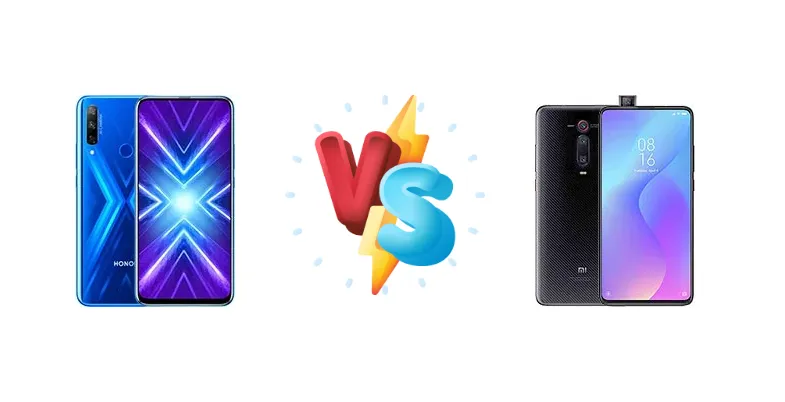
The Xiaomi Mi 9T Pro and Honor 9X represent compelling options in the mid-range smartphone market, but cater to different priorities. The Mi 9T Pro, leveraging Qualcomm’s Snapdragon 855, aims for near-flagship performance, while the Honor 9X focuses on delivering solid endurance and a respectable experience with the Kirin 710F. This comparison dissects their key differences to help you determine which device best suits your needs.
🏆 Quick Verdict
For users prioritizing performance and faster charging, the Xiaomi Mi 9T Pro is the clear winner. Its Snapdragon 855 chipset offers a significant leap in processing power. However, the Honor 9X remains a viable option for those seeking long battery life and a more budget-friendly price point.
| Network |
|---|
| 2G bands | GSM 850 / 900 / 1800 / 1900 | GSM 850 / 900 / 1800 / 1900 |
| 3G bands | HSDPA 850 / 900 / 1900 / 2100 | HSDPA 850 / 900 / 1700(AWS) / 1900 / 2100 |
| 4G bands | 1, 3, 7, 8, 20, 38, 40, 41 | 1, 2, 3, 4, 5, 7, 8, 20, 28, 38, 40 |
| Speed | HSPA 42.2/5.76 Mbps, LTE (2CA) Cat6 400/50 Mbps | HSPA, LTE |
| Technology | GSM / HSPA / LTE | GSM / HSPA / LTE |
| Launch |
|---|
| Announced | 2019, October 28. Released 2019, November 14 | 2019, August 21. Released 2019, August 21 |
| Status | Discontinued | Discontinued |
| Body |
|---|
| Build | Glass front, glass back, aluminum frame | Glass front (Gorilla Glass 5), glass back (Gorilla Glass 5), aluminum frame |
| Dimensions | 163.5 x 77.3 x 8.8 mm (6.44 x 3.04 x 0.35 in) | 156.7 x 74.3 x 8.8 mm (6.17 x 2.93 x 0.35 in) |
| SIM | Nano-SIM + Nano-SIM | Nano-SIM + Nano-SIM |
| Weight | 196.8 g (6.95 oz) | 191 g (6.74 oz) |
| Display |
|---|
| Protection | - | Corning Gorilla Glass 5 |
| Resolution | 1080 x 2340 pixels, 19.5:9 ratio (~391 ppi density) | 1080 x 2340 pixels, 19.5:9 ratio (~403 ppi density) |
| Size | 6.59 inches, 106.6 cm2 (~84.3% screen-to-body ratio) | 6.39 inches, 100.2 cm2 (~86.1% screen-to-body ratio) |
| Type | IPS LCD | Super AMOLED, HDR |
| Platform |
|---|
| CPU | Octa-core (4x2.2 GHz Cortex-A73 & 4x1.7 GHz Cortex-A53) | Octa-core (1x2.84 GHz Kryo 485 & 3x2.42 GHz Kryo 485 & 4x1.78 GHz Kryo 485) |
| Chipset | Kirin 710F (12 nm) | Qualcomm SM8150 Snapdragon 855 (7 nm) |
| GPU | Mali-G51 MP4 | Adreno 640 |
| OS | Android 9.0 (Pie), EMUI 9.1 | Android 9.0 (Pie), upgradable to Android 11, MIUI 12.5 |
| Memory |
|---|
| Card slot | microSDXC (uses shared SIM slot) | No |
| Internal | 64GB 4GB RAM, 128GB 4GB RAM, 128GB 6GB RAM | 64GB 6GB RAM, 128GB 6GB RAM, 256GB 8GB RAM |
| | UFS 2.1 | UFS 2.1 |
| Main Camera |
|---|
| Features | LED flash, HDR, panorama | Laser AF, Dual-LED flash, HDR, panorama |
| Triple | 48 MP, f/1.8, 27mm (wide), 1/2.0", 0.8µm, PDAF
8 MP, f/2.4, 13mm (ultrawide)
Auxiliary lens | 48 MP, f/1.8, 26mm (wide), 1/2.0", 0.8µm, PDAF
8 MP, f/2.4, 53mm (telephoto), 1/4.0", 1.12µm, PDAF, 2x optical zoom
13 MP, f/2.4, 12mm (ultrawide), 1/3.1", 1.12µm |
| Video | 1080p@30/60fps | 4K@30/60fps, 1080p@30/120/240fps, 1080p@960fps |
| Selfie camera |
|---|
| Features | - | HDR |
| Single | Motorized pop-up 16 MP, f/2.2, 26mm (wide), 1/3.06", 1.0µm | Motorized pop-up 20 MP, f/2.2, (wide), 1/3.4", 0.8µm |
| Video | 1080p@60fps | 1080p@30fps |
| Sound |
|---|
| 3.5mm jack | Yes | Yes |
| 35mm jack | Yes | Yes |
| Loudspeaker | Yes | Yes |
| | - | 24-bit/192kHz audio
|
| Comms |
|---|
| Bluetooth | 4.2, A2DP, LE | 5.0, A2DP, LE, aptX HD |
| NFC | No | Yes |
| Positioning | GPS, GLONASS, BDS | GPS (L1+L5), GLONASS (G1), BDS (B1), GALILEO (E1+E5a) |
| Radio | FM radio | Yes |
| USB | USB Type-C 2.0 | USB Type-C 2.0, OTG |
| WLAN | Wi-Fi 802.11 a/b/g/n/ac, dual-band, Wi-Fi Direct | Wi-Fi 802.11 a/b/g/n/ac, dual-band, Wi-Fi Direct |
| Features |
|---|
| Sensors | Fingerprint (rear-mounted), accelerometer, gyro, proximity, compass | Fingerprint (under display, optical), accelerometer, gyro, proximity, compass |
| Battery |
|---|
| Charging | 10W wired | 27W wired, QC4 |
| Type | Li-Po 4000 mAh, non-removable | Li-Po 4000 mAh, non-removable |
| Misc |
|---|
| Colors | Midnight Black, Sapphire Blue | Carbon black, Red flame, Glacier blue |
| Models | STK-LX1 | M1903F11G |
| Price | About 240 EUR | About 150 EUR |
| SAR | - | 1.03 W/kg (head) 0.72 W/kg (body) |
| SAR EU | - | 1.30 W/kg (head) 1.51 W/kg (body) |
| Tests |
|---|
| Audio quality |
Noise -94.3dB / Crosstalk -69.8dB |
Noise -93.9dB / Crosstalk -94.2dB |
| Battery life | Endurance rating 99h | Endurance rating 103h |
| Camera |
Photo / Video | - |
| Display |
Contrast ratio: 1285:1 (nominal) |
Contrast ratio: Infinite (nominal) |
| Loudspeaker |
Voice 65dB / Noise 71dB / Ring 81dB |
-26.9 LUFS (Good) |
| Performance |
AnTuTu: 140362 (v7), 187528 (v8)
GeekBench: 5345 (v4.4)
GFXBench: 6.5fps (ES 3.1 onscreen) |
AnTuTu: 368846 (v7), 437823 (v8)
GeekBench: 10684 (v4.4), 2732 (v5.1)
GFXBench: 36fps (ES 3.1 onscreen) |
Honor 9X
- Excellent battery life (99h endurance)
- More affordable price point
- Decent performance for everyday tasks
- Slow 10W charging
- Less powerful Kirin 710F chipset
- LCD display with lower contrast
Xiaomi Mi 9T Pro
- Flagship-level Snapdragon 855 performance
- Fast 27W charging with QC4
- Superior OLED display with 'Infinite' contrast
- Slightly lower battery endurance (103h)
- Generally higher price
- Potential for more heat under sustained load
Display Comparison
Both phones feature displays designed for immersive viewing, but differ in their technical implementation. The Xiaomi Mi 9T Pro boasts an 'Infinite' contrast ratio, suggesting a superior OLED panel capable of true blacks and vibrant colors. In contrast, the Honor 9X’s LCD panel has a nominal contrast ratio of 1285:1, indicating less deep blacks and potentially less vivid colors. While neither specification details peak brightness, the OLED panel on the Mi 9T Pro generally offers better outdoor visibility. The 'Infinite' contrast ratio suggests a lack of light bleed, a common issue with LCDs.
Camera Comparison
Both phones offer photo and video capabilities, but detailed sensor information is lacking. However, the chipset difference hints at superior image processing capabilities within the Mi 9T Pro. The Snapdragon 855’s image signal processor (ISP) is far more advanced than the Kirin 710F’s, enabling faster processing, better noise reduction, and improved dynamic range. While both likely feature multi-camera setups, the Mi 9T Pro’s ISP will likely extract more detail and produce higher-quality images, especially in challenging lighting conditions. Without specific sensor size data, it’s difficult to make a definitive judgment, but the Mi 9T Pro holds a clear advantage in image processing.
Performance
The performance gap between these devices is substantial. The Xiaomi Mi 9T Pro’s Qualcomm Snapdragon 855 (7nm) is a flagship-level chipset, featuring an octa-core configuration with a high-clocked Kryo 485 prime core at 2.84 GHz. This contrasts sharply with the Honor 9X’s Kirin 710F (12nm), which utilizes a more conventional octa-core setup with Cortex-A73 and A53 cores peaking at 2.2 GHz. The 7nm process node of the Snapdragon 855 translates to greater power efficiency and significantly improved sustained performance, crucial for demanding applications and gaming. The Mi 9T Pro will handle graphically intensive games and multitasking with ease, while the Honor 9X may exhibit some slowdowns under heavy load.
Battery Life
Both devices offer excellent battery endurance, with the Mi 9T Pro edging out the Honor 9X with a 103-hour rating versus 99 hours. This difference, while not massive, is likely attributable to the more efficient Snapdragon 855 chipset. However, the real differentiator is charging speed. The Mi 9T Pro supports 27W wired charging with Quick Charge 4 (QC4) technology, allowing for significantly faster top-ups compared to the Honor 9X’s slow 10W charging. This means the Mi 9T Pro can go from 0-100% in a fraction of the time, a crucial advantage for users who are always on the go.
Buying Guide
Buy the Honor 9X if you prioritize maximizing battery life and are comfortable with a more modest processor for everyday tasks like social media, browsing, and light gaming. Buy the Xiaomi Mi 9T Pro if you demand smoother performance for demanding games, multitasking, and appreciate the convenience of significantly faster 27W charging. The Mi 9T Pro is the better choice for power users.
Frequently Asked Questions
❓ Does the Kirin 710F in the Honor 9X struggle with demanding games like PUBG or Call of Duty?
The Kirin 710F can run PUBG and Call of Duty, but you'll likely need to lower the graphics settings to medium or low to maintain a stable frame rate. Expect some occasional stuttering during intense firefights. The Mi 9T Pro's Snapdragon 855 will provide a much smoother and more consistent gaming experience at higher settings.
❓ How long does it realistically take to fully charge the Honor 9X with its 10W charger?
With the 10W charger, a full charge from 0% to 100% on the Honor 9X will take approximately 3-4 hours. This is a significant drawback compared to the Mi 9T Pro, which can fully charge in around 1 hour with its 27W charger.
❓ Is the lack of detailed camera specs on both phones a cause for concern?
While the lack of specific sensor details is frustrating, the chipset difference provides a strong indication of camera performance. The Mi 9T Pro's Snapdragon 855 has a much more capable ISP, which will likely result in better image quality even if the sensors are similar. However, without more information, it's impossible to make a definitive judgment.
❓ Will the Snapdragon 855 in the Mi 9T Pro overheat during prolonged gaming sessions?
The Snapdragon 855 is known to generate some heat under sustained load. However, the Mi 9T Pro likely incorporates thermal management solutions to mitigate overheating. While some throttling may occur during extended gaming, it shouldn't be a major issue for most users. The Honor 9X, with its less powerful chipset, will generally run cooler.