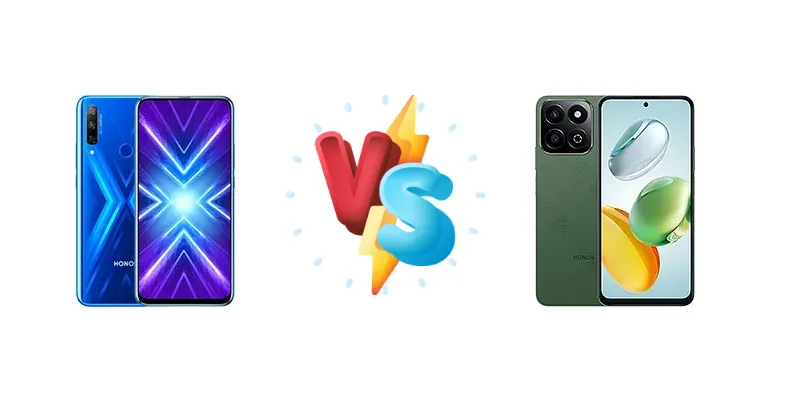
The Honor 9X, a stalwart from a previous generation, now faces a new contender in the budget space: the Honor 200 Smart. While the 9X prioritized endurance, the 200 Smart brings a modern chipset and faster charging to the table. This comparison dissects the key differences to determine which device offers the best experience for today's user.
🏆 Quick Verdict
For most users, the Honor 200 Smart is the better choice. Its Qualcomm Snapdragon 4 Gen 2 chipset, built on a 4nm process, delivers a significant performance and efficiency upgrade over the Honor 9X’s Kirin 710F. The 35W charging also drastically reduces downtime, making it a more practical daily driver.
| Network |
|---|
| 2G bands | GSM 850 / 900 / 1800 / 1900 | GSM 850 / 900 / 1800 / 1900 |
| 3G bands | HSDPA 850 / 900 / 1900 / 2100 | HSDPA 850 / 900 / 1700(AWS) / 1900 / 2100 |
| 4G bands | 1, 3, 7, 8, 20, 38, 40, 41 | LTE |
| 5G bands | - | SA/NSA |
| Speed | HSPA 42.2/5.76 Mbps, LTE (2CA) Cat6 400/50 Mbps | HSPA, LTE, 5G |
| Technology | GSM / HSPA / LTE | GSM / HSPA / LTE / 5G |
| Launch |
|---|
| Announced | 2019, October 28. Released 2019, November 14 | 2024, September 17 |
| Status | Discontinued | Available. Released 2024, September 23 |
| Body |
|---|
| Build | Glass front, glass back, aluminum frame | - |
| Dimensions | 163.5 x 77.3 x 8.8 mm (6.44 x 3.04 x 0.35 in) | 166.9 x 76.8 x 8.1 mm (6.57 x 3.02 x 0.32 in) |
| SIM | Nano-SIM + Nano-SIM | Nano-SIM + Nano-SIM |
| Weight | 196.8 g (6.95 oz) | 191 g or 193 g (6.74 oz) |
| Display |
|---|
| Protection | - | Aluminosilicate glass |
| Resolution | 1080 x 2340 pixels, 19.5:9 ratio (~391 ppi density) | 1080 x 2412 pixels, 20:9 ratio (~389 ppi density) |
| Size | 6.59 inches, 106.6 cm2 (~84.3% screen-to-body ratio) | 6.8 inches, 111.3 cm2 (~86.8% screen-to-body ratio) |
| Type | IPS LCD | TFT LCD, 120Hz, 850 nits (peak) |
| Platform |
|---|
| CPU | Octa-core (4x2.2 GHz Cortex-A73 & 4x1.7 GHz Cortex-A53) | Octa-core (2x2.2 GHz Cortex-A78 & 6x1.95 GHz Cortex-A55) |
| Chipset | Kirin 710F (12 nm) | Qualcomm SM4450 Snapdragon 4 Gen 2 (4 nm) |
| GPU | Mali-G51 MP4 | Adreno 613 |
| OS | Android 9.0 (Pie), EMUI 9.1 | Android 14, Magic OS 8 |
| Memory |
|---|
| Card slot | microSDXC (uses shared SIM slot) | No |
| Internal | 64GB 4GB RAM, 128GB 4GB RAM, 128GB 6GB RAM | 256GB 4GB RAM, 256GB 8GB RAM |
| | UFS 2.1 | - |
| Main Camera |
|---|
| Dual | - | 50 MP, f/1.8, (wide), PDAF
Auxiliary lens |
| Features | LED flash, HDR, panorama | LED flash, HDR |
| Triple | 48 MP, f/1.8, 27mm (wide), 1/2.0", 0.8µm, PDAF
8 MP, f/2.4, 13mm (ultrawide)
Auxiliary lens | - |
| Video | 1080p@30/60fps | 1080p@30fps |
| Selfie camera |
|---|
| Single | Motorized pop-up 16 MP, f/2.2, 26mm (wide), 1/3.06", 1.0µm | 5 MP, f/2.2, (wide) |
| Video | 1080p@60fps | 1080p@30fps |
| Sound |
|---|
| 3.5mm jack | Yes | - |
| 35mm jack | Yes | Yes |
| Loudspeaker | Yes | Yes, with stereo speakers |
| Comms |
|---|
| Bluetooth | 4.2, A2DP, LE | 5.0, A2DP, LE |
| NFC | No | No |
| Positioning | GPS, GLONASS, BDS | GPS, GLONASS, GALILEO, BDS |
| Radio | FM radio | No |
| USB | USB Type-C 2.0 | USB Type-C 2.0, OTG |
| WLAN | Wi-Fi 802.11 a/b/g/n/ac, dual-band, Wi-Fi Direct | Wi-Fi 802.11 a/b/g/n/ac, dual-band, Wi-Fi Direct |
| Features |
|---|
| Sensors | Fingerprint (rear-mounted), accelerometer, gyro, proximity, compass | Fingerprint (side-mounted), accelerometer, proximity, compass |
| Battery |
|---|
| Charging | 10W wired | 35W wired |
| Type | Li-Po 4000 mAh, non-removable | Li-Po 5200 mAh |
| Misc |
|---|
| Colors | Midnight Black, Sapphire Blue | Midnight Black, Forest Green |
| Models | STK-LX1 | ALT-NX1 |
| Price | About 240 EUR | € 109.99 / £ 114.99 |
| Tests |
|---|
| Audio quality |
Noise -94.3dB / Crosstalk -69.8dB | - |
| Battery life | Endurance rating 99h | - |
| Camera |
Photo / Video | - |
| Display |
Contrast ratio: 1285:1 (nominal) | - |
| Loudspeaker |
Voice 65dB / Noise 71dB / Ring 81dB | - |
| Performance |
AnTuTu: 140362 (v7), 187528 (v8)
GeekBench: 5345 (v4.4)
GFXBench: 6.5fps (ES 3.1 onscreen) | - |
Honor 9X
- Exceptional 99-hour battery endurance
- Proven reliability (older model)
- Potentially lower price point (due to age)
- Outdated Kirin 710F chipset
- Slow 10W charging
- Likely lacks modern software features
Honor 200 Smart
- Modern Snapdragon 4 Gen 2 chipset (4nm)
- Fast 35W wired charging
- Improved performance and efficiency
- Battery endurance likely lower than Honor 9X
- May be slightly more expensive
- Camera quality is unknown
Display Comparison
Both devices share a similar focus on providing a functional display, but detailed specifications beyond the Honor 9X’s 1285:1 contrast ratio are unavailable. The Honor 200 Smart likely benefits from newer display technology, potentially offering improved color accuracy and viewing angles. However, without knowing the panel type or peak brightness of either device, a definitive assessment is difficult. The 9X’s contrast ratio suggests a decent, if not exceptional, visual experience for its time.
Camera Comparison
Both phones are listed as having 'Photo / Video' capabilities, but lack specific details. Given the market positioning, it’s safe to assume neither device boasts a flagship-level camera system. The Honor 200 Smart likely benefits from newer image processing algorithms and potentially a more advanced sensor, but without knowing sensor sizes or apertures, it’s impossible to quantify the difference. The presence of a 2MP macro lens on many phones in this segment is often more of a marketing feature than a practical benefit, and its quality is unlikely to be a deciding factor.
Performance
The core difference lies in the chipsets. The Honor 9X’s Kirin 710F (12nm) utilizes a traditional big.LITTLE architecture with Cortex-A73 and A53 cores. The Honor 200 Smart’s Snapdragon 4 Gen 2 (4nm) represents a substantial leap forward. The 4nm process node inherently offers better power efficiency, translating to less heat and sustained performance. Furthermore, the 200 Smart’s CPU configuration – 2x Cortex-A78 and 6x Cortex-A55 – provides a more modern and capable core arrangement, particularly in single-core tasks. This will result in snappier app launches and smoother multitasking.
Battery Life
The Honor 9X’s standout feature is its exceptional 99-hour endurance rating. However, the Honor 200 Smart compensates with significantly faster 35W wired charging. While the 200 Smart’s battery capacity is unknown, the faster charging speed drastically reduces downtime. A full charge from 0-100% is likely to be considerably quicker on the 200 Smart, making it more convenient for users who need to top up their phone frequently. The 9X’s 10W charging is comparatively slow by today’s standards.
Buying Guide
Buy the Honor 9X if your absolute priority is maximizing battery life and you primarily engage in light tasks like calling, texting, and basic social media. Its 99-hour endurance rating remains impressive. Buy the Honor 200 Smart if you value a more responsive user experience, faster app loading times, and quicker charging, even if it means slightly reduced battery longevity. It’s the better option for those who enjoy occasional gaming or multitasking.
Frequently Asked Questions
❓ Will the Snapdragon 4 Gen 2 in the Honor 200 Smart handle demanding games like PUBG Mobile?
The Snapdragon 4 Gen 2 is a capable chipset for casual gaming. While it won't deliver flagship-level performance, it should be able to run PUBG Mobile at medium settings with reasonable frame rates. The 4nm process also helps mitigate thermal throttling during extended gaming sessions, offering a more consistent experience than the older Kirin 710F.
❓ How much faster is the 35W charging on the Honor 200 Smart compared to the 10W charging on the Honor 9X?
The difference is substantial. 35W charging will significantly reduce charging times. While exact 0-100% times depend on battery capacity, expect the Honor 200 Smart to charge fully in approximately 1.5-2 hours, compared to 4-5 hours for the Honor 9X. This makes a huge difference for users who need a quick power boost.
❓ Is the Honor 9X still a good option if battery life is my absolute top priority?
If maximizing battery life is your sole concern, the Honor 9X remains a compelling choice. Its 99-hour endurance rating is exceptional and difficult to match, even with newer devices. However, you'll be sacrificing performance, charging speed, and potentially software support.