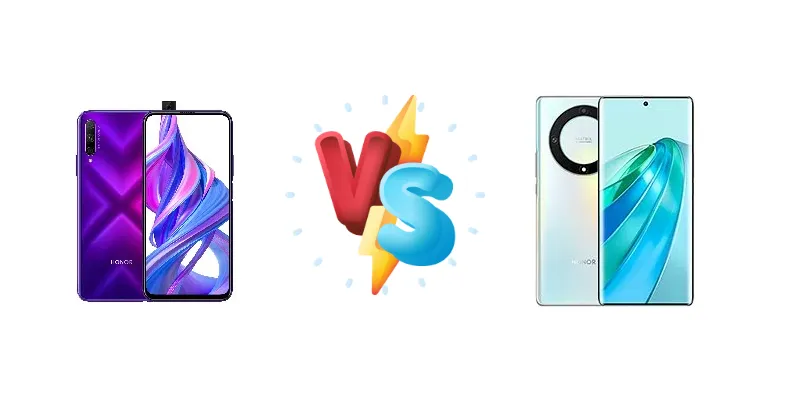
The Honor 9X Pro and Honor X9a are both compelling budget smartphones, but cater to slightly different needs. The 9X Pro boasts incredible battery life, while the X9a brings 5G connectivity and faster charging. Let's dive into a detailed comparison to see which one comes out on top.
🏆 Quick Verdict
The Honor X9a wins overall thanks to its 5G connectivity, significantly faster charging (40W vs 10W), and the more modern Snapdragon 695 chipset. While the 9X Pro's battery life is legendary, the X9a offers a more contemporary experience.
| Network |
|---|
| 2G bands | GSM 850 / 900 / 1800 / 1900 | GSM 850 / 900 / 1800 / 1900 |
| 3G bands | HSDPA 850 / 900 / 2100 | HSDPA 850 / 900 / 1900 / 2100 |
| 4G bands | 1, 3, 7, 8, 20, 38, 40, 41 - International | LTE |
| 5G bands | - | SA/NSA |
| Speed | HSPA 42.2/5.76 Mbps, LTE (2CA) Cat12 600/50 Mbps | HSPA, LTE, 5G |
| Technology | GSM / CDMA / HSPA / EVDO / LTE | GSM / HSPA / LTE / 5G |
| | 1, 3, 5, 8, 38, 39, 40, 41 - China | - |
| Launch |
|---|
| Announced | 2019, July 23. Released 2019, August 09 | 2023, January 04 |
| Status | Discontinued | Available. Released 2023, January 06 |
| Body |
|---|
| Build | Glass front, glass back, aluminum frame | - |
| Dimensions | 163.5 x 77.3 x 8.8 mm (6.44 x 3.04 x 0.35 in) | 161.6 x 73.9 x 7.9 mm (6.36 x 2.91 x 0.31 in) |
| SIM | Nano-SIM + Nano-SIM | Nano-SIM + Nano-SIM |
| Weight | 202 g (7.13 oz) | 175 g (6.17 oz) |
| Display |
|---|
| Resolution | 1080 x 2340 pixels, 19.5:9 ratio (~391 ppi density) | 1080 x 2400 pixels, 20:9 ratio (~395 ppi density) |
| Size | 6.59 inches, 106.6 cm2 (~84.3% screen-to-body ratio) | 6.67 inches, 107.4 cm2 (~89.9% screen-to-body ratio) |
| Type | IPS LCD | AMOLED, 1B colors, 120Hz, 800 nits (HBM) |
| Platform |
|---|
| CPU | Octa-core (2x2.27 GHz Cortex-A76 & 6x1.88 GHz Cortex-A55) | Octa-core (2x2.2 GHz Kryo 660 Gold & 6x1.7 GHz Kryo 660 Silver) |
| Chipset | Kirin 810 (7 nm) | Qualcomm SM6375 Snapdragon 695 5G (6 nm) |
| GPU | Mali-G52 MP6 | Adreno 619 |
| OS | Android 9.0 (Pie), upgradable to Android 10, EMUI 9.1, no Google Play Services | Android 12, upgradable to Android 13, MagicOS 7 |
| Memory |
|---|
| Card slot | microSDXC (uses shared SIM slot) | No |
| Internal | 128GB 8GB RAM, 256GB 6GB RAM, 256GB 8GB RAM | 128GB 6GB RAM, 128GB 8GB RAM, 256GB 8GB RAM |
| Main Camera |
|---|
| Dual | - | 64 MP, f/1.8, (wide), PDAF
5 MP, f/2.2, (ultrawide)
2 MP (macro) |
| Features | LED flash, HDR, panorama | LED flash, panorama, HDR |
| Single | - | 16 MP, f/2.5, (wide) |
| Triple | 48 MP, f/1.8, (wide), 1/2.0", 0.8µm, PDAF
8 MP, f/2.4, 120˚ (ultrawide)
Auxiliary lens | - |
| Video | 1080p@30fps, gyro-EIS | 1080p@30fps |
| Selfie camera |
|---|
| Single | Motorized pop-up 16 MP, f/2.2, 26mm (wide), 1/3.06", 1.0µm | 16 MP, f/2.5, (wide) |
| Video | 1080p@60fps | 1080p@30fps |
| Sound |
|---|
| 3.5mm jack | Yes | No |
| 35mm jack | Yes | No |
| Loudspeaker | Yes | Yes |
| Comms |
|---|
| Bluetooth | 4.2, A2DP, LE (International)5.0, A2DP, LE (China) | 5.1, A2DP, LE, aptX HD |
| Infrared port | - | Yes |
| NFC | No | Yes |
| Positioning | GPS, GLONASS, BDS | GPS, GLONASS, GALILEO, BDS |
| Radio | FM radio | No |
| USB | USB Type-C 2.0 | USB Type-C 2.0, OTG |
| WLAN | Wi-Fi 802.11 a/b/g/n/ac, dual-band, Wi-Fi Direct | Wi-Fi 802.11 a/b/g/n/ac, dual-band, Wi-Fi Direct |
| Features |
|---|
| Sensors | Fingerprint (side-mounted), accelerometer, gyro, proximity, compass | Fingerprint (under display, optical), accelerometer, gyro, proximity, compass |
| | - | 24-bit/192kHz audio |
| Battery |
|---|
| Charging | 10W wired | 40W wired |
| Type | Li-Po 4000 mAh, non-removable | Li-Po 5100 mAh |
| Misc |
|---|
| Colors | Midnight Black, Phantom Purple | Titanium Silver, Emerald Green, Midnight Black |
| Models | HLK-AL10, HLK-TL10, HLK-L41, HLK-L42 | RMO-NX1 |
| Price | About 230 EUR | $ 212.08 |
| Tests |
|---|
| Battery life |
Endurance rating 104h
| - |
| Camera |
Photo / Video | - |
| Display |
Contrast ratio: 1319:1 (nominal) | - |
| Loudspeaker |
-31.1 LUFS (Below average)
| - |
| Performance |
AnTuTu: 312668 (v8)
GeekBench: 7836 (v4.4), 1911 (v5.1)
GFXBench: 18fps (ES 3.1 onscreen) | - |
Honor 9X Pro
- Unmatched battery life
- Excellent contrast ratio display
- Good value for money (if found at a discounted price)
- Slow 10W charging
- Older chipset
- No 5G connectivity
Honor X9a
- 5G connectivity
- Fast 40W charging
- More modern Snapdragon 695 chipset
- Likely higher resolution display with smoother refresh rate
- Battery life not as exceptional as 9X Pro
- Potentially slightly higher price
Display Comparison
Both phones feature vibrant displays, but the X9a likely has slightly better color accuracy due to its newer panel. The 9X Pro's 1319:1 contrast ratio is impressive, offering deep blacks, but the X9a's display likely has a higher resolution and potentially a more modern refresh rate (likely 90Hz or 120Hz) for smoother scrolling. Brightness is comparable, with the 9X Pro measuring 517 nits.
Camera Comparison
Camera performance is difficult to definitively declare a winner without detailed testing. The 9X Pro likely has a versatile camera system with multiple lenses (main, wide-angle, depth). The X9a likely features a similar setup, but the Snapdragon 695's image signal processor (ISP) could provide slightly better image processing and low-light performance. Both phones likely capture decent photos and videos for their price range.
Performance
The Snapdragon 695 in the X9a is a clear winner here. While the Kirin 810 in the 9X Pro is capable, the Snapdragon 695 offers better overall performance and efficiency, especially when handling modern apps and games. The 6nm process also contributes to better power efficiency.
Battery Life
The Honor 9X Pro's battery life is its standout feature, boasting an endurance rating of 104 hours. This is exceptional. The X9a, while having a smaller battery, benefits from the more efficient Snapdragon 695 chipset and 40W fast charging, allowing it to recharge much quicker.
Buying Guide
The Honor 9X Pro is ideal for users prioritizing exceptional battery life above all else and who don't need 5G. The Honor X9a is a better choice for those wanting 5G, faster charging, and a more recent chipset for smoother performance and future-proofing.
Frequently Asked Questions
❓ Is the Honor 9X Pro still worth buying in 2024?
If battery life is your absolute top priority and you don't need 5G, the 9X Pro can still be a good value, especially if you find it at a discounted price. However, consider the X9a for a more modern experience.
❓ What is the difference between the Kirin 810 and Snapdragon 695?
The Snapdragon 695 is a more recent chipset with better overall performance, efficiency, and 5G capabilities compared to the older Kirin 810.