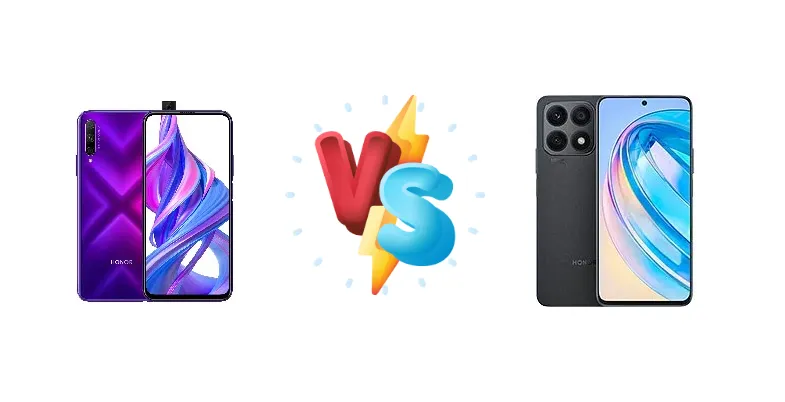
The Honor 9X Pro and Honor X8a are both contenders in the budget smartphone arena, offering compelling features at accessible prices. But which one truly delivers the best experience? This comprehensive comparison dives deep into their specs, performance, and overall value to help you make an informed decision.
🏆 Quick Verdict
The Honor 9X Pro boasts superior performance thanks to its Kirin 810 chipset and exceptional battery life. However, the Honor X8a offers faster charging and a potentially more modern design. For raw power and endurance, the 9X Pro wins, but the X8a is a strong contender for everyday use.
| Network |
|---|
| 2G bands | GSM 850 / 900 / 1800 / 1900 | GSM 850 / 900 / 1800 / 1900 |
| 3G bands | HSDPA 850 / 900 / 2100 | HSDPA 850 / 900 / 2100 |
| 4G bands | 1, 3, 7, 8, 20, 38, 40, 41 - International | LTE |
| Speed | HSPA 42.2/5.76 Mbps, LTE (2CA) Cat12 600/50 Mbps | HSPA, LTE |
| Technology | GSM / CDMA / HSPA / EVDO / LTE | GSM / HSPA / LTE |
| | 1, 3, 5, 8, 38, 39, 40, 41 - China | Virtual proximity sensing |
| Launch |
|---|
| Announced | 2019, July 23. Released 2019, August 09 | 2023, February 08 |
| Status | Discontinued | Available. Released 2023, February 11 |
| Body |
|---|
| Build | Glass front, glass back, aluminum frame | Glass front, plastic frame, plastic back |
| Dimensions | 163.5 x 77.3 x 8.8 mm (6.44 x 3.04 x 0.35 in) | 162.9 x 74.5 x 7.5 mm (6.41 x 2.93 x 0.30 in) |
| SIM | Nano-SIM + Nano-SIM | Nano-SIM + Nano-SIM |
| Weight | 202 g (7.13 oz) | 179 g (6.31 oz) |
| Display |
|---|
| Resolution | 1080 x 2340 pixels, 19.5:9 ratio (~391 ppi density) | 1080 x 2388 pixels (~391 ppi density) |
| Size | 6.59 inches, 106.6 cm2 (~84.3% screen-to-body ratio) | 6.7 inches, 108.7 cm2 (~89.6% screen-to-body ratio) |
| Type | IPS LCD | IPS LCD, 90Hz |
| Platform |
|---|
| CPU | Octa-core (2x2.27 GHz Cortex-A76 & 6x1.88 GHz Cortex-A55) | Octa-core (2x2.0 GHz Cortex-A75 & 6x1.8 GHz Cortex-A55) |
| Chipset | Kirin 810 (7 nm) | Mediatek MT6769H Helio G88 (12 nm) |
| GPU | Mali-G52 MP6 | Mali-G52 MC2 |
| OS | Android 9.0 (Pie), upgradable to Android 10, EMUI 9.1, no Google Play Services | Android 12, Magic UI 6.1 |
| Memory |
|---|
| Card slot | microSDXC (uses shared SIM slot) | No |
| Internal | 128GB 8GB RAM, 256GB 6GB RAM, 256GB 8GB RAM | 128GB 4GB RAM, 128GB 6GB RAM, 128GB 8GB RAM, 128GB 12GB RAM, 256GB 4GB RAM, 256GB 8GB RAM |
| Main Camera |
|---|
| Features | LED flash, HDR, panorama | LED flash, panorama, HDR |
| Single | - | 16 MP, f/2.5 |
| Triple | 48 MP, f/1.8, (wide), 1/2.0", 0.8µm, PDAF
8 MP, f/2.4, 120˚ (ultrawide)
Auxiliary lens | 100 MP, f/1.9, (wide), AF
5 MP, f/2.2, (ultrawide)
2 MP (macro) |
| Video | 1080p@30fps, gyro-EIS | 1080p@30fps |
| Selfie camera |
|---|
| Single | Motorized pop-up 16 MP, f/2.2, 26mm (wide), 1/3.06", 1.0µm | 16 MP, f/2.5 |
| Video | 1080p@60fps | 1080p@30fps |
| Sound |
|---|
| 3.5mm jack | Yes | No |
| 35mm jack | Yes | No |
| Loudspeaker | Yes | Yes |
| Comms |
|---|
| Bluetooth | 4.2, A2DP, LE (International)5.0, A2DP, LE (China) | 5.1, A2DP, LE |
| NFC | No | Yes (CRT-LX1 only) |
| Positioning | GPS, GLONASS, BDS | GPS, GLONASS, GALILEO, BDS |
| Radio | FM radio | No |
| USB | USB Type-C 2.0 | USB Type-C 2.0, OTG |
| WLAN | Wi-Fi 802.11 a/b/g/n/ac, dual-band, Wi-Fi Direct | Wi-Fi 802.11 a/b/g/n/ac, dual-band, Wi-Fi Direct |
| Features |
|---|
| Sensors | Fingerprint (side-mounted), accelerometer, gyro, proximity, compass | Fingerprint (side-mounted), accelerometer, compass |
| Battery |
|---|
| Charging | 10W wired | 22.5W wired, 50% in 30 min |
| Type | Li-Po 4000 mAh, non-removable | Li-Po 4500 mAh |
| Misc |
|---|
| Colors | Midnight Black, Phantom Purple | Cyan Lake, Titanium Silver, Midnight Black |
| Models | HLK-AL10, HLK-TL10, HLK-L41, HLK-L42 | CRT-LX1, CRT-LX2, CRT-LX3 |
| Price | About 230 EUR | About 170 EUR |
| Tests |
|---|
| Battery life |
Endurance rating 104h
| - |
| Camera |
Photo / Video | - |
| Display |
Contrast ratio: 1319:1 (nominal) | - |
| Loudspeaker |
-31.1 LUFS (Below average)
| - |
| Performance |
AnTuTu: 312668 (v8)
GeekBench: 7836 (v4.4), 1911 (v5.1)
GFXBench: 18fps (ES 3.1 onscreen) | - |
Honor 9X Pro
- Exceptional battery life
- Powerful Kirin 810 chipset
- High contrast ratio display
- Smooth performance
- Slow 10W charging
- Older design
- Limited camera details available
Honor X8a
- Fast 22.5W charging
- Potentially more modern design
- Decent display
- Good for everyday tasks
- Weaker chipset performance
- Battery life not as impressive
- Limited camera details available
Display Comparison
The Honor 9X Pro features a 6.59-inch IPS LCD with a 1319:1 contrast ratio and 517 nits brightness, offering vibrant colors and decent visibility. The Honor X8a has a 6.7-inch IPS LCD, likely with a slightly higher resolution, but brightness and contrast details are less readily available. While both are LCDs, the 9X Pro's measured brightness gives it a slight edge.
Camera Comparison
Camera details are limited for both devices. The Honor 9X Pro likely has a versatile multi-camera setup, potentially including a main sensor, ultrawide, and depth sensor. The Honor X8a is expected to have a similar configuration. Image quality will depend on software processing, but the 9X Pro's potentially better hardware could give it an advantage. Video recording capabilities are also likely comparable.
Performance
Here's where the Honor 9X Pro shines. Its Kirin 810 chipset, built on a 7nm process, provides significantly better performance than the Honor X8a's Helio G88 (12nm). Expect smoother multitasking, faster app loading, and better gaming performance on the 9X Pro. The X8a is adequate for everyday tasks but will struggle with demanding games.
Battery Life
The Honor 9X Pro's battery life is legendary, boasting an endurance rating of 104 hours. This is a massive advantage. The Honor X8a, while having a decent battery capacity, can't match this longevity. The X8a does offer 22.5W fast charging, allowing it to reach 50% in 30 minutes, a significant improvement over the 9X Pro's 10W charging.
Buying Guide
The Honor 9X Pro is ideal for users prioritizing performance, long battery life, and a smooth user experience. It's a great choice for gamers and those who heavily use their phones. The Honor X8a is better suited for users who value fast charging, a potentially more contemporary aesthetic, and don't require top-tier processing power.
Frequently Asked Questions
❓ Is the Honor 9X Pro still worth buying in 2024?
Yes, the Honor 9X Pro remains a compelling option due to its exceptional battery life and strong performance, especially if you can find it at a discounted price.
❓ Which phone has better gaming performance?
The Honor 9X Pro's Kirin 810 chipset provides significantly better gaming performance compared to the Honor X8a's Helio G88.