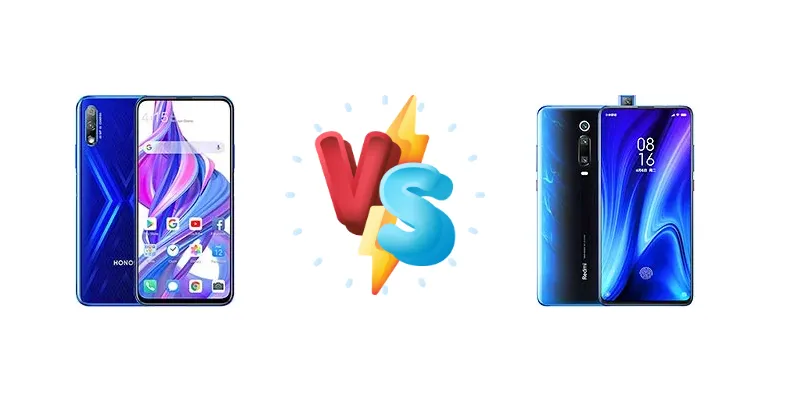
Both the Honor 9X and Xiaomi Redmi K20 Pro Premium represent compelling value propositions within the mid-range smartphone market. However, they approach this segment with drastically different philosophies. The Honor 9X prioritizes a sleek design and a competitive price, while the Redmi K20 Pro Premium aims for near-flagship performance at a slightly higher cost. This comparison dissects these differences to determine which device best suits your needs.
🏆 Quick Verdict
For the average user prioritizing performance and future-proofing, the Xiaomi Redmi K20 Pro Premium is the clear winner. Its Snapdragon 855+ chipset delivers a significantly faster experience, coupled with 27W fast charging. While the Honor 9X offers a respectable experience, it can't match the K20 Pro Premium's raw power.
| Network |
|---|
| 2G bands | GSM 850 / 900 / 1800 / 1900 | GSM 850 / 900 / 1800 / 1900 |
| 3G bands | HSDPA 850 / 900 / 1900 / 2100 | HSDPA 850 / 900 / 1900 / 2100 |
| 4G bands | 1, 3, 7, 8, 20 | 1, 3, 5, 7, 8, 34, 38, 39, 40, 41 |
| Speed | HSPA 42.2/5.76 Mbps, LTE (2CA) Cat12 600/50 Mbps | HSPA, LTE |
| Technology | GSM / HSPA / LTE | GSM / CDMA / HSPA / LTE |
| | - | CDMA 800 & TD-SCDMA |
| Launch |
|---|
| Announced | 2019, July. Released 2019, July | 2019, September. Released 2019, September |
| Status | Discontinued | Discontinued |
| Body |
|---|
| Build | - | Glass front (Gorilla Glass 5), glass back (Gorilla Glass 5), aluminum frame |
| Dimensions | 163.1 x 77.2 x 8.8 mm (6.42 x 3.04 x 0.35 in) | 156.7 x 74.3 x 8.8 mm (6.17 x 2.93 x 0.35 in) |
| SIM | · Nano-SIM· Nano-SIM + Nano-SIM | Nano-SIM + Nano-SIM |
| Weight | 206 g (7.27 oz) | 191 g (6.74 oz) |
| Display |
|---|
| Protection | - | Corning Gorilla Glass 5 |
| Resolution | 1080 x 2340 pixels, 19.5:9 ratio (~391 ppi density) | 1080 x 2340 pixels, 19.5:9 ratio (~403 ppi density) |
| Size | 6.59 inches, 106.6 cm2 (~84.7% screen-to-body ratio) | 6.39 inches, 100.2 cm2 (~86.1% screen-to-body ratio) |
| Type | IPS LCD | Super AMOLED, HDR10 |
| Platform |
|---|
| CPU | Octa-core (2x2.27 GHz Cortex-A76 & 6x1.88 GHz Cortex-A55) | Octa-core (1x2.96 GHz Kryo 485 & 3x2.42 GHz Kryo 485 & 4x1.8 GHz Kryo 485) |
| Chipset | Kirin 810 (7 nm) | Qualcomm SM8150 Snapdragon 855+ (7 nm) |
| GPU | Mali-G52 MP6 | Adreno 640 (700 MHz) |
| OS | Android 9.0 (Pie), EMUI 9.1 | Android 10, MIUI 11 |
| Memory |
|---|
| Card slot | microSDXC (uses shared SIM slot) | No |
| Internal | 64GB 4GB RAM, 64GB 6GB RAM, 128GB 6GB RAM, 128GB 8GB RAM | 128GB 8GB RAM, 512GB 8GB RAM, 512GB 12GB RAM |
| | - | UFS 2.1 |
| Main Camera |
|---|
| Dual | 48 MP, f/1.8, (wide), 1/2.0", 0.8µm, PDAF
Auxiliary lens | - |
| Features | LED flash, HDR, panorama | Laser AF, Dual-LED flash, HDR, panorama |
| Triple | - | 48 MP, f/1.8, 26mm (wide), 1/2.0", 0.8µm, PDAF
8 MP, f/2.4, 53mm (telephoto), 1/4.0", 1.12µm, PDAF, 2x optical zoom
13 MP, f/2.4, 12mm (ultrawide), 1/3.1", 1.12µm |
| Video | 1080p@30fps | 4K@30/60fps, 1080p@30/120/240fps, 1080p@960fps |
| Selfie camera |
|---|
| Features | - | HDR |
| Single | Motorized pop-up 16 MP, f/2.2, 26mm (wide), 1/3.06", 1.0µm | Motorized pop-up 20 MP, f/2.2, (wide), 1/3.4", 0.8µm |
| Video | 1080p@60fps | 1080p@30fps |
| Sound |
|---|
| 3.5mm jack | Yes | Yes |
| 35mm jack | Yes | Yes |
| Loudspeaker | Yes | Yes |
| | - | 24-bit/192kHz audio
|
| Comms |
|---|
| Bluetooth | 5.0, A2DP, LE | 5.0, A2DP, LE, aptX HD |
| NFC | No | Yes |
| Positioning | GPS, GLONASS, BDS | GPS (L1+L5), GLONASS (G1), BDS (B1), GALILEO (E1+E5a) |
| Radio | FM radio | Yes |
| USB | USB Type-C 2.0 | USB Type-C 2.0, OTG |
| WLAN | Wi-Fi 802.11 a/b/g/n/ac, dual-band, Wi-Fi Direct | Wi-Fi 802.11 a/b/g/n/ac, dual-band, Wi-Fi Direct |
| Features |
|---|
| Sensors | Fingerprint (side-mounted), accelerometer, gyro, proximity, compass | Fingerprint (under display, optical), accelerometer, gyro, proximity, compass |
| Battery |
|---|
| Charging | 10W wired | 27W wired, QC4 |
| Type | Li-Po 4000 mAh, non-removable | Li-Po 4000 mAh, non-removable |
| Misc |
|---|
| Colors | Magic Night Black, Charm Sea Blue, Charm Red, Icelandic White | Carbon black, Flame red, Glacier blue, Summer Honey, Pearl White |
| Models | HLK-AL00, HLK-TL00 | - |
| Price | About 180 EUR | About 450 EUR |
Honor 9X (China)
- More affordable price point
- Sleek design (assumed)
- Potentially lighter weight (assumed)
- Significantly slower processor
- Slow 10W charging
- Limited gaming performance
Xiaomi Redmi K20 Pro Premium
- Flagship-level Snapdragon 855+ performance
- 27W fast charging with QC4
- Superior gaming capabilities
- Higher price tag
- Potentially larger and heavier
- May run slightly warmer under heavy load
Display Comparison
Neither device's display specifications are provided, so a direct comparison is limited. However, given the Redmi K20 Pro Premium's positioning as a more premium device, it likely features a higher-quality panel with potentially better color accuracy and peak brightness. The Honor 9X, aiming for cost-effectiveness, may utilize a slightly less refined display. Bezels are likely comparable given the market segment, but the K20 Pro Premium may have a slightly more premium feel.
Camera Comparison
Without detailed camera specifications, a precise comparison is difficult. However, the Redmi K20 Pro Premium, being the more premium offering, likely features a larger sensor and more sophisticated image processing. The Snapdragon 855+ also benefits from a more mature ISP (Image Signal Processor) capable of faster processing and better dynamic range. While both phones likely offer acceptable image quality in good lighting conditions, the K20 Pro Premium is expected to excel in low-light photography and video recording. The presence of OIS (Optical Image Stabilization) on the K20 Pro Premium would further enhance its camera capabilities.
Performance
The core difference lies in the chipsets. The Xiaomi Redmi K20 Pro Premium’s Qualcomm Snapdragon 855+ (7nm) is a flagship-level processor, boasting a 1x2.96 GHz Kryo 485 prime core, 3x2.42 GHz Kryo 485 cores, and 4x1.8 GHz Kryo 485 cores. This architecture provides a substantial performance advantage over the Honor 9X’s Kirin 810 (7nm), which features a 2x2.27 GHz Cortex-A76 and 6x1.88 GHz Cortex-A55 configuration. The Snapdragon 855+’s higher clock speeds and more efficient core arrangement translate to faster app loading, smoother multitasking, and significantly better gaming performance. The K20 Pro Premium will handle graphically intensive games with higher frame rates and fewer stutters. The Kirin 810 is capable, but will show its limitations in demanding scenarios.
Battery Life
The Honor 9X is limited to 10W wired charging, a significant disadvantage compared to the Redmi K20 Pro Premium’s 27W wired charging with Quick Charge 4 (QC4) support. This means the K20 Pro Premium can replenish its battery much faster, minimizing downtime. While battery capacity isn't specified, the faster charging of the K20 Pro Premium effectively mitigates any potential capacity difference. A full charge on the K20 Pro Premium will take significantly less time than on the Honor 9X.
Buying Guide
Buy the Honor 9X (China) if you need a stylish device for everyday tasks like social media, browsing, and light gaming, and are on a very tight budget. You'll accept compromises in performance and charging speed. Buy the Xiaomi Redmi K20 Pro Premium if you prioritize gaming, demanding applications, and faster charging, and are willing to spend a bit more for a significantly smoother and more responsive experience.
Frequently Asked Questions
❓ Will the Kirin 810 in the Honor 9X struggle with demanding games like Genshin Impact?
Yes, the Kirin 810 will likely struggle with Genshin Impact and other graphically intensive games. You'll need to lower graphics settings significantly to achieve playable frame rates, and even then, expect occasional stuttering. The Snapdragon 855+ in the Redmi K20 Pro Premium is far better equipped to handle these titles at higher settings.
❓ How much faster is the 27W charging on the Redmi K20 Pro Premium compared to the 10W charging on the Honor 9X?
The 27W charging on the Redmi K20 Pro Premium will dramatically reduce charging times. While exact figures depend on battery capacity, you can expect a full charge in approximately 60-90 minutes, compared to potentially 3+ hours with the Honor 9X's 10W charger. This makes a significant difference for users who need to quickly top up their battery.
❓ Is the Snapdragon 855+ known for overheating? Will the Redmi K20 Pro Premium get too hot during gaming?
The Snapdragon 855+ *can* generate heat under sustained load, but the Redmi K20 Pro Premium likely incorporates thermal management solutions to mitigate this. While it may get warm during extended gaming sessions, it shouldn't reach uncomfortable temperatures. The Kirin 810, being less powerful, will generate less heat but also offer lower performance.