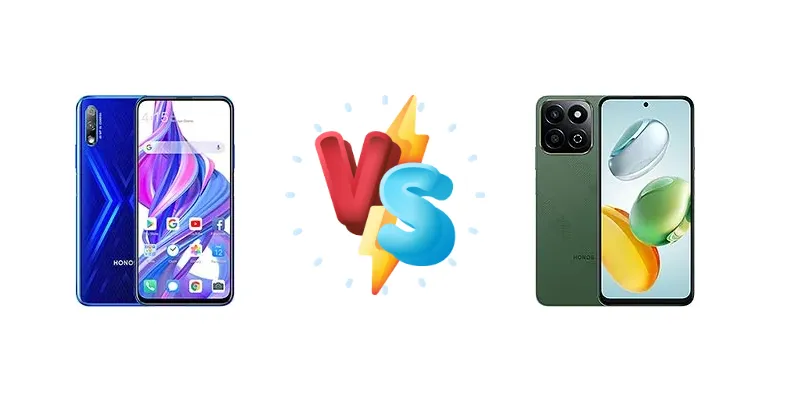
The Honor 9X (China variant) represented a strong value proposition in its time, powered by the Kirin 810. Now, the Honor 200 Smart enters the scene with Qualcomm's Snapdragon 4 Gen 2. This comparison dissects the core differences – chipset architecture and charging speed – to determine which device offers a superior experience in today's market.
🏆 Quick Verdict
For most users, the Honor 200 Smart is the better choice. While the Kirin 810 in the 9X offered respectable performance, the Snapdragon 4 Gen 2’s 4nm process provides improved efficiency and the 35W charging dramatically reduces downtime, making it a more practical daily driver.
| Network |
|---|
| 2G bands | GSM 850 / 900 / 1800 / 1900 | GSM 850 / 900 / 1800 / 1900 |
| 3G bands | HSDPA 850 / 900 / 1900 / 2100 | HSDPA 850 / 900 / 1700(AWS) / 1900 / 2100 |
| 4G bands | 1, 3, 7, 8, 20 | LTE |
| 5G bands | - | SA/NSA |
| Speed | HSPA 42.2/5.76 Mbps, LTE (2CA) Cat12 600/50 Mbps | HSPA, LTE, 5G |
| Technology | GSM / HSPA / LTE | GSM / HSPA / LTE / 5G |
| Launch |
|---|
| Announced | 2019, July. Released 2019, July | 2024, September 17 |
| Status | Discontinued | Available. Released 2024, September 23 |
| Body |
|---|
| Dimensions | 163.1 x 77.2 x 8.8 mm (6.42 x 3.04 x 0.35 in) | 166.9 x 76.8 x 8.1 mm (6.57 x 3.02 x 0.32 in) |
| SIM | · Nano-SIM· Nano-SIM + Nano-SIM | Nano-SIM + Nano-SIM |
| Weight | 206 g (7.27 oz) | 191 g or 193 g (6.74 oz) |
| Display |
|---|
| Protection | - | Aluminosilicate glass |
| Resolution | 1080 x 2340 pixels, 19.5:9 ratio (~391 ppi density) | 1080 x 2412 pixels, 20:9 ratio (~389 ppi density) |
| Size | 6.59 inches, 106.6 cm2 (~84.7% screen-to-body ratio) | 6.8 inches, 111.3 cm2 (~86.8% screen-to-body ratio) |
| Type | IPS LCD | TFT LCD, 120Hz, 850 nits (peak) |
| Platform |
|---|
| CPU | Octa-core (2x2.27 GHz Cortex-A76 & 6x1.88 GHz Cortex-A55) | Octa-core (2x2.2 GHz Cortex-A78 & 6x1.95 GHz Cortex-A55) |
| Chipset | Kirin 810 (7 nm) | Qualcomm SM4450 Snapdragon 4 Gen 2 (4 nm) |
| GPU | Mali-G52 MP6 | Adreno 613 |
| OS | Android 9.0 (Pie), EMUI 9.1 | Android 14, Magic OS 8 |
| Memory |
|---|
| Card slot | microSDXC (uses shared SIM slot) | No |
| Internal | 64GB 4GB RAM, 64GB 6GB RAM, 128GB 6GB RAM, 128GB 8GB RAM | 256GB 4GB RAM, 256GB 8GB RAM |
| Main Camera |
|---|
| Dual | 48 MP, f/1.8, (wide), 1/2.0", 0.8µm, PDAF
Auxiliary lens | 50 MP, f/1.8, (wide), PDAF
Auxiliary lens |
| Features | LED flash, HDR, panorama | LED flash, HDR |
| Video | 1080p@30fps | 1080p@30fps |
| Selfie camera |
|---|
| Single | Motorized pop-up 16 MP, f/2.2, 26mm (wide), 1/3.06", 1.0µm | 5 MP, f/2.2, (wide) |
| Video | 1080p@60fps | 1080p@30fps |
| Sound |
|---|
| 3.5mm jack | Yes | - |
| 35mm jack | Yes | Yes |
| Loudspeaker | Yes | Yes, with stereo speakers |
| Comms |
|---|
| Bluetooth | 5.0, A2DP, LE | 5.0, A2DP, LE |
| NFC | No | No |
| Positioning | GPS, GLONASS, BDS | GPS, GLONASS, GALILEO, BDS |
| Radio | FM radio | No |
| USB | USB Type-C 2.0 | USB Type-C 2.0, OTG |
| WLAN | Wi-Fi 802.11 a/b/g/n/ac, dual-band, Wi-Fi Direct | Wi-Fi 802.11 a/b/g/n/ac, dual-band, Wi-Fi Direct |
| Features |
|---|
| Sensors | Fingerprint (side-mounted), accelerometer, gyro, proximity, compass | Fingerprint (side-mounted), accelerometer, proximity, compass |
| Battery |
|---|
| Charging | 10W wired | 35W wired |
| Type | Li-Po 4000 mAh, non-removable | Li-Po 5200 mAh |
| Misc |
|---|
| Colors | Magic Night Black, Charm Sea Blue, Charm Red, Icelandic White | Midnight Black, Forest Green |
| Models | HLK-AL00, HLK-TL00 | ALT-NX1 |
| Price | About 180 EUR | € 109.99 / £ 114.99 |
Honor 9X (China)
- Potentially lower price point
- Kirin 810 offers decent performance for everyday tasks
- Established Honor brand
- Slow 10W charging
- Older chipset architecture (7nm)
- Potentially limited software updates
Honor 200 Smart
- Faster 35W charging
- More efficient Snapdragon 4 Gen 2 (4nm)
- Likely longer software support
- Modern chipset architecture
- Potentially higher price
- Snapdragon 4 Gen 2 is an entry-level chipset
Display Comparison
Display specifications are not provided, so a direct comparison is impossible. However, given the market positioning, the Honor 9X likely featured an LCD panel, while the Honor 200 Smart may utilize an AMOLED. The 200 Smart’s newer design likely benefits from smaller bezels. Color accuracy will depend on calibration, but newer panels generally offer wider color gamuts.
Camera Comparison
Camera details are absent, making a detailed comparison impossible. However, given the market segment, both phones likely feature multi-camera setups. The Honor 200 Smart, being a newer device, likely benefits from improved image processing algorithms and potentially larger sensor sizes. The Snapdragon 4 Gen 2’s ISP (Image Signal Processor) is also more advanced, offering better noise reduction and dynamic range. The presence of OIS (Optical Image Stabilization) would be a significant advantage for the 200 Smart, but this is unknown.
Performance
The core difference lies in the chipsets. The Honor 9X’s Kirin 810 (7nm) utilizes a dual-cluster architecture with 2x Cortex-A76 cores for performance and 6x Cortex-A55 cores for efficiency. The Honor 200 Smart’s Snapdragon 4 Gen 2 (4nm) employs 2x Cortex-A78 cores and 6x Cortex-A55 cores. The move to a 4nm process with the Snapdragon 4 Gen 2 is significant; it translates to better power efficiency and reduced thermal throttling under sustained loads. While the Kirin 810’s A76 cores are theoretically faster than the A78 cores in the Snapdragon, the 4nm node and architectural improvements in the Snapdragon likely result in comparable, if not superior, real-world performance. The Snapdragon 4 Gen 2 also benefits from Qualcomm’s optimized software and ISP.
Battery Life
Battery capacity is not specified for either device. However, the charging speed is a major differentiator. The Honor 9X is limited to 10W wired charging, meaning a full charge will take a considerable amount of time. The Honor 200 Smart’s 35W wired charging is a game-changer, potentially reducing 0-100% charge times to under an hour. This faster charging is particularly beneficial for users who frequently find themselves needing to top up their battery quickly. Even with a similar battery capacity, the 200 Smart’s charging speed provides a more convenient user experience.
Buying Guide
Buy the Honor 9X (China) if you prioritize finding the absolute lowest price and are comfortable with slower charging speeds and potentially limited software support. Buy the Honor 200 Smart if you value faster charging, a more modern and efficient chipset, and a longer software support lifecycle, even if it means a slightly higher initial investment.
Frequently Asked Questions
❓ Will the Kirin 810 in the Honor 9X struggle with demanding games like PUBG or Genshin Impact?
The Kirin 810 can run these games, but you may need to lower graphics settings to maintain a stable frame rate. The 7nm process and potential for thermal throttling could lead to performance drops during extended gaming sessions. The Snapdragon 4 Gen 2 in the Honor 200 Smart, while not a gaming powerhouse, benefits from better thermal management and may offer a more consistent experience.
❓ How much faster is the 35W charging on the Honor 200 Smart compared to the 10W charging on the Honor 9X?
The difference is substantial. 10W charging can take over 3 hours to fully charge a typical smartphone battery. 35W charging can reduce that time to under 90 minutes, potentially even closer to 60 minutes depending on battery capacity. This means significantly less time tethered to a charger.
❓ Is the Snapdragon 4 Gen 2 a significant upgrade over the Kirin 810 for everyday tasks like browsing and social media?
While the Kirin 810 is perfectly capable for everyday tasks, the Snapdragon 4 Gen 2’s 4nm process and architectural improvements offer better power efficiency. This translates to longer battery life and a smoother, more responsive user experience, even when multitasking.