
Honor 9S vs Xiaomi Redmi Note 9T: A Deep Dive into Budget 5G Contenders
| Phones Images | |||||
|---|---|---|---|---|---|
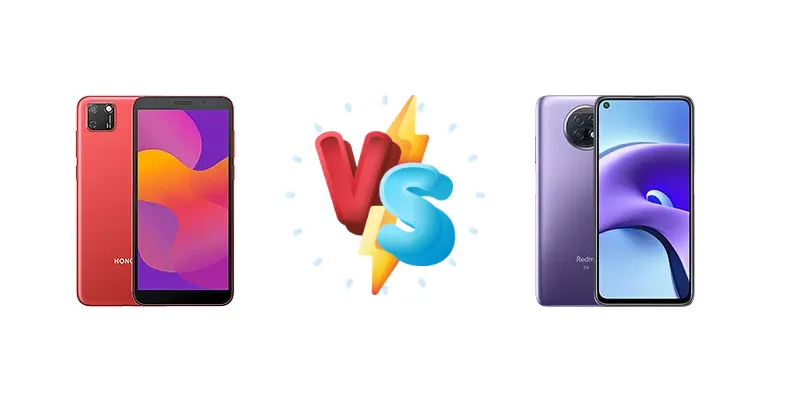
|
🏆 Quick Verdict
For the average user, the Xiaomi Redmi Note 9T is the clear winner. Its Mediatek Dimensity 800U chipset provides a substantial performance uplift over the Honor 9S’s Helio P22, making it far more capable for demanding tasks and future-proofing. While battery life is comparable, the Redmi Note 9T’s faster charging and superior processing power make it the more practical choice.
| PHONES | ||
|---|---|---|
| Phone Names | Honor 9S | Xiaomi Redmi Note 9T |
| Network | ||
|---|---|---|
| 2G bands | GSM 850 / 900 / 1800 / 1900 | GSM 850 / 900 / 1800 / 1900 |
| 3G bands | HSDPA 850 / 900 / 1900 / 2100 | HSDPA 850 / 900 / 1700(AWS) / 1900 / 2100 |
| 4G bands | 1, 2, 3, 4, 5, 7, 8, 20, 28, 38, 40, 41 | 1, 2, 3, 4, 5, 7, 8, 12, 17, 18, 19, 20, 26, 28, 32, 38, 40, 41, 42 |
| 5G bands | - | 1, 3, 5, 7, 8, 20, 28, 38, 41, 77, 78, 79 SA/NSA/Sub6 |
| Speed | HSPA, LTE | HSPA, LTE, 5G |
| Technology | GSM / HSPA / LTE | GSM / HSPA / LTE / 5G |
| Launch | ||
|---|---|---|
| Announced | 2020, April 29. Released 2020, May 04 | 2021, January 08 |
| Status | Discontinued | Available. Released 2021, January 18 |
| Body | ||
|---|---|---|
| Build | - | Glass front (Gorilla Glass 5), plastic back, plastic frame |
| Dimensions | 146.5 x 70.9 x 8.4 mm (5.77 x 2.79 x 0.33 in) | 161.2 x 77.3 x 9.1 mm (6.35 x 3.04 x 0.36 in) |
| SIM | Nano-SIM + Nano-SIM | Nano-SIM + Nano-SIM |
| Weight | 144 g (5.08 oz) | 199 g (7.02 oz) |
| - | Water-repellent coating | |
| Display | ||
|---|---|---|
| Protection | - | Corning Gorilla Glass 5 |
| Resolution | 720 x 1440 pixels, 18:9 ratio (~295 ppi density) | 1080 x 2340 pixels, 19.5:9 ratio (~395 ppi density) |
| Size | 5.45 inches, 76.7 cm2 (~73.8% screen-to-body ratio) | 6.53 inches, 104.7 cm2 (~84.0% screen-to-body ratio) |
| Type | IPS LCD | IPS LCD, 450 nits (typ) |
| Platform | ||
|---|---|---|
| CPU | Octa-core (4x2.0 GHz Cortex-A53 & 4x1.5 GHz Cortex-A53) | Octa-core (2x2.4 GHz Cortex-A76 & 6x2.0 GHz Cortex-A55) |
| Chipset | Mediatek MT6762R Helio P22 (12 nm) | Mediatek Dimensity 800U (7 nm) |
| GPU | PowerVR GE8320 | Mali-G57 MC3 |
| OS | Android 10, Magic UI 3.1, no Google Play Services | Android 10, MIUI 12 |
| Memory | ||
|---|---|---|
| Card slot | microSDXC (dedicated slot) | microSDXC (dedicated slot) |
| Internal | 32GB 2GB RAM | 64GB 4GB RAM, 128GB 4GB RAM, 128GB 6GB RAM |
| eMMC 5.1 | UFS 2.1 - 64GB UFS 2.2 - 128GB | |
| Main Camera | ||
|---|---|---|
| Features | LED flash, HDR, panorama | LED flash, HDR, panorama |
| Single | 8 MP, f/2.0, (wide), AF | - |
| Triple | - | 48 MP, f/1.8, 26mm (wide), 1/2.0", 0.8µm, PDAF 2 MP (macro) Auxiliary lens |
| Video | 1080p@30fps | 4K@30fps, 1080p@30/60fps |
| Selfie camera | ||
|---|---|---|
| Single | 5 MP, f/2.2 | 13 MP, f/2.3, 29mm (standard), 1/3.1", 1.12µm |
| Video | 1080p@30fps | 1080p@30fps |
| Sound | ||
|---|---|---|
| 3.5mm jack | Yes | Yes |
| 35mm jack | Yes | Yes |
| Loudspeaker | Yes | Yes, with stereo speakers |
| - | 24-bit/192kHz audio | |
| Comms | ||
|---|---|---|
| Bluetooth | 5.0, A2DP, LE | 5.1, A2DP, LE |
| Infrared port | - | Yes |
| NFC | No | Yes |
| Positioning | GPS, GLONASS, BDS | GPS, GLONASS, GALILEO, BDS |
| Radio | FM radio | FM radio, recording |
| USB | microUSB 2.0 | USB Type-C 2.0 |
| WLAN | Wi-Fi 802.11 b/g/n, Wi-Fi Direct | Wi-Fi 802.11 a/b/g/n/ac, dual-band, Wi-Fi Direct |
| Features | ||
|---|---|---|
| Sensors | Accelerometer, proximity | Fingerprint (side-mounted), accelerometer, gyro, proximity, compass |
| Battery | ||
|---|---|---|
| Charging | - | 18W wired, 33% in 30 min |
| Type | Li-Po 3020 mAh | Li-Po 5000 mAh |
| Misc | ||
|---|---|---|
| Colors | Black, Blue, Red | Nightfall Black, Daybreak Purple |
| Models | DUA-LX9 | M2007J22G, J22 |
| Price | About 90 EUR | About 130 EUR |
| SAR | - | 1.07 W/kg (head) 1.05 W/kg (body) |
| SAR EU | - | 0.59 W/kg (head) 0.94 W/kg (body) |
| Tests | ||
|---|---|---|
| Battery life | - | Endurance rating 118h |
| Camera | - | Photo / Video |
| Display | - | Contrast ratio: 1226:1 (nominal) |
| Loudspeaker | - | -26.3 LUFS (Good) |
| Performance | - | AnTuTu: 288732 (v8) GeekBench: 1775 (v5.1) |
Honor 9S
- Potentially lower price point
- Acceptable battery endurance
- Basic smartphone functionality
- Significantly weaker processor
- Likely limited multitasking capabilities
- Outdated chipset architecture
Xiaomi Redmi Note 9T
- Much faster processor (Dimensity 800U)
- Faster charging (18W)
- Better display brightness
- Slightly higher price
- Similar battery endurance to Honor 9S
- May have more bloatware (typical Xiaomi)
Display Comparison
Both the Honor 9S and Redmi Note 9T feature displays with a 1226:1 contrast ratio, suggesting similar visual pop. However, the Redmi Note 9T boasts a measured peak brightness of 471 nits, which will translate to better visibility in outdoor conditions compared to the Honor 9S, whose brightness is not specified. The lack of information regarding panel technology (IPS, AMOLED) for the Honor 9S suggests a more basic display experience, while the Redmi Note 9T likely utilizes an IPS LCD, common for this price bracket.
Camera Comparison
Both phones are listed as having Photo/Video capabilities, but detailed camera specifications are absent. Given the market positioning, it’s safe to assume both utilize relatively basic camera setups. Without sensor size or aperture information, it’s difficult to make a definitive judgment. However, the Redmi Note 9T’s more powerful chipset likely enables more sophisticated image processing algorithms, potentially leading to better image quality in various lighting conditions. The presence of a dedicated Night Mode on the Redmi Note 9T (based on typical Xiaomi implementations) is also probable, a feature likely missing on the Honor 9S.
Performance
The performance gap between these two devices is substantial. The Xiaomi Redmi Note 9T’s Mediatek Dimensity 800U (7nm) is a significant leap forward from the Honor 9S’s Mediatek MT6762R Helio P22 (12nm). The Dimensity 800U features a more modern CPU architecture – Cortex-A76 cores versus the A53 cores in the Helio P22 – resulting in a noticeable improvement in both single-core and multi-core performance. The 7nm process node also contributes to better power efficiency and reduced thermal throttling. This means the Redmi Note 9T will handle multitasking, gaming, and demanding applications with far greater ease.
Battery Life
Both the Honor 9S and Redmi Note 9T achieve an endurance rating of 118 hours, indicating comparable battery life under similar usage patterns. However, the Redmi Note 9T offers 18W wired charging, capable of adding 33% charge in 30 minutes. The Honor 9S’s charging speed is not specified, suggesting it’s likely slower. This faster charging capability on the Redmi Note 9T provides a significant convenience factor, allowing users to quickly top up their battery when needed.
Buying Guide
Buy the Honor 9S if your primary needs are basic smartphone functionality – calls, texts, and light social media – and you prioritize a minimal budget above all else. Buy the Xiaomi Redmi Note 9T if you want a phone capable of handling more demanding apps, occasional gaming, and benefit from significantly faster processing speeds, even if it means a slightly higher initial investment.