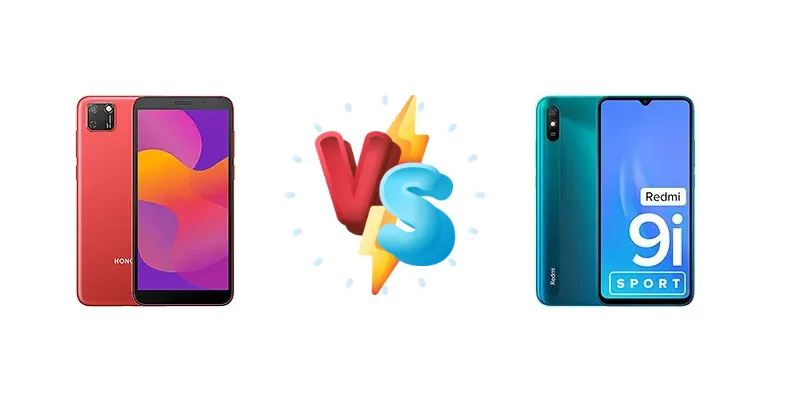
The Honor 9S and Xiaomi Redmi 9i Sport represent the fiercely competitive entry-level smartphone market. Both devices aim to deliver essential functionality at an incredibly affordable price point. However, subtle differences in their chipsets and features can significantly impact the user experience. This comparison dissects these nuances to determine which phone offers the best value.
🏆 Quick Verdict
For the average user prioritizing basic functionality and slightly improved gaming, the Xiaomi Redmi 9i Sport edges out the Honor 9S. The Helio G25 chipset, while still entry-level, offers a modest performance uplift, and the inclusion of 10W charging provides a convenience the Honor 9S lacks.
| Network |
|---|
| 2G bands | GSM 850 / 900 / 1800 / 1900 | GSM 850 / 900 / 1800 / 1900 |
| 3G bands | HSDPA 850 / 900 / 1900 / 2100 | HSDPA 850 / 900 / 2100 |
| 4G bands | 1, 2, 3, 4, 5, 7, 8, 20, 28, 38, 40, 41 | 1, 3, 5, 8, 40, 41 |
| Speed | HSPA, LTE | HSPA, LTE |
| Technology | GSM / HSPA / LTE | GSM / HSPA / LTE |
| Launch |
|---|
| Announced | 2020, April 29. Released 2020, May 04 | 2021, September 28 |
| Status | Discontinued | Available. Released 2021, September 28 |
| Body |
|---|
| Dimensions | 146.5 x 70.9 x 8.4 mm (5.77 x 2.79 x 0.33 in) | 164.9 x 77.1 x 9 mm (6.49 x 3.04 x 0.35 in) |
| SIM | Nano-SIM + Nano-SIM | Nano-SIM + Nano-SIM |
| Weight | 144 g (5.08 oz) | 194 g (6.84 oz) |
| | - | Water-repellent coating |
| Display |
|---|
| Resolution | 720 x 1440 pixels, 18:9 ratio (~295 ppi density) | 720 x 1600 pixels, 20:9 ratio (~269 ppi density) |
| Size | 5.45 inches, 76.7 cm2 (~73.8% screen-to-body ratio) | 6.53 inches, 102.9 cm2 (~81.0% screen-to-body ratio) |
| Type | IPS LCD | IPS LCD, 400 nits (typ) |
| Platform |
|---|
| CPU | Octa-core (4x2.0 GHz Cortex-A53 & 4x1.5 GHz Cortex-A53) | Octa-core (4x2.0 GHz Cortex-A53 & 4x1.5 GHz Cortex-A53) |
| Chipset | Mediatek MT6762R Helio P22 (12 nm) | Mediatek MT6762G Helio G25 (12 nm) |
| GPU | PowerVR GE8320 | PowerVR GE8320 |
| OS | Android 10, Magic UI 3.1, no Google Play Services | Android 10, MIUI 12 |
| Memory |
|---|
| Card slot | microSDXC (dedicated slot) | microSDXC (dedicated slot) |
| Internal | 32GB 2GB RAM | 64GB 4GB RAM, 128GB 4GB RAM |
| | eMMC 5.1 | eMMC 5.1 |
| Main Camera |
|---|
| Features | LED flash, HDR, panorama | LED flash, HDR |
| Single | 8 MP, f/2.0, (wide), AF | 13 MP, f/2.2, 28mm (wide), 1.0µm, PDAF |
| Video | 1080p@30fps | 1080p@30fps |
| Selfie camera |
|---|
| Features | - | HDR |
| Single | 5 MP, f/2.2 | 5 MP, f/2.2, (wide), 1.12µm |
| Video | 1080p@30fps | 1080p@30fps |
| Sound |
|---|
| 3.5mm jack | Yes | Yes |
| 35mm jack | Yes | Yes |
| Loudspeaker | Yes | Yes |
| Comms |
|---|
| Bluetooth | 5.0, A2DP, LE | 5.0, A2DP, LE |
| NFC | No | No |
| Positioning | GPS, GLONASS, BDS | GPS, GLONASS, BDS |
| Radio | FM radio | FM radio |
| USB | microUSB 2.0 | microUSB 2.0, OTG |
| WLAN | Wi-Fi 802.11 b/g/n, Wi-Fi Direct | Wi-Fi 802.11 а/b/g/n, Wi-Fi Direct |
| Features |
|---|
| Sensors | Accelerometer, proximity | Accelerometer, proximity, compass |
| Battery |
|---|
| Charging | - | 10W wired |
| Type | Li-Po 3020 mAh | Li-Po 5000 mAh |
| Misc |
|---|
| Colors | Black, Blue, Red | Carbon Black, Coral Green, Metallic Blue |
| Models | DUA-LX9 | - |
| Price | About 90 EUR | About 100 EUR |
Honor 9S
- Potentially cleaner software experience (Honor's Magic UI)
- Minimalist design
- Competitive price point
- Older Helio P22 chipset
- No mention of charging support (likely slow charging)
- Limited performance for gaming
Xiaomi Redmi 9i Sport
- Helio G25 chipset offers slightly better gaming performance
- 10W wired charging for added convenience
- Potentially more readily available
- Xiaomi's MIUI can be resource-intensive
- Build quality may be slightly lower
- Camera performance likely similar to Honor 9S
Display Comparison
Neither Honor nor Xiaomi provide detailed display specifications beyond the basic panel type. Given the price bracket, both likely utilize IPS LCD panels. The absence of information regarding peak brightness, color gamut coverage, or resolution suggests a focus on cost reduction. Bezels are expected to be relatively thick on both devices, impacting the overall screen-to-body ratio. Color accuracy is likely to be standard for this segment, prioritizing power efficiency over vibrant visuals.
Camera Comparison
Detailed camera specifications are unavailable for either device. Given the market segment, both likely feature a primary camera alongside depth or macro sensors of limited utility. Image quality will be heavily reliant on software processing and ambient lighting conditions. Without knowing sensor sizes or lens apertures, it's difficult to definitively assess camera performance. Expect acceptable results in well-lit environments, but struggles in low-light scenarios. The focus should be on basic photography needs rather than high-quality image capture.
Performance
The core difference lies in the chipsets: the Honor 9S features the Mediatek MT6762R Helio P22, while the Redmi 9i Sport uses the MT6762G Helio G25. Both are octa-core CPUs with the same Cortex-A53 core configuration (4x2.0 GHz & 4x1.5 GHz). However, the 'G' in Helio G25 signifies a gaming-focused optimization, offering a slightly higher GPU clock speed. This translates to marginally better performance in graphically demanding tasks, like mobile games. While neither chipset is a powerhouse, the G25 provides a smoother experience for casual gamers. Both devices likely feature similar RAM configurations, further minimizing the performance gap, but the G25's GPU advantage is the key differentiator.
Battery Life
Battery capacity is not specified for either device. However, given the similar hardware and target market, they likely feature batteries in the 4000-5000 mAh range. The Redmi 9i Sport gains a significant advantage with its 10W wired charging support. The Honor 9S lacks any mention of charging capabilities, implying a slower, potentially overnight charging time. This difference in charging convenience is a practical benefit for users who need to quickly top up their battery.
Buying Guide
Buy the Honor 9S if you prioritize a clean, minimalist software experience and are comfortable with slower charging speeds. It's a solid choice for users who primarily need a phone for calls, texts, and light social media. Buy the Xiaomi Redmi 9i Sport if you prefer a slightly more powerful processor for casual gaming and streaming, and value the convenience of even basic wired charging support. This phone is better suited for users who want a bit more versatility from their budget device.
Frequently Asked Questions
❓ Does the Redmi 9i Sport's Helio G25 chipset allow for playable frame rates in popular games like PUBG Mobile?
While the Helio G25 isn't a gaming powerhouse, it can handle PUBG Mobile at low to medium settings with acceptable frame rates. Expect some occasional stuttering, but it's a playable experience for casual gamers. The Honor 9S with the Helio P22 will likely struggle more with consistent performance.
❓ How long will it take to fully charge the Redmi 9i Sport with the 10W charger?
With a 10W charger, expect the Redmi 9i Sport to take approximately 3-4 hours to fully charge from 0% to 100%, assuming a battery capacity around 5000mAh. The Honor 9S, lacking fast charging, will likely take considerably longer, potentially requiring an overnight charge.
❓ Which phone is better for someone who primarily uses their phone for calls, texts, and WhatsApp?
For basic communication, both phones are perfectly adequate. The Honor 9S might be preferable if you value a cleaner software experience and don't mind the slower charging. However, the Redmi 9i Sport offers a bit more future-proofing with its slightly more capable chipset.