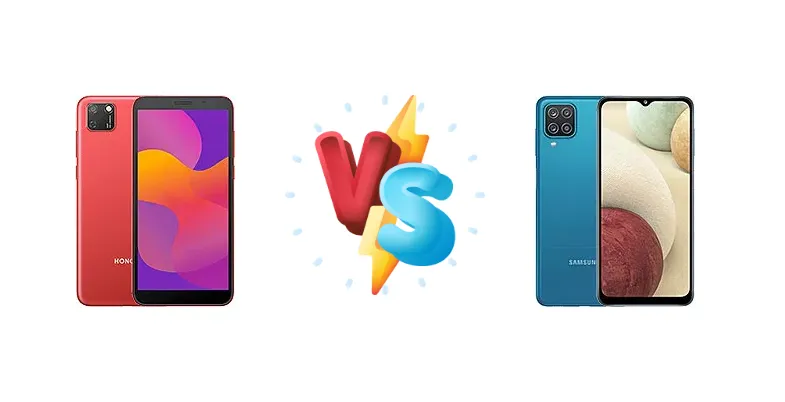
The sub-₹15,000 (approximately $180 USD) smartphone market in India is fiercely competitive. Both the Honor 9S and the Samsung Galaxy A12 aim to deliver essential smartphone functionality at an accessible price. However, they take different approaches to achieving this, primarily through their chipset choices. This comparison dives deep into the architectural differences and real-world implications of the Mediatek Helio P22 in the Honor 9S versus the Samsung Exynos 850 in the Galaxy A12.
🏆 Quick Verdict
For the average user prioritizing consistent performance and future-proofing, the Samsung Galaxy A12 (India) is the better choice. Its Exynos 850 chipset, built on an 8nm process, offers a significant performance and efficiency advantage over the Honor 9S’s 12nm Helio P22, translating to smoother multitasking and a more responsive user experience.
| Network |
|---|
| 2G bands | GSM 850 / 900 / 1800 / 1900 | GSM 850 / 900 / 1800 / 1900 |
| 3G bands | HSDPA 850 / 900 / 1900 / 2100 | HSDPA 850 / 900 / 2100 |
| 4G bands | 1, 2, 3, 4, 5, 7, 8, 20, 28, 38, 40, 41 | 1, 3, 5, 7, 8, 20, 28, 38, 40, 41 |
| Speed | HSPA, LTE | HSPA 42.2/5.76 Mbps, LTE Cat4 150/50 Mbps |
| Technology | GSM / HSPA / LTE | GSM / HSPA / LTE |
| Launch |
|---|
| Announced | 2020, April 29. Released 2020, May 04 | 2021, August 12 |
| Status | Discontinued | Available. Released 2021, August 12 |
| Body |
|---|
| Build | - | Glass front, plastic back, plastic frame |
| Dimensions | 146.5 x 70.9 x 8.4 mm (5.77 x 2.79 x 0.33 in) | 164 x 75.8 x 8.9 mm (6.46 x 2.98 x 0.35 in) |
| SIM | Nano-SIM + Nano-SIM | · Nano-SIM· Nano-SIM + Nano-SIM |
| Weight | 144 g (5.08 oz) | 205 g (7.23 oz) |
| Display |
|---|
| Resolution | 720 x 1440 pixels, 18:9 ratio (~295 ppi density) | 720 x 1600 pixels, 20:9 ratio (~270 ppi density) |
| Size | 5.45 inches, 76.7 cm2 (~73.8% screen-to-body ratio) | 6.5 inches, 102.0 cm2 (~82.1% screen-to-body ratio) |
| Type | IPS LCD | PLS LCD |
| Platform |
|---|
| CPU | Octa-core (4x2.0 GHz Cortex-A53 & 4x1.5 GHz Cortex-A53) | Octa-core (4x2.0 GHz Cortex-A55 & 4x2.0 GHz Cortex-A55) |
| Chipset | Mediatek MT6762R Helio P22 (12 nm) | Exynos 850 (8 nm) |
| GPU | PowerVR GE8320 | Mali-G52 |
| OS | Android 10, Magic UI 3.1, no Google Play Services | Android 11, upgradable to Android 13, One UI 5.1 |
| Memory |
|---|
| Card slot | microSDXC (dedicated slot) | microSDXC (dedicated slot) |
| Internal | 32GB 2GB RAM | 64GB 4GB RAM, 128GB 4GB RAM, 128GB 6GB RAM |
| | eMMC 5.1 | eMMC 5.1 |
| Main Camera |
|---|
| Features | LED flash, HDR, panorama | LED flash, panorama, HDR |
| Quad | - | 48 MP, f/2.0, 26mm (wide), AF
5 MP, f/2.2, 123˚ (ultrawide)
2 MP (macro)
Auxiliary lens |
| Single | 8 MP, f/2.0, (wide), AF | - |
| Video | 1080p@30fps | 1080p@30fps |
| Selfie camera |
|---|
| Single | 5 MP, f/2.2 | 8 MP, f/2.2 |
| Video | 1080p@30fps | 1080p@30fps |
| Sound |
|---|
| 3.5mm jack | Yes | Yes |
| 35mm jack | Yes | Yes |
| Loudspeaker | Yes | Yes |
| Comms |
|---|
| Bluetooth | 5.0, A2DP, LE | 5.0, A2DP, LE |
| NFC | No | No |
| Positioning | GPS, GLONASS, BDS | GPS, GLONASS, GALILEO, BDS |
| Radio | FM radio | FM radio, RDS, recording |
| USB | microUSB 2.0 | USB Type-C 2.0 |
| WLAN | Wi-Fi 802.11 b/g/n, Wi-Fi Direct | Wi-Fi 802.11 b/g/n, Wi-Fi Direct |
| Features |
|---|
| Sensors | Accelerometer, proximity | Fingerprint (side-mounted), accelerometer |
| | - | Virtual proximity sensing |
| Battery |
|---|
| Charging | - | 15W wired |
| Type | Li-Po 3020 mAh | Li-Po 5000 mAh |
| Misc |
|---|
| Colors | Black, Blue, Red | Black, Blue, White |
| Models | DUA-LX9 | SM-A127F, SM-A127F/DS |
| Price | About 90 EUR | About 160 EUR |
| SAR | - | 0.79 W/kg (head) |
Honor 9S
- Potentially lower price point
- Sufficient for basic smartphone tasks
- Simple and straightforward user experience
- Outdated Helio P22 chipset
- Lower performance and efficiency
- May struggle with multitasking and demanding apps
Samsung Galaxy A12 (India)
- More powerful and efficient Exynos 850 chipset
- Smoother multitasking and app performance
- Faster 15W charging
- Better image processing capabilities
- Potentially higher price
- Samsung’s One UI can be resource intensive
Display Comparison
Neither device boasts a particularly impressive display. While specific display specs (resolution, brightness) are not provided, the focus here is on the underlying processing power needed to drive the UI. The Exynos 850’s superior GPU will likely result in smoother animations and transitions, even with a similar panel. The Honor 9S, with its older chipset, may exhibit slight lag during scrolling or app switching.
Camera Comparison
Without detailed camera specifications, a direct comparison is difficult. However, the Exynos 850’s integrated image signal processor (ISP) is likely more advanced than the Helio P22’s, potentially leading to better image processing, noise reduction, and dynamic range in photos and videos. The A12’s ISP will also be better equipped to handle features like HDR and scene optimization. The presence of a 15W charger suggests Samsung anticipates more frequent photo/video capture, requiring more frequent charging.
Performance
The core difference lies in the chipsets. The Samsung Galaxy A12’s Exynos 850, fabricated on an 8nm process, is a clear upgrade over the Honor 9S’s 12nm Mediatek Helio P22. The Exynos 850 utilizes newer Cortex-A55 cores across all eight cores, offering improved instruction-per-clock (IPC) compared to the A53 cores in the Helio P22. This means the A12 will handle demanding apps and multitasking more efficiently. The Helio P22’s older architecture will struggle with resource-intensive tasks, leading to noticeable slowdowns. While both have octa-core CPUs clocked at 2.0 GHz, the architectural improvements in the Exynos 850 are crucial.
Battery Life
Battery capacity isn't specified for either device, but the Exynos 850’s 8nm process contributes to significantly better power efficiency. This means the Galaxy A12 will likely achieve longer battery life on a single charge compared to the Honor 9S, despite potentially having a similar battery capacity. The A12’s 15W wired charging is a notable advantage, allowing for faster top-ups compared to the likely slower charging speeds of the Honor 9S.
Buying Guide
Buy the Honor 9S if you need a basic smartphone for essential tasks like calls, messaging, and light social media use, and are on an extremely tight budget. Its lower price point makes it appealing for first-time smartphone users or those needing a secondary device. Buy the Samsung Galaxy A12 (India) if you prefer a more capable device for everyday multitasking, occasional gaming, and appreciate the benefits of a more modern and efficient chipset. The 15W charging is also a plus for those who dislike long charging times.
Frequently Asked Questions
❓ Does the Exynos 850 in the Galaxy A12 get noticeably hot during extended gaming sessions?
The Exynos 850 is built on an 8nm process, which generally results in better thermal efficiency compared to the 12nm Helio P22. While it may warm up during prolonged gaming, it's unlikely to experience significant throttling or overheating issues, providing a more consistent gaming experience than the Honor 9S.
❓ Is the performance difference between the Helio P22 and Exynos 850 noticeable in everyday tasks like browsing and social media?
Yes, the difference is noticeable. The Exynos 850’s newer CPU architecture and improved efficiency result in smoother scrolling, faster app loading times, and a more responsive user interface, even during everyday tasks. The Helio P22 may exhibit slight lag or stuttering, especially when multiple apps are open.
❓ Will the Honor 9S struggle with newer Android updates?
The Helio P22’s limited processing power and older architecture may lead to performance issues with future Android updates. Samsung is more likely to provide longer software support and smoother updates for the Galaxy A12 due to the Exynos 850’s capabilities.
❓ How much faster is the 15W charging on the Galaxy A12 compared to the Honor 9S (assuming the Honor 9S has a standard 10W charger)?
15W charging is significantly faster than 10W. While exact 0-100% times aren't available, you can expect the Galaxy A12 to charge approximately 30-50% faster, reducing downtime and allowing you to get back to using your phone sooner.