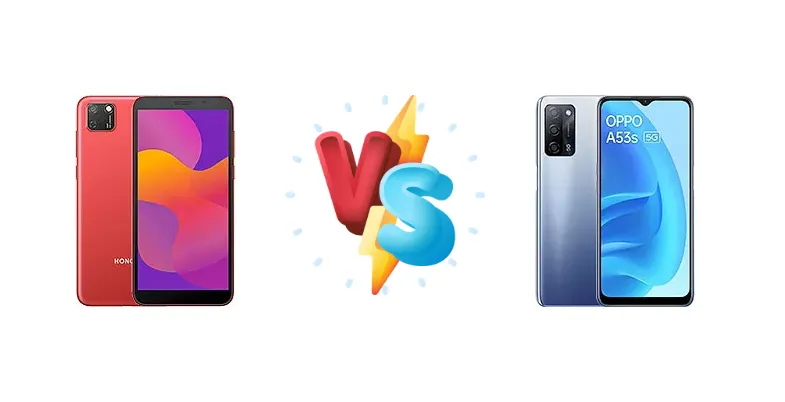
The Honor 9S and Oppo A53s 5G represent two approaches to the budget smartphone market. The Honor 9S, leveraging an older chipset, aims for affordability, while the Oppo A53s 5G integrates a more modern Dimensity 700 SoC, promising 5G connectivity and improved performance. This comparison dissects their key differences to help you choose the right device.
🏆 Quick Verdict
For the average user prioritizing responsiveness and future-proofing, the Oppo A53s 5G is the clear winner. Its Mediatek Dimensity 700 chipset delivers a substantial performance uplift over the Honor 9S’s Helio P22, making it better suited for multitasking, gaming, and 5G network access. However, the Honor 9S remains a viable option for basic use cases where cost is the primary concern.
| Network |
|---|
| 2G bands | GSM 850 / 900 / 1800 / 1900 | GSM 850 / 900 / 1800 / 1900 |
| 3G bands | HSDPA 850 / 900 / 1900 / 2100 | HSDPA 800 / 850 / 900 / 2100 |
| 4G bands | 1, 2, 3, 4, 5, 7, 8, 20, 28, 38, 40, 41 | 1, 3, 5, 8, 34, 38, 39, 40, 41 |
| 5G bands | - | 1, 28, 41, 77, 78 SA/NSA |
| Speed | HSPA, LTE | HSPA, LTE, 5G |
| Technology | GSM / HSPA / LTE | GSM / HSPA / LTE / 5G |
| Launch |
|---|
| Announced | 2020, April 29. Released 2020, May 04 | 2021, April 27 |
| Status | Discontinued | Available. Released 2021, May 07 |
| Body |
|---|
| Dimensions | 146.5 x 70.9 x 8.4 mm (5.77 x 2.79 x 0.33 in) | 164 x 75.7 x 8.4 mm (6.46 x 2.98 x 0.33 in) |
| SIM | Nano-SIM + Nano-SIM | Nano-SIM + Nano-SIM |
| Weight | 144 g (5.08 oz) | 189.6 g (6.70 oz) |
| Display |
|---|
| Resolution | 720 x 1440 pixels, 18:9 ratio (~295 ppi density) | 720 x 1600 pixels, 20:9 ratio (~269 ppi density) |
| Size | 5.45 inches, 76.7 cm2 (~73.8% screen-to-body ratio) | 6.52 inches, 102.6 cm2 (~82.7% screen-to-body ratio) |
| Type | IPS LCD | IPS LCD, 480 nits (typ) |
| Platform |
|---|
| CPU | Octa-core (4x2.0 GHz Cortex-A53 & 4x1.5 GHz Cortex-A53) | Octa-core (2x2.2 GHz Cortex-A76 & 6x2.0 GHz Cortex-A55) |
| Chipset | Mediatek MT6762R Helio P22 (12 nm) | Mediatek Dimensity 700 (7 nm) |
| GPU | PowerVR GE8320 | Mali-G57 MC2 |
| OS | Android 10, Magic UI 3.1, no Google Play Services | Android 11, ColorOS 11.1 |
| Memory |
|---|
| Card slot | microSDXC (dedicated slot) | microSDXC (dedicated slot) |
| Internal | 32GB 2GB RAM | 128GB 6GB RAM, 128GB 8GB RAM |
| | eMMC 5.1 | UFS 2.2 |
| Main Camera |
|---|
| Features | LED flash, HDR, panorama | LED flash, HDR, panorama |
| Single | 8 MP, f/2.0, (wide), AF | 8 MP, f/2.0, 26mm (wide) |
| Triple | - | 13 MP, f/2.2, 25mm (wide), 1/3.06", 1.12µm, PDAF
2 MP (macro)
Auxiliary lens |
| Video | 1080p@30fps | 1080p@30fps |
| Selfie camera |
|---|
| Features | - | HDR |
| Single | 5 MP, f/2.2 | 8 MP, f/2.0, 26mm (wide) |
| Video | 1080p@30fps | 1080p@30fps |
| Sound |
|---|
| 3.5mm jack | Yes | Yes |
| 35mm jack | Yes | Yes |
| Loudspeaker | Yes | Yes |
| Comms |
|---|
| Bluetooth | 5.0, A2DP, LE | 5.0, A2DP, LE, aptX HD |
| NFC | No | No |
| Positioning | GPS, GLONASS, BDS | GPS, GLONASS, GALILEO, BDS, QZSS |
| Radio | FM radio | No |
| USB | microUSB 2.0 | USB Type-C 2.0, OTG |
| WLAN | Wi-Fi 802.11 b/g/n, Wi-Fi Direct | Wi-Fi 802.11 a/b/g/n/ac, dual-band, Wi-Fi Direct |
| Features |
|---|
| Sensors | Accelerometer, proximity | Fingerprint (side-mounted), accelerometer, gyro, proximity, compass |
| Battery |
|---|
| Charging | - | 10W wired |
| Type | Li-Po 3020 mAh | Li-Po 5000 mAh |
| Misc |
|---|
| Colors | Black, Blue, Red | Crystal Blue, Ink Black |
| Models | DUA-LX9 | CPH2321 |
| Price | About 90 EUR | About 170 EUR |
Honor 9S
- Potentially lower price point
- Simple and straightforward user experience
- May have longer standby time due to less powerful processor
- Significantly slower performance
- Limited multitasking capabilities
- Outdated chipset architecture
- Likely lacks 5G connectivity
Oppo A53s 5G
- 5G connectivity for faster data speeds
- Much faster and more responsive performance
- More efficient chipset for potentially better battery life
- Improved image processing capabilities
- Slower 10W charging
- Potentially higher price
- May experience more thermal throttling under heavy load
Display Comparison
Neither device boasts a standout display. While specific display specs (resolution, panel type) are missing for the Honor 9S, its market positioning suggests a basic LCD panel. The Oppo A53s 5G also likely features an LCD, but the focus here is on the chipset impact on display rendering. The Honor 9S’s Helio P22 will struggle to drive higher refresh rates or complex UI elements smoothly, resulting in a less fluid visual experience. The A53s 5G’s Dimensity 700, with its more powerful GPU, will handle display tasks with greater ease.
Camera Comparison
Without detailed camera specifications, a direct comparison is limited. However, given the price points, both devices likely employ modest camera setups. The Oppo A53s 5G’s Dimensity 700 includes an integrated Image Signal Processor (ISP) that offers improved image processing capabilities compared to the Helio P22’s ISP. This could result in better dynamic range and noise reduction in photos and videos. The A53s 5G is more likely to support features like HDR video recording, which the Honor 9S may lack. The presence of a dedicated ISP in the Dimensity 700 is a key advantage.
Performance
The performance gap is the most significant differentiator. The Honor 9S’s Mediatek MT6762R Helio P22, built on a 12nm process, utilizes a Cortex-A53 cluster for both its high-performance and efficiency cores. This older architecture is demonstrably slower than the Oppo A53s 5G’s Dimensity 700 (7nm). The Dimensity 700 features a combination of Cortex-A76 and Cortex-A55 cores, offering a substantial increase in both single-core and multi-core performance. This translates to faster app loading times, smoother multitasking, and a more responsive overall experience. The 7nm process also contributes to better power efficiency, though the A53s 5G's 10W charging suggests a smaller battery to compensate.
Battery Life
The Oppo A53s 5G’s 10W wired charging is a notable limitation. While the Honor 9S’s charging speed is unknown, it’s unlikely to be significantly faster. The real-world impact will depend on battery capacity, which is not provided for either device. However, the Dimensity 700’s superior power efficiency could partially offset the slower charging speed, potentially providing comparable or even slightly better battery life in typical usage scenarios. The 7nm process is a key factor here.
Buying Guide
Buy the Honor 9S if you need a smartphone for essential tasks like calls, texts, and light social media browsing, and your budget is extremely limited. You're accepting a significant performance compromise for the lowest possible price. Buy the Oppo A53s 5G if you prioritize a smoother user experience, want to take advantage of 5G networks, and occasionally engage in mobile gaming or more demanding applications. The A53s 5G offers a better long-term investment.
Frequently Asked Questions
❓ Will the Oppo A53s 5G's Dimensity 700 handle demanding games like PUBG Mobile?
The Dimensity 700 is capable of running PUBG Mobile, but you'll likely need to lower the graphics settings to achieve a consistently smooth frame rate. While it won't deliver a flagship gaming experience, it's a significant improvement over the Honor 9S's Helio P22, which would struggle with even medium settings.
❓ Is the 10W charging on the Oppo A53s 5G a dealbreaker?
10W charging is slow by modern standards. Expect a full charge to take over 2 hours. However, the Dimensity 700's power efficiency may mean you don't need to charge as frequently, mitigating the impact of the slow charging speed. If fast charging is a priority, these phones aren't ideal.
❓ How much of a real-world performance difference will I notice between the Helio P22 and the Dimensity 700?
The difference will be very noticeable. The Dimensity 700 offers a substantial performance boost in everyday tasks like app loading, web browsing, and multitasking. The Honor 9S will feel sluggish in comparison, especially when switching between apps or running multiple applications simultaneously.