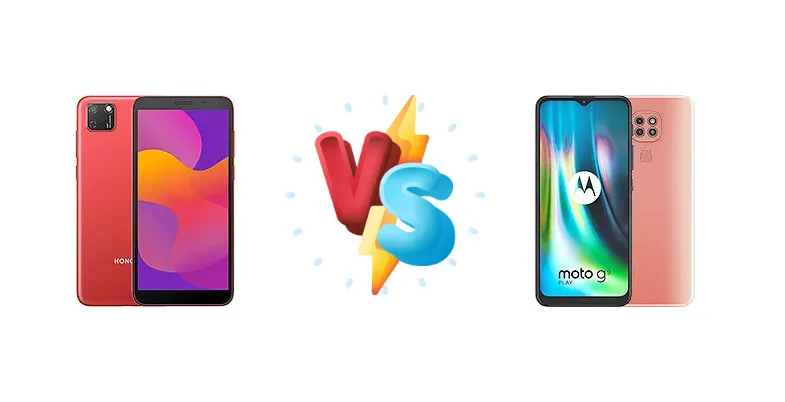
The Honor 9S and Motorola Moto G9 Play represent two compelling options in the ultra-budget smartphone space. While both aim to deliver essential smartphone functionality at a low price point, they take different approaches to achieving this. The Honor 9S relies on MediaTek’s Helio P22, while the Moto G9 Play leverages Qualcomm’s Snapdragon 662. This comparison dives deep into the specifics to determine which device offers the best overall experience.
🏆 Quick Verdict
For most users, the Motorola Moto G9 Play is the superior choice. Its Snapdragon 662 chipset, built on an 11nm process, provides a noticeable performance advantage over the Honor 9S’s Helio P22. The G9 Play’s 20W charging also significantly improves usability, offsetting its potentially slightly lower battery capacity.
| Network |
|---|
| 2G bands | GSM 850 / 900 / 1800 / 1900 | GSM 850 / 900 / 1800 / 1900 |
| 3G bands | HSDPA 850 / 900 / 1900 / 2100 | HSDPA 850 / 900 / 1900 / 2100 |
| 4G bands | 1, 2, 3, 4, 5, 7, 8, 20, 28, 38, 40, 41 | 1, 2, 3, 5, 7, 8, 18, 19, 20, 26, 28, 38, 40, 41 |
| EDGE | - | Class 10 |
| GPRS | - | Class 10 |
| Speed | HSPA, LTE | HSPA 42.2/5.76 Mbps, LTE Cat4 150/50 Mbps |
| Technology | GSM / HSPA / LTE | GSM / HSPA / LTE |
| Launch |
|---|
| Announced | 2020, April 29. Released 2020, May 04 | 2020, August 24. Released 2020, August 28 |
| Status | Discontinued | Discontinued |
| Body |
|---|
| Build | - | Glass front, plastic back, plastic frame |
| Dimensions | 146.5 x 70.9 x 8.4 mm (5.77 x 2.79 x 0.33 in) | 165.2 x 75.7 x 9.2 mm (6.50 x 2.98 x 0.36 in) |
| Keyboard | - | QWERTY |
| SIM | Nano-SIM + Nano-SIM | · Nano-SIM· Nano-SIM + Nano-SIM |
| Weight | 144 g (5.08 oz) | 200 g (7.05 oz) |
| | - | Water-repellent coating |
| Display |
|---|
| Resolution | 720 x 1440 pixels, 18:9 ratio (~295 ppi density) | 720 x 1600 pixels, 20:9 ratio (~269 ppi density) |
| Size | 5.45 inches, 76.7 cm2 (~73.8% screen-to-body ratio) | 6.5 inches, 102.8 cm2 (~82.2% screen-to-body ratio) |
| Type | IPS LCD | IPS LCD |
| Platform |
|---|
| CPU | Octa-core (4x2.0 GHz Cortex-A53 & 4x1.5 GHz Cortex-A53) | Octa-core (4x2.0 GHz Kryo 260 Gold & 4x1.8 GHz Kryo 260 Silver) |
| Chipset | Mediatek MT6762R Helio P22 (12 nm) | Qualcomm SM6115 Snapdragon 662 (11 nm) |
| GPU | PowerVR GE8320 | Adreno 610 |
| OS | Android 10, Magic UI 3.1, no Google Play Services | Android 10, upgradable to Android 11 |
| Memory |
|---|
| Card slot | microSDXC (dedicated slot) | microSDXC (uses shared SIM slot) |
| Internal | 32GB 2GB RAM | 64GB 4GB RAM, 128GB 4GB RAM |
| | eMMC 5.1 | - |
| Main Camera |
|---|
| Features | LED flash, HDR, panorama | LED flash, HDR, panorama |
| Single | 8 MP, f/2.0, (wide), AF | 1.3 MP |
| Triple | - | 48 MP, f/1.7, (wide), 1/2.0", 0.8µm, PDAF
2 MP (macro)
Auxiliary lens |
| Video | 1080p@30fps | 1080p@30/60fps |
| Selfie camera |
|---|
| Features | - | HDR |
| Single | 5 MP, f/2.2 | 8 MP, f/2.2, 1.12µm |
| Video | 1080p@30fps | 1080p@30fps |
| Sound |
|---|
| 3.5mm jack | Yes | Yes |
| 35mm jack | Yes | Yes |
| Loudspeaker | Yes | Yes |
| Comms |
|---|
| Bluetooth | 5.0, A2DP, LE | 5.0, A2DP, LE |
| Infrared port | - | Yes |
| NFC | No | Yes |
| Positioning | GPS, GLONASS, BDS | GPS, GLONASS, GALILEO |
| Radio | FM radio | FM radio |
| USB | microUSB 2.0 | USB Type-C 2.0 |
| WLAN | Wi-Fi 802.11 b/g/n, Wi-Fi Direct | Wi-Fi 802.11 a/b/g/n/ac, dual-band, Wi-Fi Direct |
| Features |
|---|
| Browser | - | WAP 2.0/xHTML, HTML (PocketIE) |
| Sensors | Accelerometer, proximity | Fingerprint (rear-mounted), accelerometer, gyro, proximity |
| Battery |
|---|
| Charging | - | 20W wired |
| Type | Li-Po 3020 mAh | Li-Po 5000 mAh |
| Misc |
|---|
| Colors | Black, Blue, Red | Forest Green, Sapphire Blue, Spring Pink |
| Models | DUA-LX9 | XT2083, XT2083-1 |
| Price | About 90 EUR | About 430 EUR |
| Tests |
|---|
| Camera | - |
Photo / Video |
| Display | - |
Contrast ratio: 1944:1 |
| Loudspeaker | - |
-27.6 LUFS (Good)
|
| Performance | - |
AnTuTu: 170064 (v8)
GeekBench: 1402 (v5.1)
GFXBench: 13fps (ES 3.1 onscreen) |
Honor 9S
- Potentially lower price point
- Functional for basic tasks
- May have longer standby time (speculation due to less powerful chipset)
- Significantly weaker performance
- Likely slower charging
- Inferior display quality (based on lack of specs)
Motorola Moto G9 Play
- Faster and more efficient Snapdragon 662 chipset
- 20W fast charging
- Brighter and higher contrast display
- Potentially slightly higher price
- May have slightly shorter battery life (depending on capacity)
- Basic camera system
Display Comparison
The Motorola Moto G9 Play boasts a measured peak brightness of 465 nits and a 1944:1 contrast ratio, providing a more vibrant and visible display experience, especially outdoors. The Honor 9S’s display specifications are not provided, suggesting a potentially lower brightness and contrast. While both likely utilize LCD panels, the G9 Play’s higher brightness translates to better readability in direct sunlight. The lack of detailed display information for the Honor 9S makes a direct comparison difficult, but the G9 Play clearly has the edge in display quality based on available data.
Camera Comparison
Both phones offer 'Photo / Video' capabilities, but lack specific details. Without sensor size, aperture, or image processing details, a direct comparison is limited. However, given the market positioning, it’s likely both phones feature basic camera setups. The absence of information suggests neither phone will excel in low-light photography or offer advanced features. The G9 Play’s potential for better image processing due to the more powerful chipset could give it a slight advantage, but this is speculative.
Performance
The core difference lies in the chipsets. The Motorola Moto G9 Play’s Qualcomm Snapdragon 662 (11nm) is a significant upgrade over the Honor 9S’s MediaTek Helio P22 (12nm). The Snapdragon 662 utilizes Kryo 260 cores – 4x2.0 GHz Gold and 4x1.8 GHz Silver – offering a more efficient and powerful architecture than the Helio P22’s Cortex-A53 configuration. The 11nm process node of the Snapdragon 662 further contributes to better thermal efficiency, reducing the likelihood of performance throttling during sustained tasks. This means the Moto G9 Play will handle multitasking and moderately demanding apps with greater ease.
Battery Life
Battery capacity isn’t specified for either device. However, the Motorola Moto G9 Play’s 20W wired charging is a major advantage. This allows for significantly faster charging times compared to the likely slower charging speeds of the Honor 9S. While a larger battery capacity is always desirable, the convenience of quickly topping up the battery with 20W charging can offset a slightly smaller battery size. The G9 Play’s faster charging is a practical benefit for users who frequently use their phones throughout the day.
Buying Guide
Buy the Honor 9S if your primary need is a basic, functional smartphone for essential tasks like calls, texts, and light social media, and you prioritize absolute lowest cost. Buy the Motorola Moto G9 Play if you value smoother performance for multitasking, occasional gaming, and faster charging, even if it means spending a little more. The G9 Play is the better option for users who want a phone that feels responsive and doesn't require constant patience.
Frequently Asked Questions
❓ Will the Snapdragon 662 in the Moto G9 Play handle popular games like PUBG Mobile?
The Snapdragon 662 is capable of running PUBG Mobile, but likely at lower graphics settings and frame rates to maintain a smooth experience. It's not a gaming powerhouse, but it offers a playable experience for casual gamers.
❓ Is the lack of detailed camera specs on both phones a concern?
Yes, it indicates that neither phone is likely to excel in photography. Expect basic image quality suitable for casual snapshots, but don't anticipate features like optical image stabilization or exceptional low-light performance.
❓ How much faster is the 20W charging on the Moto G9 Play compared to a standard 10W charger?
20W charging can reduce charging times by approximately 40-50%, allowing you to go from 0% to 50% in around 30-45 minutes, compared to potentially over an hour with a 10W charger. This is a significant convenience factor.
❓ Does the Helio P22 in the Honor 9S struggle with multitasking?
Yes, the Helio P22 is a relatively weak chipset and will likely exhibit noticeable lag when switching between multiple apps or running demanding applications. It's best suited for single-tasking and basic usage.