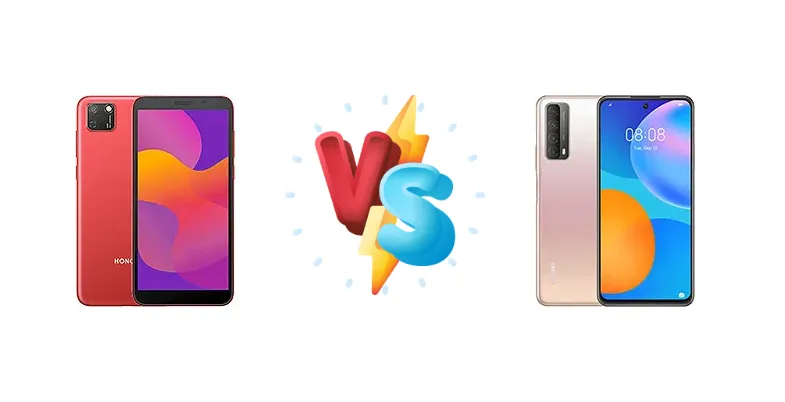
The Honor 9S and Huawei P smart 2021 represent compelling options in the ultra-budget smartphone segment. Both devices aim to deliver essential smartphone functionality at a low price point, but they achieve this with different approaches to chipset design and feature sets. This comparison dives deep into the specifications to determine which phone offers the best value for your money.
🏆 Quick Verdict
For the average user prioritizing overall responsiveness and a slightly more modern chipset architecture, the Huawei P smart 2021 emerges as the better choice. Its Kirin 710A, featuring Cortex-A73 cores, provides a noticeable performance edge over the Honor 9S’s Helio P22, despite both being fabricated on older process nodes.
| Network |
|---|
| 2G bands | GSM 850 / 900 / 1800 / 1900 | GSM 900 / 1800 / 1900 |
| 3G bands | HSDPA 850 / 900 / 1900 / 2100 | HSDPA 850 / 900 / 1700(AWS) / 1900 / 2100 |
| 4G bands | 1, 2, 3, 4, 5, 7, 8, 20, 28, 38, 40, 41 | 1, 3, 5, 7, 8, 20, 28, 38, 40, 41 |
| Speed | HSPA, LTE | HSPA, LTE |
| Technology | GSM / HSPA / LTE | GSM / HSPA / LTE |
| Launch |
|---|
| Announced | 2020, April 29. Released 2020, May 04 | 2020, September 28. Released 2020, September 28 |
| Status | Discontinued | Discontinued |
| Body |
|---|
| Dimensions | 146.5 x 70.9 x 8.4 mm (5.77 x 2.79 x 0.33 in) | 165.7 x 76.9 x 9.3 mm (6.52 x 3.03 x 0.37 in) |
| SIM | Nano-SIM + Nano-SIM | Nano-SIM + Nano-SIM |
| Weight | 144 g (5.08 oz) | 206 g (7.27 oz) |
| Display |
|---|
| Resolution | 720 x 1440 pixels, 18:9 ratio (~295 ppi density) | 1080 x 2400 pixels, 20:9 ratio (~395 ppi density) |
| Size | 5.45 inches, 76.7 cm2 (~73.8% screen-to-body ratio) | 6.67 inches, 107.4 cm2 (~84.3% screen-to-body ratio) |
| Type | IPS LCD | IPS LCD |
| Platform |
|---|
| CPU | Octa-core (4x2.0 GHz Cortex-A53 & 4x1.5 GHz Cortex-A53) | Octa-core (4x2.0 GHz Cortex-A73 & 4x1.7 GHz Cortex-A53) |
| Chipset | Mediatek MT6762R Helio P22 (12 nm) | Kirin 710A (14 nm) |
| GPU | PowerVR GE8320 | Mali-G51 MP4 |
| OS | Android 10, Magic UI 3.1, no Google Play Services | Android 10, EMUI 10.1, no Google Play Services |
| Memory |
|---|
| Card slot | microSDXC (dedicated slot) | microSDXC (dedicated slot) |
| Internal | 32GB 2GB RAM | 64GB 4GB RAM, 128GB 4GB RAM |
| | eMMC 5.1 | - |
| Main Camera |
|---|
| Features | LED flash, HDR, panorama | LED flash, HDR, panorama |
| Quad | - | 48 MP, f/1.8, 26mm (wide), 1/2.0", 0.8µm, PDAF
8 MP, f/2.4, 120˚ (ultrawide), 1/4.0", 1.12µm
2 MP (macro)
Auxiliary lens |
| Single | 8 MP, f/2.0, (wide), AF | - |
| Video | 1080p@30fps | 1080p@30/60fps |
| Selfie camera |
|---|
| Features | - | HDR |
| Single | 5 MP, f/2.2 | 8 MP, f/2.0, (wide) |
| Video | 1080p@30fps | 1080p@30fps |
| Sound |
|---|
| 3.5mm jack | Yes | Yes |
| 35mm jack | Yes | Yes |
| Loudspeaker | Yes | Yes |
| Comms |
|---|
| Bluetooth | 5.0, A2DP, LE | 5.1, A2DP, LE |
| NFC | No | No |
| Positioning | GPS, GLONASS, BDS | GPS, GLONASS, BDS |
| Radio | FM radio | FM radio, built-in antenna |
| USB | microUSB 2.0 | USB Type-C 2.0, OTG |
| WLAN | Wi-Fi 802.11 b/g/n, Wi-Fi Direct | Wi-Fi 802.11 b/g/n, Wi-Fi Direct |
| Features |
|---|
| Sensors | Accelerometer, proximity | Fingerprint (side-mounted), accelerometer, proximity, compass |
| Battery |
|---|
| Charging | - | 22.5W wired, 46% in 30 min |
| Type | Li-Po 3020 mAh | Li-Po 5000 mAh |
| Misc |
|---|
| Colors | Black, Blue, Red | Crush Green, Blush Gold, Midnight Black |
| Models | DUA-LX9 | PPA-LX1, PPA-LX2 |
| Price | About 90 EUR | About 230 EUR |
| Tests |
|---|
| Battery life | - | Endurance rating 119h |
| Camera | - |
Photo / Video |
| Display | - |
Contrast ratio: 1252:1 (nominal) |
| Loudspeaker | - |
-28.8 LUFS (Average) |
| Performance | - |
AnTuTu: 169253 (v8)
GeekBench: 1334 (v5.1)
GFXBench: 7fps (ES 3.1 onscreen) |
Honor 9S
- Potentially lower price point.
- Functional for basic smartphone tasks.
- May have longer software support due to Honor's independence.
- Older, less efficient CPU architecture.
- Slower overall performance.
- Likely slower charging speeds.
Huawei P smart 2021
- More powerful Kirin 710A chipset.
- Faster 22.5W charging.
- Potentially better camera image processing.
- May be slightly more expensive.
- Huawei's software situation (potential limitations).
- No detailed display specifications.
Display Comparison
Both phones lack detailed display specifications beyond the Huawei P smart 2021’s measured 442 nits of peak brightness and 1252:1 contrast ratio. While the Honor 9S’s display details are absent, the Huawei’s brightness suggests adequate visibility indoors, but potential struggles in direct sunlight. The identical contrast ratios suggest similar panel technology, likely IPS LCD, and neither device is expected to offer vibrant colors or wide viewing angles. The absence of high refresh rate support on either device is standard for this price bracket.
Camera Comparison
Both devices are listed with 'Photo / Video' capabilities, offering minimal insight into camera performance. Without sensor size, aperture, or image processing details, a direct comparison is difficult. However, given the price point, expectations should be tempered. The absence of any mention of OIS or advanced features suggests both cameras will struggle in low-light conditions. Focusing on the chipset, the Kirin 710A’s ISP (Image Signal Processor) is likely more capable than the Helio P22’s, potentially leading to better image quality and faster processing times, but this is speculative without further data.
Performance
The core difference lies in the chipsets. The Huawei P smart 2021’s Kirin 710A (14nm) utilizes a more modern CPU architecture with four Cortex-A73 cores clocked at 2.0 GHz, paired with four Cortex-A53 cores at 1.7 GHz. This contrasts with the Honor 9S’s Mediatek MT6762R Helio P22 (12nm) which employs only Cortex-A53 cores – four at 2.0 GHz and four at 1.5 GHz. The A73 cores in the Kirin 710A offer significantly improved single-core performance, translating to snappier app launches and smoother multitasking. While the Helio P22’s 12nm process is theoretically more efficient, the architectural advantage of the Kirin 710A likely outweighs this benefit in real-world usage.
Battery Life
Both the Honor 9S and Huawei P smart 2021 achieve an endurance rating of 119 hours, indicating similar battery life under comparable usage scenarios. However, the Huawei P smart 2021 boasts 22.5W wired charging, capable of reaching 46% charge in just 30 minutes. The Honor 9S’s charging speed is not specified, suggesting a slower charging experience. This faster charging capability provides a significant convenience factor for users who need to quickly top up their battery.
Buying Guide
Buy the Honor 9S if you need a basic, functional smartphone for essential tasks like calls, messaging, and light web browsing, and are operating on an extremely tight budget. Buy the Huawei P smart 2021 if you prefer a smoother user experience, faster app loading times, and the convenience of 22.5W fast charging, even if it means spending a little more upfront.
Frequently Asked Questions
❓ Does the Kirin 710A in the Huawei P smart 2021 struggle with demanding games like PUBG Mobile?
While the Kirin 710A isn't a gaming powerhouse, it's capable of running PUBG Mobile at medium settings with reasonable frame rates. Expect some occasional stuttering and frame drops, especially in intense firefights. The Honor 9S’s Helio P22 will likely offer a less smooth gaming experience.
❓ What is the software experience like on the Huawei P smart 2021, given the ongoing restrictions?
The Huawei P smart 2021 ships with EMUI based on Android, but it lacks Google Mobile Services (GMS). This means no pre-installed Google apps like Gmail, YouTube, or the Play Store. Huawei’s AppGallery is available, but the app selection is limited. Users can sideload apps, but this requires technical knowledge and carries security risks.
❓ Is the lack of detailed display specs a major concern for everyday use?
For typical usage like browsing, social media, and video streaming, the lack of detailed display specs isn't a dealbreaker. However, users who prioritize color accuracy or viewing angles may find both displays underwhelming. The 442 nits peak brightness of the Huawei P smart 2021 is adequate for indoor use, but may struggle in direct sunlight.