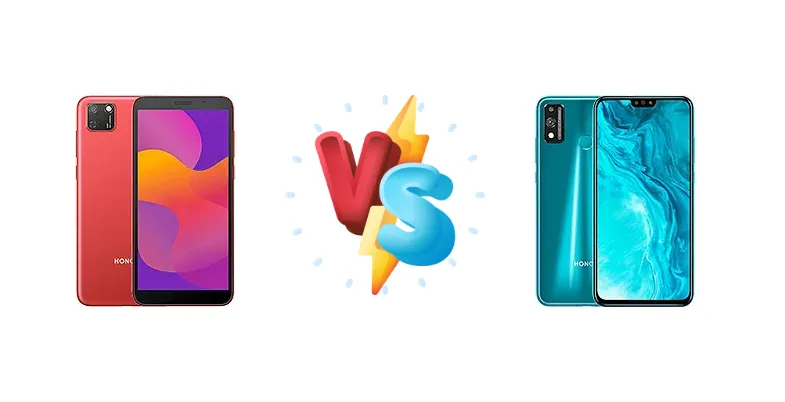
The Honor 9S and 9X Lite represent Honor's commitment to delivering affordable smartphones. While both aim for the budget-conscious consumer, they diverge significantly in their core processing power. This comparison dissects the key differences between the Mediatek Helio P22-powered 9S and the Kirin 710F-equipped 9X Lite, helping you determine which device offers the best value for your needs.
🏆 Quick Verdict
For most users, the Honor 9X Lite is the superior choice. Its Kirin 710F chipset delivers a noticeable performance boost over the Helio P22 in the 9S, making it better suited for multitasking, moderate gaming, and a smoother overall user experience. While the 9S is cheaper, the performance trade-off is substantial.
| Network |
|---|
| 2G bands | GSM 850 / 900 / 1800 / 1900 | GSM 850 / 900 / 1800 / 1900 |
| 3G bands | HSDPA 850 / 900 / 1900 / 2100 | HSDPA 850 / 900 / 1900 / 2100 |
| 4G bands | 1, 2, 3, 4, 5, 7, 8, 20, 28, 38, 40, 41 | 1, 3, 7, 8, 20 |
| Speed | HSPA, LTE | HSPA 42.2/5.76 Mbps, LTE (2CA) Cat6 300/50 Mbps |
| Technology | GSM / HSPA / LTE | GSM / HSPA / LTE |
| Launch |
|---|
| Announced | 2020, April 29. Released 2020, May 04 | 2020, April 17. Released 2020, May 14 |
| Status | Discontinued | Discontinued |
| Body |
|---|
| Dimensions | 146.5 x 70.9 x 8.4 mm (5.77 x 2.79 x 0.33 in) | 160.4 x 76.6 x 7.8 mm (6.31 x 3.02 x 0.31 in) |
| SIM | Nano-SIM + Nano-SIM | Nano-SIM + Nano-SIM |
| Weight | 144 g (5.08 oz) | 188 g (6.63 oz) |
| Display |
|---|
| Resolution | 720 x 1440 pixels, 18:9 ratio (~295 ppi density) | 1080 x 2340 pixels, 19.5:9 ratio (~397 ppi density) |
| Size | 5.45 inches, 76.7 cm2 (~73.8% screen-to-body ratio) | 6.5 inches, 103.2 cm2 (~84.0% screen-to-body ratio) |
| Type | IPS LCD | IPS LCD |
| Platform |
|---|
| CPU | Octa-core (4x2.0 GHz Cortex-A53 & 4x1.5 GHz Cortex-A53) | Octa-core (4x2.2 GHz Cortex-A73 & 4x1.7 GHz Cortex-A53) |
| Chipset | Mediatek MT6762R Helio P22 (12 nm) | Kirin 710F (12 nm) |
| GPU | PowerVR GE8320 | Mali-G51 MP4 |
| OS | Android 10, Magic UI 3.1, no Google Play Services | Android 9.0 (Pie), EMUI 9.1, Google Play Services |
| Memory |
|---|
| Card slot | microSDXC (dedicated slot) | microSDXC (dedicated slot) |
| Internal | 32GB 2GB RAM | 128GB 4GB RAM |
| | eMMC 5.1 | - |
| Main Camera |
|---|
| Dual | - | 48 MP, f/1.8, (wide), 1/2.0", 0.8µm, PDAF
Auxiliary lens |
| Features | LED flash, HDR, panorama | LED flash, HDR, panorama |
| Single | 8 MP, f/2.0, (wide), AF | - |
| Video | 1080p@30fps | 1080p@30fps |
| Selfie camera |
|---|
| Single | 5 MP, f/2.2 | 8 MP, f/2.0, (wide) |
| Video | 1080p@30fps | 1080p@30fps |
| Sound |
|---|
| 3.5mm jack | Yes | Yes |
| 35mm jack | Yes | Yes |
| Loudspeaker | Yes | Yes |
| Comms |
|---|
| Bluetooth | 5.0, A2DP, LE | 4.2, A2DP, LE |
| NFC | No | Yes (market/region dependent) |
| Positioning | GPS, GLONASS, BDS | GPS, GLONASS, BDS |
| Radio | FM radio | FM radio |
| USB | microUSB 2.0 | microUSB 2.0 |
| WLAN | Wi-Fi 802.11 b/g/n, Wi-Fi Direct | Wi-Fi 802.11 a/b/g/n/ac, dual-band, Wi-Fi Direct |
| Features |
|---|
| Sensors | Accelerometer, proximity | Fingerprint (rear-mounted), accelerometer, proximity, compass |
| Battery |
|---|
| Charging | - | 10W wired |
| Type | Li-Po 3020 mAh | Li-Po 3750 mAh |
| Misc |
|---|
| Colors | Black, Blue, Red | Emerald Green, Midnight Black |
| Models | DUA-LX9 | JSN-L21, JSN-L22, JSN-L23 |
| Price | About 90 EUR | About 220 EUR |
Honor 9S
- Lower price point makes it highly accessible.
- Sufficient for basic smartphone tasks.
- Likely lighter and more compact due to less powerful components.
- Noticeably slower performance compared to the 9X Lite.
- Struggles with multitasking and demanding apps.
- Less capable camera system.
Honor 9X Lite
- Significantly faster performance thanks to the Kirin 710F.
- Smoother user experience and better multitasking.
- More capable camera with improved image processing.
- Slightly higher price.
- 10W charging is relatively slow.
- May have slightly shorter battery life under heavy load.
Display Comparison
Neither Honor explicitly details display specs beyond size and resolution. However, given their market positioning, both likely utilize IPS LCD panels. The real difference lies in the processing power driving the display; the 9X Lite’s Kirin 710F will provide smoother animations and faster app loading, indirectly improving the perceived display experience. Expect similar color accuracy and viewing angles on both devices, but the 9X Lite will feel more fluid.
Camera Comparison
Without detailed camera specifications, a direct comparison is difficult. Both phones likely feature a primary camera and depth sensor, but the image quality will be heavily influenced by the ISP (Image Signal Processor) within each chipset. The Kirin 710F’s ISP is more advanced than the Helio P22’s, enabling better noise reduction, dynamic range, and overall image processing. While the megapixel count may be similar, the 9X Lite will likely produce more detailed and visually appealing photos, especially in challenging lighting conditions. Any 2MP macro or depth sensors on either device should be considered supplementary features, offering limited practical benefit.
Performance
The core distinction between these phones is the chipset. The Honor 9S utilizes the Mediatek MT6762R Helio P22, an octa-core processor with a split core configuration of 4x2.0 GHz Cortex-A53 and 4x1.5 GHz Cortex-A53. The Honor 9X Lite, however, boasts the Kirin 710F, also an octa-core chip, but with a more powerful configuration of 4x2.2 GHz Cortex-A73 and 4x1.7 GHz Cortex-A53 cores. The Cortex-A73 cores in the 9X Lite represent a significant architectural improvement over the A53 cores in the 9S, resulting in substantially better single-core and multi-core performance. This translates to faster app launches, smoother multitasking, and a more responsive user interface. While both are 12nm chips, the Kirin 710F’s superior core design provides a clear advantage.
Battery Life
Battery capacity isn't specified, but both phones likely feature batteries in the 3000-4000 mAh range, typical for this price segment. The Honor 9X Lite includes 10W wired charging, a relatively slow charging speed by today’s standards. The 9S’s charging speed is not specified, but is likely similar. The Kirin 710F’s improved power efficiency may partially offset the slower charging, potentially resulting in comparable real-world battery life despite the performance difference. However, users prioritizing quick top-ups will find the 10W charging on the 9X Lite limiting.
Buying Guide
Buy the Honor 9S if you prioritize absolute affordability and only need a phone for basic tasks like calls, texts, and light social media browsing. Its Helio P22 chipset is sufficient for these simple workloads. Buy the Honor 9X Lite if you value a more responsive user experience, enjoy occasional gaming, or frequently switch between apps. The Kirin 710F provides a significant performance uplift that justifies the slightly higher price.
Frequently Asked Questions
❓ Will the Kirin 710F in the Honor 9X Lite handle popular games like PUBG Mobile?
The Kirin 710F is capable of running PUBG Mobile, but likely at medium graphics settings and frame rates. Expect playable performance, but don't anticipate a high-end gaming experience. The Helio P22 in the 9S will struggle significantly with PUBG Mobile, even at the lowest settings.
❓ Is the difference in performance between the Helio P22 and Kirin 710F noticeable in everyday use?
Yes, the difference is quite noticeable. The Kirin 710F provides a much smoother and more responsive experience when navigating the user interface, opening apps, and multitasking. The Helio P22 can feel sluggish, especially when running multiple apps simultaneously.
❓ Does the Honor 9X Lite support fast charging beyond the 10W standard?
No, the Honor 9X Lite is officially rated for 10W wired charging. While it might be possible to use a charger with a higher wattage, the phone will likely only draw 10W due to its internal limitations.