
Xiaomi Redmi Note 9T vs. Honor 9C: A Detailed Comparison of Budget Champions
| Phones Images | |||||
|---|---|---|---|---|---|
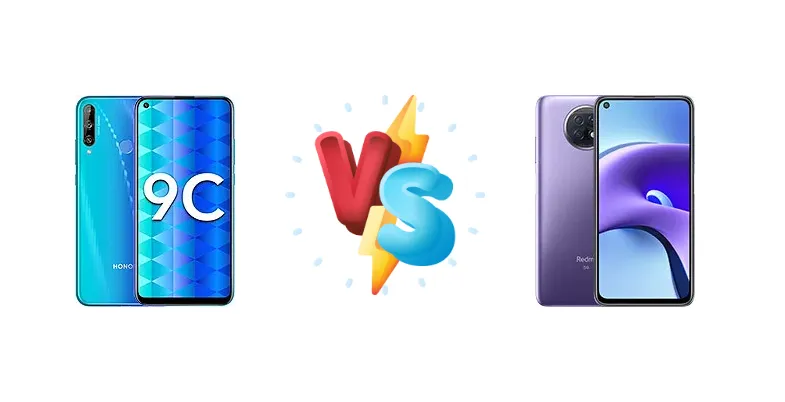
|
🏆 Quick Verdict
For most users, the Xiaomi Redmi Note 9T emerges as the stronger choice. Its Dimensity 800U chipset provides a significant performance advantage, particularly in gaming and demanding applications, offsetting the identical battery endurance rating. While the Honor 9C offers a respectable experience, the Note 9T’s superior processing power makes it the more future-proof option.
| PHONES | ||
|---|---|---|
| Phone Names | Honor 9C | Xiaomi Redmi Note 9T |
| Network | ||
|---|---|---|
| 2G bands | GSM 850 / 900 / 1800 / 1900 | GSM 850 / 900 / 1800 / 1900 |
| 3G bands | HSDPA 850 / 900 / 1900 / 2100 | HSDPA 850 / 900 / 1700(AWS) / 1900 / 2100 |
| 4G bands | 1, 2, 3, 4, 5, 7, 8, 20, 34, 38, 39, 40, 41 | 1, 2, 3, 4, 5, 7, 8, 12, 17, 18, 19, 20, 26, 28, 32, 38, 40, 41, 42 |
| 5G bands | - | 1, 3, 5, 7, 8, 20, 28, 38, 41, 77, 78, 79 SA/NSA/Sub6 |
| Speed | HSPA, LTE | HSPA, LTE, 5G |
| Technology | GSM / HSPA / LTE | GSM / HSPA / LTE / 5G |
| Launch | ||
|---|---|---|
| Announced | 2020, April 29. Released 2020, May 04 | 2021, January 08 |
| Status | Discontinued | Available. Released 2021, January 18 |
| Body | ||
|---|---|---|
| Build | - | Glass front (Gorilla Glass 5), plastic back, plastic frame |
| Dimensions | 159.8 x 76.1 x 8.1 mm (6.29 x 3.00 x 0.32 in) | 161.2 x 77.3 x 9.1 mm (6.35 x 3.04 x 0.36 in) |
| SIM | Nano-SIM + Nano-SIM | Nano-SIM + Nano-SIM |
| Weight | 176 g (6.21 oz) | 199 g (7.02 oz) |
| - | Water-repellent coating | |
| Display | ||
|---|---|---|
| Protection | - | Corning Gorilla Glass 5 |
| Resolution | 720 x 1560 pixels, 19.5:9 ratio (~269 ppi density) | 1080 x 2340 pixels, 19.5:9 ratio (~395 ppi density) |
| Size | 6.39 inches, 100.2 cm2 (~82.4% screen-to-body ratio) | 6.53 inches, 104.7 cm2 (~84.0% screen-to-body ratio) |
| Type | IPS LCD | IPS LCD, 450 nits (typ) |
| Platform | ||
|---|---|---|
| CPU | Octa-core (4x2.2 GHz Cortex-A73 & 4x1.7 GHz Cortex-A53) | Octa-core (2x2.4 GHz Cortex-A76 & 6x2.0 GHz Cortex-A55) |
| Chipset | Kirin 710A (14 nm) | Mediatek Dimensity 800U (7 nm) |
| GPU | Mali-G51 MP4 | Mali-G57 MC3 |
| OS | Android 10, EMUI 10.1, no Google Play Services | Android 10, MIUI 12 |
| Memory | ||
|---|---|---|
| Card slot | microSDXC (dedicated slot) | microSDXC (dedicated slot) |
| Internal | 64GB 4GB RAM | 64GB 4GB RAM, 128GB 4GB RAM, 128GB 6GB RAM |
| eMMC 5.1 | UFS 2.1 - 64GB UFS 2.2 - 128GB | |
| Main Camera | ||
|---|---|---|
| Features | LED flash, HDR, panorama | LED flash, HDR, panorama |
| Triple | 48 MP, f/1.8, (wide), 1/2.0", 0.8µm, PDAF 8 MP, f/2.4, 120˚ (ultrawide) Auxiliary lens | 48 MP, f/1.8, 26mm (wide), 1/2.0", 0.8µm, PDAF 2 MP (macro) Auxiliary lens |
| Video | 1080p@30fps | 4K@30fps, 1080p@30/60fps |
| Selfie camera | ||
|---|---|---|
| Features | HDR | - |
| Single | 8 MP, f/2.0, (wide) | 13 MP, f/2.3, 29mm (standard), 1/3.1", 1.12µm |
| Video | 1080p@30fps | 1080p@30fps |
| Sound | ||
|---|---|---|
| 3.5mm jack | Yes | Yes |
| 35mm jack | Yes | Yes |
| Loudspeaker | Yes | Yes, with stereo speakers |
| - | 24-bit/192kHz audio | |
| Comms | ||
|---|---|---|
| Bluetooth | 5.0, A2DP, LE | 5.1, A2DP, LE |
| Infrared port | - | Yes |
| NFC | No | Yes |
| Positioning | GPS, GLONASS, BDS | GPS, GLONASS, GALILEO, BDS |
| Radio | No | FM radio, recording |
| USB | microUSB 2.0 | USB Type-C 2.0 |
| WLAN | Wi-Fi 802.11 b/g/n, Wi-Fi Direct | Wi-Fi 802.11 a/b/g/n/ac, dual-band, Wi-Fi Direct |
| Features | ||
|---|---|---|
| Sensors | Fingerprint (rear-mounted), accelerometer, proximity, compass | Fingerprint (side-mounted), accelerometer, gyro, proximity, compass |
| Battery | ||
|---|---|---|
| Charging | - | 18W wired, 33% in 30 min |
| Type | Li-Po 4000 mAh | Li-Po 5000 mAh |
| Misc | ||
|---|---|---|
| Colors | Black, Blue | Nightfall Black, Daybreak Purple |
| Models | AKA-L29 | M2007J22G, J22 |
| Price | About 160 EUR | About 130 EUR |
| SAR | - | 1.07 W/kg (head) 1.05 W/kg (body) |
| SAR EU | - | 0.59 W/kg (head) 0.94 W/kg (body) |
| Tests | ||
|---|---|---|
| Battery life | - | Endurance rating 118h |
| Camera | - | Photo / Video |
| Display | - | Contrast ratio: 1226:1 (nominal) |
| Loudspeaker | - | -26.3 LUFS (Good) |
| Performance | - | AnTuTu: 288732 (v8) GeekBench: 1775 (v5.1) |
Honor 9C
- Potentially better efficiency due to Kirin 710A's architecture.
- Competitive price point.
- Solid endurance rating of 118 hours.
- Significantly weaker processor compared to the Dimensity 800U.
- Lack of detailed specifications hinders a full assessment.
- Charging speed likely slower than the Redmi Note 9T.
Xiaomi Redmi Note 9T
- Powerful MediaTek Dimensity 800U chipset for superior performance.
- Faster 18W charging with 33% charge in 30 minutes.
- 5G connectivity (implied by Dimensity 800U).
- Similar battery endurance to the Honor 9C despite more powerful chipset.
- Camera specifications are unknown.
- May be slightly more expensive than the Honor 9C.
Display Comparison
Both the Honor 9C and Redmi Note 9T feature displays with a 1226:1 contrast ratio, suggesting similar visual fidelity in terms of dynamic range. However, the Redmi Note 9T boasts a measured peak brightness of 471 nits, which will translate to better visibility in direct sunlight compared to the Honor 9C, whose brightness is not specified. The lack of information regarding panel technology (IPS, AMOLED) for the Honor 9C makes a direct comparison difficult, but given the price point, both are likely utilizing IPS LCDs. Bezels are not specified for either device, but the overall user experience will likely be similar in terms of screen real estate.
Camera Comparison
Both devices are listed as having Photo/Video capabilities, but specific details are lacking. Without sensor size, aperture, or image processing details, a meaningful comparison is impossible. It’s reasonable to assume both phones will offer adequate performance in good lighting conditions, but low-light photography will likely be a weak point for both. The absence of information regarding Optical Image Stabilization (OIS) suggests neither device features this technology, further limiting low-light performance. Ignoring the likely low-resolution macro lenses common in this price bracket, the primary camera performance will be dictated by the sensor and image processing, which remain unknown.
Performance
The core difference between these two phones lies in their chipsets. The Xiaomi Redmi Note 9T’s MediaTek Dimensity 800U, built on a 7nm process, offers a substantial advantage over the Honor 9C’s Kirin 710A (14nm). The Dimensity 800U’s octa-core configuration, featuring 2x2.4 GHz Cortex-A76 cores and 6x2.0 GHz Cortex-A55 cores, delivers significantly higher peak performance than the Kirin 710A’s 4x2.2 GHz Cortex-A73 and 4x1.7 GHz Cortex-A53 setup. This translates to faster app loading times, smoother multitasking, and a more enjoyable gaming experience on the Redmi Note 9T. The 7nm process also contributes to better thermal efficiency, reducing the likelihood of throttling during sustained workloads.
Battery Life
Both the Honor 9C and Xiaomi Redmi Note 9T achieve an endurance rating of 118 hours, indicating comparable battery life under similar usage conditions. However, the Redmi Note 9T offers 18W wired charging, capable of delivering a 33% charge in 30 minutes. The Honor 9C’s charging speed is not specified, suggesting it’s likely slower. While the overall battery life is similar, the Redmi Note 9T’s faster charging capability provides a convenience advantage, allowing users to quickly top up their battery when needed.
Buying Guide
Buy the Honor 9C if you prioritize a consistently smooth, if less powerful, experience for everyday tasks like browsing, social media, and light communication. It’s a solid choice for users who value efficiency and aren’t demanding gamers. Buy the Xiaomi Redmi Note 9T if you want a phone capable of handling more intensive tasks, including mobile gaming and video editing, and appreciate the benefits of 5G connectivity. It’s ideal for users who want a phone that can keep up with their evolving needs.