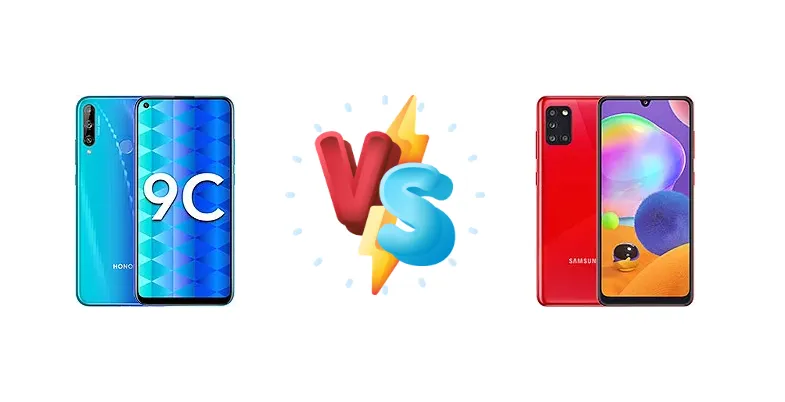
The Honor 9C and Samsung Galaxy A31 represent compelling options in the crowded budget smartphone market. Both aim to deliver essential features at an accessible price point, but they take different approaches to achieving this. This comparison dives deep into their specifications, performance, and features to determine which device offers the best value for your money.
🏆 Quick Verdict
For most users, the Samsung Galaxy A31 emerges as the slightly better choice. While the Honor 9C offers a respectable processor, the A31’s brighter display and comparable battery life, coupled with Samsung’s established software ecosystem, provide a more polished overall experience.
| Network |
|---|
| 2G bands | GSM 850 / 900 / 1800 / 1900 | GSM 850 / 900 / 1800 / 1900 |
| 3G bands | HSDPA 850 / 900 / 1900 / 2100 | HSDPA 850 / 900 / 1900 / 2100 - SM-A315F |
| 4G bands | 1, 2, 3, 4, 5, 7, 8, 20, 34, 38, 39, 40, 41 | 1, 2, 3, 5, 7, 8, 20, 38, 40, 41 - SM-A315F |
| Speed | HSPA, LTE | HSPA, LTE |
| Technology | GSM / HSPA / LTE | GSM / HSPA / LTE |
| Launch |
|---|
| Announced | 2020, April 29. Released 2020, May 04 | 2020, March 24. Released 2020, April 27 |
| Status | Discontinued | Discontinued |
| Body |
|---|
| Dimensions | 159.8 x 76.1 x 8.1 mm (6.29 x 3.00 x 0.32 in) | 159.3 x 73.1 x 8.6 mm (6.27 x 2.88 x 0.34 in) |
| SIM | Nano-SIM + Nano-SIM | · Nano-SIM· Nano-SIM + Nano-SIM |
| Weight | 176 g (6.21 oz) | 185 g (6.53 oz) |
| Display |
|---|
| Resolution | 720 x 1560 pixels, 19.5:9 ratio (~269 ppi density) | 1080 x 2400 pixels, 20:9 ratio (~411 ppi density) |
| Size | 6.39 inches, 100.2 cm2 (~82.4% screen-to-body ratio) | 6.4 inches, 98.9 cm2 (~84.9% screen-to-body ratio) |
| Type | IPS LCD | Super AMOLED |
| Platform |
|---|
| CPU | Octa-core (4x2.2 GHz Cortex-A73 & 4x1.7 GHz Cortex-A53) | Octa-core (2x2.0 GHz Cortex-A75 & 6x1.7 GHz Cortex-A55) |
| Chipset | Kirin 710A (14 nm) | Mediatek MT6768 Helio P65 (12 nm) |
| GPU | Mali-G51 MP4 | Mali-G52 MC2 |
| OS | Android 10, EMUI 10.1, no Google Play Services | Android 10, upgradable to Android 12, One UI 4.1 |
| Memory |
|---|
| Card slot | microSDXC (dedicated slot) | microSDXC (dedicated slot) |
| Internal | 64GB 4GB RAM | 64GB 4GB RAM, 128GB 4GB RAM, 128GB 6GB RAM, 128GB 8GB RAM |
| | eMMC 5.1 | - |
| Main Camera |
|---|
| Features | LED flash, HDR, panorama | LED flash, panorama, HDR |
| Quad | - | 48 MP, f/2.0, 26mm (wide), 1/2.0", 0.8µm, PDAF
8 MP, f/2.2, 123˚, (ultrawide), 1/4.0", 1.12µm
5 MP (macro)
Auxiliary lens |
| Triple | 48 MP, f/1.8, (wide), 1/2.0", 0.8µm, PDAF
8 MP, f/2.4, 120˚ (ultrawide)
Auxiliary lens | - |
| Video | 1080p@30fps | 1080p@30fps |
| Selfie camera |
|---|
| Features | HDR | - |
| Single | 8 MP, f/2.0, (wide) | 20 MP, f/2.2, (wide) |
| Video | 1080p@30fps | 1080p@30fps |
| Sound |
|---|
| 3.5mm jack | Yes | Yes |
| 35mm jack | Yes | Yes |
| Loudspeaker | Yes | Yes |
| Comms |
|---|
| Bluetooth | 5.0, A2DP, LE | 5.0, A2DP, LE |
| NFC | No | Yes (market/region dependent) |
| Positioning | GPS, GLONASS, BDS | GPS, GLONASS, GALILEO, BDS |
| Radio | No | FM radio, RDS, recording |
| USB | microUSB 2.0 | USB Type-C 2.0, OTG |
| WLAN | Wi-Fi 802.11 b/g/n, Wi-Fi Direct | Wi-Fi 802.11 a/b/g/n/ac, dual-band, Wi-Fi Direct |
| Features |
|---|
| Sensors | Fingerprint (rear-mounted), accelerometer, proximity, compass | Fingerprint (under display, optical), accelerometer, gyro, compass |
| Battery |
|---|
| Charging | - | 15W wired |
| Type | Li-Po 4000 mAh | Li-Po 5000 mAh |
| Misc |
|---|
| Colors | Black, Blue | Prism Crush Black, Prism Crush Blue, Prism Crush Red, Prism Crush White |
| Models | AKA-L29 | SM-A315F, SM-A315F/DS, SM-A315G/DS, SM-A315G, SM-A315N |
| Price | About 160 EUR | £ 139.00 / € 138.27 |
| SAR EU | - | 0.49 W/kg (head) 1.68 W/kg (body) |
| Tests |
|---|
| Battery life | - | Endurance rating 124h |
| Camera | - |
Photo / Video |
| Display | - |
Contrast ratio: Infinite (nominal) |
| Loudspeaker | - |
-30.9 LUFS (Below average) |
| Performance | - |
AnTuTu: 151815 (v8)
GeekBench: 5096 (v4.4), 1216 (v5.1)
GFXBench: 7fps (ES 3.1 onscreen) |
Honor 9C
- Potentially more modern CPU architecture (Cortex-A73)
- Competitive price point
- Adequate performance for basic tasks
- Less detailed display specifications
- Uncertain camera performance
- EMUI software may not appeal to all users
Samsung Galaxy A31
- Brighter display for better outdoor visibility
- Faster 15W charging
- Established Samsung brand and software ecosystem
- Slightly older CPU architecture (Cortex-A75)
- Potentially less efficient processor (12nm vs 14nm)
- Camera quality relies heavily on software processing
Display Comparison
The Samsung Galaxy A31 boasts a significant advantage in display quality with a measured peak brightness of 635 nits. This translates to better visibility outdoors and in brightly lit environments compared to the Honor 9C, which lacks published brightness data. While the A31’s contrast ratio is listed as ‘Infinite’ (a common marketing term), the higher peak brightness is the more tangible benefit for everyday use. The Honor 9C’s display specifications are less detailed, suggesting a more standard LCD panel that likely won’t match the A31’s vibrancy.
Camera Comparison
Both devices feature 'Photo / Video' capabilities, but lack specific details regarding sensor size or megapixel count in the provided data. This suggests a focus on affordability over cutting-edge camera technology. Without further information, it’s difficult to definitively assess camera quality. However, given Samsung’s generally strong image processing algorithms, the A31 is likely to produce more consistently pleasing images, especially in challenging lighting conditions. The presence of a 2MP macro camera on the A31 is unlikely to significantly impact overall camera performance, serving more as a marketing feature than a practical tool.
Performance
Both phones utilize octa-core processors, but their architectures differ. The Honor 9C’s Kirin 710A (14nm) features Cortex-A73 cores for performance and A53 cores for efficiency. The Samsung Galaxy A31’s MediaTek Helio P65 (12nm) uses Cortex-A75 cores, which generally offer a slight performance edge over the A73, alongside A55 efficiency cores. The 12nm process node of the Helio P65 also contributes to potentially better power efficiency. However, the real-world performance difference will likely be subtle, with both phones handling everyday tasks adequately. The A31’s GPU is also likely to offer a small advantage in graphics-intensive tasks.
Battery Life
Both the Honor 9C and Samsung Galaxy A31 achieve an endurance rating of 124 hours, indicating comparable battery life under similar usage conditions. However, the Samsung Galaxy A31 includes 15W wired charging, which offers a faster charging experience than what is typically found on Honor devices in this price range. While both phones should comfortably last a full day for average users, the A31’s faster charging capability provides a convenience advantage.
Buying Guide
Buy the Honor 9C if you prioritize a slightly more modern CPU architecture and are comfortable with the EMUI software experience. It’s a good fit for users who primarily need a reliable phone for basic tasks and light multitasking. Buy the Samsung Galaxy A31 if you value a brighter, more visible display, a longer-established brand reputation, and a more refined software experience, even if the processor is a generation older.
Frequently Asked Questions
❓ Does the MediaTek Helio P65 in the Galaxy A31 struggle with demanding games like PUBG?
While the Helio P65 isn't a gaming powerhouse, it can handle PUBG Mobile at medium settings with reasonable frame rates. Expect some occasional frame drops during intense action. The Honor 9C’s Kirin 710A will offer similar gaming performance, but neither phone is ideal for hardcore mobile gamers.
❓ Is the 15W charging on the Galaxy A31 significantly faster than what the Honor 9C offers?
Yes, 15W charging is noticeably faster than the typical 10W or 12W charging found on Honor devices in this price range. While not as fast as modern fast-charging standards, it will reduce your 0-100% charging time by a considerable margin.
❓ How does EMUI on the Honor 9C compare to Samsung's One UI in terms of user experience?
Samsung's One UI is generally considered more polished and user-friendly, with a wider range of features and customization options. EMUI, while functional, can sometimes feel cluttered and includes pre-installed bloatware. Preference is subjective, but One UI is often favored for its smoother animations and intuitive interface.