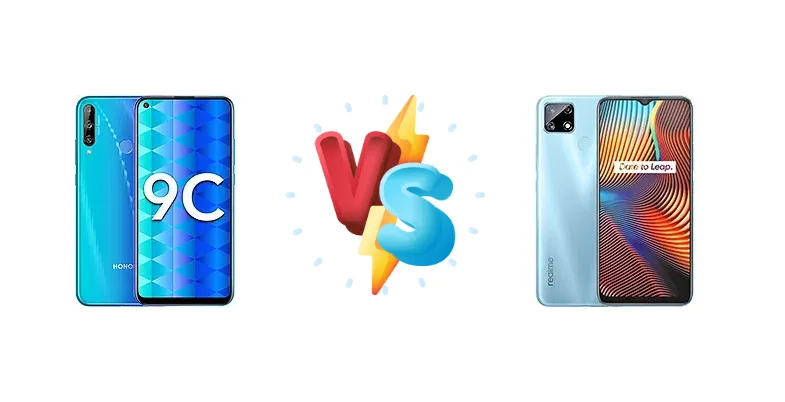
The Honor 9C and Realme 7i represent compelling options in the sub-$200 smartphone market. While both aim to deliver essential features at an accessible price, they diverge significantly in their core hardware, particularly in their chipsets. This comparison dissects these differences to determine which device offers the best value for specific user needs.
🏆 Quick Verdict
For the average user prioritizing overall responsiveness and faster charging, the Realme 7i (Global) is the better choice. Its Helio G85 chipset, built on a more efficient 12nm process, provides a noticeable performance edge, and the 18W charging significantly reduces downtime. However, the Honor 9C remains a viable option for those seeking a slightly different CPU architecture.
| Network |
|---|
| 2G bands | GSM 850 / 900 / 1800 / 1900 | GSM 850 / 900 / 1800 / 1900 |
| 3G bands | HSDPA 850 / 900 / 1900 / 2100 | HSDPA 850 / 900 / 1700(AWS) / 1900 / 2100 |
| 4G bands | 1, 2, 3, 4, 5, 7, 8, 20, 34, 38, 39, 40, 41 | 1, 2, 3, 4, 5, 7, 8, 20, 28, 38, 40, 41 |
| Speed | HSPA, LTE | HSPA, LTE |
| Technology | GSM / HSPA / LTE | GSM / HSPA / LTE |
| Launch |
|---|
| Announced | 2020, April 29. Released 2020, May 04 | 2020, December 22. Released 2020, December 23 |
| Status | Discontinued | Discontinued |
| Body |
|---|
| Dimensions | 159.8 x 76.1 x 8.1 mm (6.29 x 3.00 x 0.32 in) | 164.5 x 75.9 x 9.8 mm (6.48 x 2.99 x 0.39 in) |
| SIM | Nano-SIM + Nano-SIM | Nano-SIM + Nano-SIM |
| Weight | 176 g (6.21 oz) | 208 g (7.34 oz) |
| Display |
|---|
| Resolution | 720 x 1560 pixels, 19.5:9 ratio (~269 ppi density) | 720 x 1600 pixels, 20:9 ratio (~270 ppi density) |
| Size | 6.39 inches, 100.2 cm2 (~82.4% screen-to-body ratio) | 6.5 inches, 102.0 cm2 (~81.7% screen-to-body ratio) |
| Type | IPS LCD | IPS LCD, 450 nits (typ), 560 nits (peak) |
| Platform |
|---|
| CPU | Octa-core (4x2.2 GHz Cortex-A73 & 4x1.7 GHz Cortex-A53) | Octa-core (2x2.0 GHz Cortex-A75 & 6x1.8 GHz Cortex-A55) |
| Chipset | Kirin 710A (14 nm) | Mediatek MT6769Z Helio G85 (12 nm) |
| GPU | Mali-G51 MP4 | Mali-G52 MC2 |
| OS | Android 10, EMUI 10.1, no Google Play Services | Android 10, Realme UI |
| Memory |
|---|
| Card slot | microSDXC (dedicated slot) | microSDXC (dedicated slot) |
| Internal | 64GB 4GB RAM | 64GB 4GB RAM |
| | eMMC 5.1 | eMMC 5.1 |
| Main Camera |
|---|
| Features | LED flash, HDR, panorama | LED flash, HDR, panorama |
| Triple | 48 MP, f/1.8, (wide), 1/2.0", 0.8µm, PDAF
8 MP, f/2.4, 120˚ (ultrawide)
Auxiliary lens | 48 MP, f/1.8, 26mm (wide), 1/2.0", 0.8µm, PDAF
8 MP, f/2.3, 16mm, 119˚ (ultrawide), 1/4.0", 1.12µm
2 MP (macro) |
| Video | 1080p@30fps | 1080p@30/60fps |
| Selfie camera |
|---|
| Features | HDR | HDR, panorama |
| Single | 8 MP, f/2.0, (wide) | 8 MP, f/2.0, 26mm (wide), 1/4.0", 1.12µm |
| Video | 1080p@30fps | 1080p@30fps |
| Sound |
|---|
| 3.5mm jack | Yes | Yes |
| 35mm jack | Yes | Yes |
| Loudspeaker | Yes | Yes |
| Comms |
|---|
| Bluetooth | 5.0, A2DP, LE | 5.0, A2DP, LE, aptX HD |
| NFC | No | No |
| Positioning | GPS, GLONASS, BDS | GPS, GLONASS, BDS |
| Radio | No | FM radio |
| USB | microUSB 2.0 | USB Type-C 2.0, OTG |
| WLAN | Wi-Fi 802.11 b/g/n, Wi-Fi Direct | Wi-Fi 802.11 a/b/g/n/ac, dual-band, Wi-Fi Direct |
| Features |
|---|
| Sensors | Fingerprint (rear-mounted), accelerometer, proximity, compass | Fingerprint (rear-mounted), accelerometer, proximity, compass |
| Battery |
|---|
| Charging | - | 18W wired
5W reverse wired |
| Type | Li-Po 4000 mAh | 6000 mAh |
| Misc |
|---|
| Colors | Black, Blue | Glory Silver, Victory Blue |
| Models | AKA-L29 | - |
| Price | About 160 EUR | About 190 EUR |
Honor 9C
- Potentially different CPU architecture for specific software compatibility.
- May offer a more conservative software experience.
- Solid build quality expected from Honor.
- Older, less efficient Kirin 710A chipset.
- Slower charging speeds.
- Likely less responsive UI.
Realme 7i (Global)
- More powerful and efficient MediaTek Helio G85 chipset.
- Faster 18W wired charging.
- 5W reverse wired charging.
- Improved gaming performance.
- Realme UI can be feature-rich but potentially bloated.
- Build quality may not match Honor's premium feel.
Display Comparison
Neither device boasts a standout display. Both likely feature LCD panels, typical for this price bracket. The absence of detailed display specs necessitates a focus on the chipset's impact on UI smoothness. While both will likely offer 720p+ resolution, the Realme 7i’s more powerful GPU will contribute to a more fluid experience when scrolling and navigating the interface.
Camera Comparison
Without detailed camera specs, a direct comparison is difficult. However, it’s safe to assume both phones feature a primary camera and supporting lenses. The Realme 7i’s chipset likely offers slightly better image signal processing (ISP) capabilities, potentially resulting in more detailed and vibrant photos. The Honor 9C’s ISP, while adequate, is likely less sophisticated. The presence of a dedicated ISP within the Helio G85 allows for faster image processing and potentially better low-light performance. The usefulness of any 2MP macro or depth sensors on either device is questionable.
Performance
The core difference lies in the chipsets. The Realme 7i’s MediaTek Helio G85 (12nm) is a clear step up from the Honor 9C’s Kirin 710A (14nm). The 12nm process node of the Helio G85 translates to improved power efficiency and potentially lower thermal throttling during sustained workloads. While the Kirin 710A utilizes a Cortex-A73 cluster, the Helio G85’s Cortex-A75 cores, though fewer in number (2 vs 4), generally offer higher single-core performance. The Realme 7i’s CPU configuration (2x2.0 GHz Cortex-A75 & 6x1.8 GHz Cortex-A55) is optimized for responsiveness, while the Honor 9C’s (4x2.2 GHz Cortex-A73 & 4x1.7 GHz Cortex-A53) may show its age in multitasking scenarios. The GPU within the Helio G85 will also provide a more capable gaming experience.
Battery Life
The Realme 7i’s 18W wired charging is a significant advantage over the Honor 9C’s presumed standard charging speed (likely 10W). This translates to substantially faster charging times, reducing downtime. While battery capacity isn’t specified, the Helio G85’s improved efficiency could offset a potentially smaller battery size in the Realme 7i, resulting in comparable real-world battery life. The Realme 7i also includes 5W reverse wired charging, a feature absent on the Honor 9C, allowing it to top up other devices.
Buying Guide
Buy the Honor 9C if you prioritize a potentially different CPU architecture and are less concerned with peak performance or fast charging. It's a solid choice for basic tasks and media consumption. Buy the Realme 7i (Global) if you need a phone that feels snappier in everyday use, offers faster charging for minimal downtime, and can handle light gaming without significant throttling. It’s the better all-rounder for most users.
Frequently Asked Questions
❓ Will the Realme 7i’s Helio G85 overheat during prolonged gaming sessions?
The Helio G85 is generally well-managed in terms of thermals. While some heat is expected during extended gaming, the 12nm process node and MediaTek’s thermal management features should prevent significant throttling. Expect playable frame rates, but not necessarily sustained peak performance for very demanding titles.
❓ Is the reverse charging feature on the Realme 7i useful for everyday use?
The 5W reverse charging is primarily a convenience feature. It’s ideal for topping up accessories like wireless earbuds or a smartwatch, but it won’t rapidly charge another phone. It’s a useful addition for emergencies or when access to a wall charger is limited.
❓ How does the Kirin 710A in the Honor 9C handle multitasking compared to the Helio G85?
The Helio G85 in the Realme 7i is expected to handle multitasking more smoothly due to its more modern CPU architecture and higher single-core performance. The Kirin 710A, while capable, may exhibit more lag when switching between multiple apps or running demanding applications simultaneously.