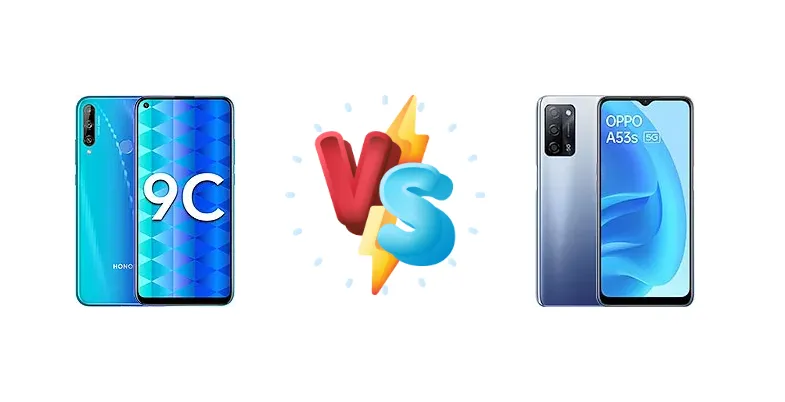
The Honor 9C and Oppo A53s 5G represent two approaches to the budget 5G smartphone market. The Honor 9C, leveraging Huawei’s Kirin chipset, aims for a balance of features at a low price point. The Oppo A53s 5G, powered by MediaTek’s Dimensity 700, prioritizes 5G connectivity and a more modern processor architecture. This comparison will dissect their strengths and weaknesses to determine which device offers the best value.
🏆 Quick Verdict
For the average user prioritizing 5G and future-proofing, the Oppo A53s 5G is the better choice. Its Dimensity 700 chipset, built on a 7nm process, delivers significantly improved performance and efficiency compared to the Honor 9C’s older 14nm Kirin 710A, despite the Honor's potentially more optimized software.
| Network |
|---|
| 2G bands | GSM 850 / 900 / 1800 / 1900 | GSM 850 / 900 / 1800 / 1900 |
| 3G bands | HSDPA 850 / 900 / 1900 / 2100 | HSDPA 800 / 850 / 900 / 2100 |
| 4G bands | 1, 2, 3, 4, 5, 7, 8, 20, 34, 38, 39, 40, 41 | 1, 3, 5, 8, 34, 38, 39, 40, 41 |
| 5G bands | - | 1, 28, 41, 77, 78 SA/NSA |
| Speed | HSPA, LTE | HSPA, LTE, 5G |
| Technology | GSM / HSPA / LTE | GSM / HSPA / LTE / 5G |
| Launch |
|---|
| Announced | 2020, April 29. Released 2020, May 04 | 2021, April 27 |
| Status | Discontinued | Available. Released 2021, May 07 |
| Body |
|---|
| Dimensions | 159.8 x 76.1 x 8.1 mm (6.29 x 3.00 x 0.32 in) | 164 x 75.7 x 8.4 mm (6.46 x 2.98 x 0.33 in) |
| SIM | Nano-SIM + Nano-SIM | Nano-SIM + Nano-SIM |
| Weight | 176 g (6.21 oz) | 189.6 g (6.70 oz) |
| Display |
|---|
| Resolution | 720 x 1560 pixels, 19.5:9 ratio (~269 ppi density) | 720 x 1600 pixels, 20:9 ratio (~269 ppi density) |
| Size | 6.39 inches, 100.2 cm2 (~82.4% screen-to-body ratio) | 6.52 inches, 102.6 cm2 (~82.7% screen-to-body ratio) |
| Type | IPS LCD | IPS LCD, 480 nits (typ) |
| Platform |
|---|
| CPU | Octa-core (4x2.2 GHz Cortex-A73 & 4x1.7 GHz Cortex-A53) | Octa-core (2x2.2 GHz Cortex-A76 & 6x2.0 GHz Cortex-A55) |
| Chipset | Kirin 710A (14 nm) | Mediatek Dimensity 700 (7 nm) |
| GPU | Mali-G51 MP4 | Mali-G57 MC2 |
| OS | Android 10, EMUI 10.1, no Google Play Services | Android 11, ColorOS 11.1 |
| Memory |
|---|
| Card slot | microSDXC (dedicated slot) | microSDXC (dedicated slot) |
| Internal | 64GB 4GB RAM | 128GB 6GB RAM, 128GB 8GB RAM |
| | eMMC 5.1 | UFS 2.2 |
| Main Camera |
|---|
| Features | LED flash, HDR, panorama | LED flash, HDR, panorama |
| Single | - | 8 MP, f/2.0, 26mm (wide) |
| Triple | 48 MP, f/1.8, (wide), 1/2.0", 0.8µm, PDAF
8 MP, f/2.4, 120˚ (ultrawide)
Auxiliary lens | 13 MP, f/2.2, 25mm (wide), 1/3.06", 1.12µm, PDAF
2 MP (macro)
Auxiliary lens |
| Video | 1080p@30fps | 1080p@30fps |
| Selfie camera |
|---|
| Features | HDR | HDR |
| Single | 8 MP, f/2.0, (wide) | 8 MP, f/2.0, 26mm (wide) |
| Video | 1080p@30fps | 1080p@30fps |
| Sound |
|---|
| 3.5mm jack | Yes | Yes |
| 35mm jack | Yes | Yes |
| Loudspeaker | Yes | Yes |
| Comms |
|---|
| Bluetooth | 5.0, A2DP, LE | 5.0, A2DP, LE, aptX HD |
| NFC | No | No |
| Positioning | GPS, GLONASS, BDS | GPS, GLONASS, GALILEO, BDS, QZSS |
| Radio | No | No |
| USB | microUSB 2.0 | USB Type-C 2.0, OTG |
| WLAN | Wi-Fi 802.11 b/g/n, Wi-Fi Direct | Wi-Fi 802.11 a/b/g/n/ac, dual-band, Wi-Fi Direct |
| Features |
|---|
| Sensors | Fingerprint (rear-mounted), accelerometer, proximity, compass | Fingerprint (side-mounted), accelerometer, gyro, proximity, compass |
| Battery |
|---|
| Charging | - | 10W wired |
| Type | Li-Po 4000 mAh | Li-Po 5000 mAh |
| Misc |
|---|
| Colors | Black, Blue | Crystal Blue, Ink Black |
| Models | AKA-L29 | CPH2321 |
| Price | About 160 EUR | About 170 EUR |
Honor 9C
- Potentially more refined software experience (depending on Honor's UI)
- Likely lower price point
- May have a slightly larger battery capacity
- Older, less efficient Kirin 710A chipset
- Inferior CPU performance
- Limited 5G capabilities
Oppo A53s 5G
- More powerful and efficient MediaTek Dimensity 700 chipset
- Superior CPU performance for gaming and multitasking
- 5G connectivity for faster data speeds
- Slower 10W charging
- Potentially less optimized software
- May be slightly more expensive
Display Comparison
Neither device boasts a standout display. Both likely utilize LCD panels, common in this price bracket. The Honor 9C’s display specifications are unavailable, but given its market positioning, it likely features a 720p+ resolution. The Oppo A53s 5G also likely features a 720p+ display. The key difference isn’t display quality, but the processor’s ability to drive the UI smoothly. A more powerful chipset, like the Dimensity 700, will result in less stuttering during scrolling and animations.
Camera Comparison
Camera performance is difficult to assess without detailed sensor information. Both phones likely feature a multi-camera setup with a primary sensor and supporting lenses. However, the image signal processor (ISP) within the Dimensity 700 is more advanced, potentially leading to better image processing, especially in low-light conditions. The Honor 9C’s ISP, tied to the older Kirin 710A, will likely struggle to match the Oppo’s capabilities. The presence of 5G on the Oppo also allows for faster cloud uploads of photos and videos.
Performance
The performance gap is the most significant differentiator. The Oppo A53s 5G’s MediaTek Dimensity 700 (7nm) utilizes Cortex-A76 cores, a substantial upgrade over the Honor 9C’s Kirin 710A (14nm) and its Cortex-A73 cores. The 7nm process node of the Dimensity 700 translates to better power efficiency and reduced thermal throttling under sustained load. While both are octa-core CPUs, the A76 cores in the Oppo offer a noticeable performance boost in CPU-intensive tasks and gaming. The Honor 9C will be adequate for basic tasks, but the Oppo A53s 5G will provide a smoother, more responsive experience.
Battery Life
Battery life will depend heavily on usage patterns. While the Honor 9C’s battery capacity is unknown, it’s reasonable to assume it’s around 4000-5000mAh. The Oppo A53s 5G’s battery capacity is also likely in this range. However, the Dimensity 700’s superior power efficiency will likely result in longer battery life for the Oppo, despite the Honor potentially having a slightly larger battery. The Oppo A53s 5G’s 10W charging is significantly slower than what’s becoming standard, meaning longer recharge times.
Buying Guide
Buy the Honor 9C if you need a reliable, basic smartphone for everyday tasks and prioritize a potentially more refined software experience, accepting compromises in processing power and 5G performance. Buy the Oppo A53s 5G if you want a phone capable of handling more demanding apps, smoother multitasking, and benefit from the faster speeds and lower latency of 5G networks, even if it means a slower charging speed.
Frequently Asked Questions
❓ Will the Oppo A53s 5G’s 5G connectivity actually make a difference in my daily use?
5G’s impact depends on your location and carrier coverage. However, even in areas with limited 5G, the Dimensity 700’s modem offers improved 4G LTE performance. More importantly, 5G future-proofs the device, ensuring compatibility with evolving network infrastructure.
❓ Is the Kirin 710A in the Honor 9C still capable of running popular apps like TikTok and Instagram smoothly?
The Kirin 710A can handle basic apps like TikTok and Instagram, but you may experience occasional lag or stuttering, especially when multitasking. The Oppo A53s 5G’s Dimensity 700 will provide a significantly smoother experience with these and other demanding applications.
❓ How long will it take to fully charge the Oppo A53s 5G with its 10W charger?
With a 10W charger, expect the Oppo A53s 5G to take approximately 2.5 to 3.5 hours to fully charge from 0% to 100%. This is considerably slower than phones with 18W or higher fast charging capabilities.