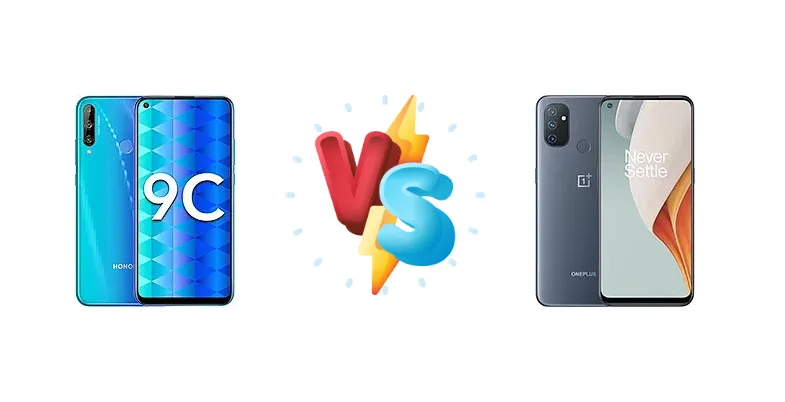
The sub-$150 smartphone market is fiercely competitive. The Honor 9C, powered by the Kirin 710A, and the OnePlus Nord N100, featuring the Snapdragon 460, represent compelling options for budget-conscious buyers. This comparison dissects their key differences, focusing on performance, battery, and overall value to determine which device delivers the best experience.
🏆 Quick Verdict
For the average user prioritizing everyday tasks and occasional gaming, the OnePlus Nord N100 emerges as the slightly better choice. Its newer Snapdragon 460 chipset, built on an 11nm process, offers improved efficiency and 18W fast charging, a feature absent on the Honor 9C, despite the Kirin 710A's slightly higher clock speeds.
| Network |
|---|
| 2G bands | GSM 850 / 900 / 1800 / 1900 | GSM 850 / 900 / 1800 / 1900 |
| 3G bands | HSDPA 850 / 900 / 1900 / 2100 | HSDPA 850 / 900 / 1700(AWS) / 1900 / 2100 |
| 4G bands | 1, 2, 3, 4, 5, 7, 8, 20, 34, 38, 39, 40, 41 | 1, 2, 3, 4, 5, 7, 8, 12, 17, 20, 28, 38, 40, 41 - International |
| Speed | HSPA, LTE | HSPA 42.2/5.76 Mbps, LTE Cat13 400/50 Mbps |
| Technology | GSM / HSPA / LTE | GSM / CDMA / HSPA / LTE |
| | - | 1, 2, 3, 4, 5, 7, 8, 12, 13, 17, 20, 25, 26, 28, 38, 41, 66, 71 - USA |
| Launch |
|---|
| Announced | 2020, April 29. Released 2020, May 04 | 2020, October 26 |
| Status | Discontinued | Available. Released 2020, November 11 |
| Body |
|---|
| Build | - | Glass front (Gorilla Glass 3), plastic frame |
| Dimensions | 159.8 x 76.1 x 8.1 mm (6.29 x 3.00 x 0.32 in) | 164.9 x 75.1 x 8.5 mm (6.49 x 2.96 x 0.33 in) |
| SIM | Nano-SIM + Nano-SIM | Nano-SIM + Nano-SIM |
| Weight | 176 g (6.21 oz) | 188 g (6.63 oz) |
| Display |
|---|
| Protection | - | Corning Gorilla Glass 3 |
| Resolution | 720 x 1560 pixels, 19.5:9 ratio (~269 ppi density) | 720 x 1600 pixels, 20:9 ratio (~269 ppi density) |
| Size | 6.39 inches, 100.2 cm2 (~82.4% screen-to-body ratio) | 6.52 inches, 102.6 cm2 (~82.9% screen-to-body ratio) |
| Type | IPS LCD | IPS LCD, 90Hz |
| Platform |
|---|
| CPU | Octa-core (4x2.2 GHz Cortex-A73 & 4x1.7 GHz Cortex-A53) | Octa-core (4x1.8 GHz Kryo 240 & 4x1.6 GHz Kryo 240) |
| Chipset | Kirin 710A (14 nm) | Qualcomm SM4250 Snapdragon 460 (11 nm) |
| GPU | Mali-G51 MP4 | Adreno 610 |
| OS | Android 10, EMUI 10.1, no Google Play Services | Android 10, OxygenOS 10.5.9 |
| Memory |
|---|
| Card slot | microSDXC (dedicated slot) | microSDXC |
| Internal | 64GB 4GB RAM | 64GB 4GB RAM |
| | eMMC 5.1 | UFS 2.1 |
| Main Camera |
|---|
| Features | LED flash, HDR, panorama | LED flash, HDR, panorama |
| Triple | 48 MP, f/1.8, (wide), 1/2.0", 0.8µm, PDAF
8 MP, f/2.4, 120˚ (ultrawide)
Auxiliary lens | 13 MP, f/2.2, (wide), PDAF
2 MP (macro)
Auxiliary lens |
| Video | 1080p@30fps | 1080p@30fps, gyro-EIS |
| Selfie camera |
|---|
| Features | HDR | HDR |
| Single | 8 MP, f/2.0, (wide) | 8 MP, f/2.0 |
| Video | 1080p@30fps | 1080p@30fps |
| Sound |
|---|
| 3.5mm jack | Yes | Yes |
| 35mm jack | Yes | Yes |
| Loudspeaker | Yes | Yes, with stereo speakers |
| Comms |
|---|
| Bluetooth | 5.0, A2DP, LE | 5.0, A2DP, LE |
| NFC | No | - |
| Positioning | GPS, GLONASS, BDS | GPS, GLONASS, GALILEO, BDS |
| Radio | No | FM radio |
| USB | microUSB 2.0 | USB Type-C 2.0, OTG |
| WLAN | Wi-Fi 802.11 b/g/n, Wi-Fi Direct | Wi-Fi 802.11 a/b/g/n/ac, dual-band, Wi-Fi Direct |
| Features |
|---|
| Sensors | Fingerprint (rear-mounted), accelerometer, proximity, compass | Fingerprint (rear-mounted), accelerometer, gyro, proximity, compass |
| Battery |
|---|
| Charging | - | 18W wired |
| Type | Li-Po 4000 mAh | Li-Po 5000 mAh |
| Misc |
|---|
| Colors | Black, Blue | Midnight Frost |
| Models | AKA-L29 | BE2013, BE2015, BE2011, BE2012 |
| Price | About 160 EUR | About 80 EUR |
| Pricing |
|---|
| 64GB 4GB RAM | - | $ 125.00 |
| RENEWED | - | $ 129.00 |
Honor 9C
- Potentially smoother performance in specific app workloads due to Cortex-A73 cores.
- May offer a slightly lower price point depending on retailer.
- Familiar EMUI interface for existing Huawei/Honor users.
- Lacks fast charging support.
- Older 14nm chipset is less power efficient.
- Limited software update support likely.
OnePlus Nord N100
- 18W fast charging for quicker top-ups.
- More efficient Snapdragon 460 chipset (11nm).
- Larger 5000mAh battery for extended usage.
- Likely better long-term software support from OnePlus.
- Slightly lower CPU clock speeds compared to the Honor 9C.
- May be slightly more expensive depending on retailer.
- OxygenOS, while clean, may not appeal to all users.
Display Comparison
Neither device boasts a standout display. Specifications are unavailable for the Honor 9C's display, but given its price point, it likely features a standard 60Hz LCD panel. The OnePlus Nord N100 also utilizes an LCD, but its focus is on size (6.52 inches) rather than advanced features like high refresh rates or HDR support. Both will likely offer adequate viewing experiences for everyday content consumption, but neither is geared towards media enthusiasts.
Camera Comparison
Camera performance is likely to be similar, with both phones targeting the budget segment. Details on sensor sizes and apertures are unavailable for the Honor 9C, but it's reasonable to assume a primary sensor around 13MP. The OnePlus Nord N100 features a 13MP main camera. Both will struggle in low-light conditions, and image processing will likely prioritize speed over detail. The inclusion of 2MP macro lenses on both devices is largely a marketing tactic, offering limited practical benefit due to their low resolution and fixed focus.
Performance
The core difference lies in the chipsets. The Honor 9C’s Kirin 710A (14nm) utilizes a big.LITTLE architecture with four Cortex-A73 cores clocked at 2.2 GHz and four Cortex-A53 cores at 1.7 GHz. The OnePlus Nord N100’s Snapdragon 460 (11nm) employs four Kryo 240 cores at 1.8 GHz and another four at 1.6 GHz. While the Kirin 710A’s A73 cores have a higher peak clock speed, the Snapdragon 460 benefits from a smaller 11nm manufacturing process, leading to better power efficiency and potentially sustained performance. This means the N100 is less likely to throttle under prolonged load. The N100's Adreno 610 GPU also provides a more modern graphics solution.
Battery Life
The OnePlus Nord N100’s 18W wired charging is a significant advantage over the Honor 9C, which lacks fast charging capabilities. While battery capacity isn’t specified for the Honor 9C, the Nord N100 packs a 5000mAh battery. The Snapdragon 460’s improved efficiency further extends the N100’s battery life, allowing for a full day of moderate use. The Honor 9C will likely require more frequent charging, and a full charge will take considerably longer.
Buying Guide
Buy the Honor 9C if you prioritize a potentially smoother experience with graphically less demanding apps and are comfortable with slower charging speeds. Its Kirin 710A CPU architecture, with Cortex-A73 cores, may offer a slight edge in specific workloads. Buy the OnePlus Nord N100 if you value battery efficiency, faster charging, and a more modern chipset architecture, making it better suited for sustained use and future software updates.
Frequently Asked Questions
❓ Will the Snapdragon 460 in the OnePlus Nord N100 handle popular games like PUBG Mobile?
The Snapdragon 460 can run PUBG Mobile, but expect to play at lower graphics settings (Balanced or Low) to maintain a stable frame rate. The Adreno 610 GPU is capable, but it's not designed for demanding gaming experiences. The Honor 9C's Kirin 710A might offer slightly better performance in some games, but the N100's thermal management will likely prevent significant throttling.
❓ How significant is the difference between the 14nm Kirin 710A and the 11nm Snapdragon 460 in terms of battery life?
The 11nm process of the Snapdragon 460 is considerably more efficient than the 14nm process of the Kirin 710A. This translates to less power consumption for the same tasks, resulting in noticeably longer battery life on the OnePlus Nord N100. Coupled with the N100's 5000mAh battery, you can expect a substantial improvement in endurance.
❓ Does the OnePlus Nord N100 support software updates, and for how long?
OnePlus generally provides at least one major Android update and several security patches for its Nord N-series devices. While the exact update schedule isn't guaranteed, the Nord N100 is likely to receive updates for at least two years, offering better long-term software support compared to the Honor 9C, which may have limited updates due to geopolitical factors.