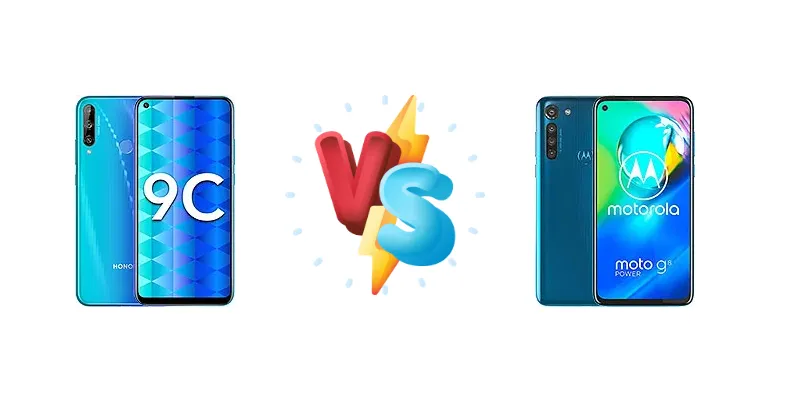
The Honor 9C and Motorola Moto G8 Power represent compelling options in the crowded budget smartphone market. Both aim to deliver essential features without breaking the bank, but they take different approaches. The Honor 9C prioritizes a more modern chipset architecture, while the Moto G8 Power doubles down on extended battery life. This comparison dissects their strengths and weaknesses to determine which device offers the best value.
🏆 Quick Verdict
For the average user prioritizing all-around performance and a slightly more responsive experience, the Honor 9C emerges as the better choice. Its Kirin 710A chipset, built on a smaller 14nm process, offers a performance edge over the Snapdragon 665. However, the Moto G8 Power remains a strong contender for those whose primary concern is maximizing battery endurance.
| Network |
|---|
| 2G bands | GSM 850 / 900 / 1800 / 1900 | GSM 850 / 900 / 1800 / 1900 |
| 3G bands | HSDPA 850 / 900 / 1900 / 2100 | HSDPA 850 / 900 / 1700(AWS) / 1900 / 2100 |
| 4G bands | 1, 2, 3, 4, 5, 7, 8, 20, 34, 38, 39, 40, 41 | 1, 2, 3, 4, 5, 7, 8, 12, 17, 28, 66 |
| Speed | HSPA, LTE | HSPA 42.2/5.76 Mbps, LTE (2CA) Cat13 600/100 Mbps |
| Technology | GSM / HSPA / LTE | GSM / HSPA / LTE |
| | - | 1, 2, 3, 4, 5, 7, 8, 18, 19, 20, 26, 28, 38, 40, 41 |
| Launch |
|---|
| Announced | 2020, April 29. Released 2020, May 04 | 2020, February 07. Released 2020, April 16 |
| Status | Discontinued | Discontinued |
| Body |
|---|
| Build | - | Glass front, plastic back, aluminum frame (6000 series) |
| Dimensions | 159.8 x 76.1 x 8.1 mm (6.29 x 3.00 x 0.32 in) | 156 x 75.8 x 9.6 mm (6.14 x 2.98 x 0.38 in) |
| SIM | Nano-SIM + Nano-SIM | Nano-SIM + Nano-SIM |
| Weight | 176 g (6.21 oz) | 197 g (6.95 oz) |
| | - | Water-repellent coating |
| Display |
|---|
| Resolution | 720 x 1560 pixels, 19.5:9 ratio (~269 ppi density) | 1080 x 2300 pixels (~399 ppi density) |
| Size | 6.39 inches, 100.2 cm2 (~82.4% screen-to-body ratio) | 6.4 inches, 100.7 cm2 (~85.1% screen-to-body ratio) |
| Type | IPS LCD | IPS LCD |
| Platform |
|---|
| CPU | Octa-core (4x2.2 GHz Cortex-A73 & 4x1.7 GHz Cortex-A53) | Octa-core (4x2.0 GHz Kryo 260 Gold & 4x1.8 GHz Kryo 260 Silver) |
| Chipset | Kirin 710A (14 nm) | Qualcomm SDM665 Snapdragon 665 (11 nm) |
| GPU | Mali-G51 MP4 | Adreno 610 |
| OS | Android 10, EMUI 10.1, no Google Play Services | Android 10, upgradable to Android 11 |
| Memory |
|---|
| Card slot | microSDXC (dedicated slot) | microSDXC (uses shared SIM slot) |
| Internal | 64GB 4GB RAM | 32GB 2GB RAM, 32GB 4GB RAM, 64GB 4GB RAM |
| | eMMC 5.1 | eMMC 5.1 |
| Main Camera |
|---|
| Features | LED flash, HDR, panorama | LED flash, HDR, panorama |
| Quad | - | 16 MP, f/1.7, (wide), 1/2.8", 1.12µm, PDAF
8 MP, f/2.2, (telephoto), 1/4.0", 1.12µm, PDAF, 2x optical zoom
8 MP, f/2.2, 118˚ (ultrawide), 1/4.0", 1.12µm
2 MP (macro) |
| Triple | 48 MP, f/1.8, (wide), 1/2.0", 0.8µm, PDAF
8 MP, f/2.4, 120˚ (ultrawide)
Auxiliary lens | - |
| Video | 1080p@30fps | 4K@30fps, 1080p@30/60fps, 1080p@30fps (gyro-EIS) |
| Selfie camera |
|---|
| Features | HDR | HDR |
| Single | 8 MP, f/2.0, (wide) | 16 MP, f/2.0, (wide), 1/3.06", 1.0µm |
| Video | 1080p@30fps | 1080p@30fps |
| Sound |
|---|
| 3.5mm jack | Yes | Yes |
| 35mm jack | Yes | Yes |
| Loudspeaker | Yes | Yes, with stereo speakers |
| Comms |
|---|
| Bluetooth | 5.0, A2DP, LE | 5.0, A2DP, LE |
| NFC | No | No |
| Positioning | GPS, GLONASS, BDS | GPS, GLONASS, BDS, GALILEO |
| Radio | No | FM radio |
| USB | microUSB 2.0 | USB Type-C 2.0 |
| WLAN | Wi-Fi 802.11 b/g/n, Wi-Fi Direct | Wi-Fi 802.11 b/g/n, Wi-Fi Direct |
| Features |
|---|
| Sensors | Fingerprint (rear-mounted), accelerometer, proximity, compass | Fingerprint (rear-mounted), accelerometer, gyro, proximity |
| Battery |
|---|
| Charging | - | 18W wired |
| Type | Li-Po 4000 mAh | Li-Po 5000 mAh |
| Misc |
|---|
| Colors | Black, Blue | Smoke Black, Capri Blue |
| Models | AKA-L29 | XT2041-1, XT2041-3 |
| Price | About 160 EUR | About 180 EUR |
| Tests |
|---|
| Battery life | - |
Endurance rating 136h
|
| Camera | - |
Photo / Video |
| Display | - |
Contrast ratio: 1466:1 (nominal) |
| Loudspeaker | - |
-24.6 LUFS (Very good)
|
| Performance | - |
AnTuTu: 173607 (v8)
GeekBench: 1394 (v5.1)
GFXBench: 6.6fps (ES 3.1 onscreen) |
Honor 9C
- More powerful processor for smoother performance
- Modern CPU architecture (Cortex-A73)
- Potentially better multitasking capabilities
- Battery life likely shorter than Moto G8 Power
- Specific battery capacity unknown
Motorola Moto G8 Power
- Exceptional battery life (136-hour endurance)
- 18W fast charging
- Potentially better thermal management due to 11nm process
- Less powerful processor
- Older CPU architecture (Kryo 260)
Display Comparison
Both devices share a nominal contrast ratio of 1466:1, suggesting similar visual pop. However, detailed display specs like resolution, brightness, and panel type are missing. Given the price point, both likely utilize IPS LCD panels. The lack of information prevents a definitive judgment on display quality, but the Moto G8 Power’s larger screen size (typically found in this model range) could offer a more immersive viewing experience, assuming similar pixel density.
Camera Comparison
Both phones feature 'Photo / Video' capabilities, but lack specific details regarding sensor size, aperture, or image processing. In this segment, the devil is in the details. Without knowing the megapixel count or sensor size, it’s difficult to assess image quality. The presence of a dedicated night mode or HDR processing would be a significant advantage. It's likely both phones rely on software processing to enhance image quality, but the Honor 9C’s more powerful chipset could potentially handle more complex algorithms.
Performance
The Honor 9C’s Kirin 710A (14nm) and the Moto G8 Power’s Snapdragon 665 (11nm) represent different approaches to mobile processing. While the Snapdragon 665 benefits from a smaller manufacturing node – generally leading to improved efficiency – the Kirin 710A’s CPU architecture (Cortex-A73 cores) offers a performance advantage in raw processing power. The A73 cores, found in the Honor 9C, are more capable than the Kryo 260 Gold cores in the Moto G8 Power. This translates to faster app loading times and smoother multitasking on the Honor 9C. However, the 11nm process of the Snapdragon 665 may contribute to slightly better thermal management under sustained load.
Battery Life
The Motorola Moto G8 Power’s standout feature is its impressive 136-hour endurance rating. This suggests a large battery capacity (typically 5000mAh in this model) coupled with efficient power management. The 18W wired charging is a welcome addition, allowing for relatively quick top-ups. The Honor 9C’s battery capacity is unknown, but given its focus on performance, it likely prioritizes a smaller battery to keep the device lightweight. While the Honor 9C may not match the Moto G8 Power’s endurance, its more efficient chipset could potentially offset the difference to some extent.
Buying Guide
Buy the Honor 9C if you need a phone that feels snappier for everyday tasks, handles multitasking more efficiently, and offers a more modern processor architecture. This phone is ideal for users who frequently switch between apps or enjoy light gaming. Buy the Motorola Moto G8 Power if you prioritize exceptional battery life above all else. This is the phone for travelers, commuters, or anyone who frequently finds themselves away from a power outlet, offering a remarkable 136-hour endurance rating.
Frequently Asked Questions
❓ Will the Snapdragon 665 in the Moto G8 Power struggle with demanding apps or games?
The Snapdragon 665 is a capable chipset for everyday tasks, but it may exhibit slowdowns or lag when running graphically intensive games or multitasking with numerous apps. It's best suited for casual gaming and basic productivity.
❓ How long does it realistically take to fully charge the Motorola Moto G8 Power with the 18W charger?
While the Moto G8 Power supports 18W charging, a full charge from 0% typically takes around 2-3 hours due to its large battery capacity. The 18W charger provides a noticeable improvement over standard 5W charging, but it's not a super-fast charging solution.
❓ Is the Kirin 710A chipset in the Honor 9C known for overheating during prolonged use?
The Kirin 710A is generally well-behaved in terms of thermal management. While it may get warm during extended gaming sessions, it's unlikely to overheat to the point of causing performance throttling. The 14nm process helps to mitigate heat generation.
❓ Does either phone have expandable storage via microSD card?
While not explicitly stated in the provided specs, both the Honor 9C and Motorola Moto G8 Power typically include a microSD card slot for expandable storage, a common feature in budget smartphones. This allows users to increase the device's storage capacity beyond the internal memory.