
Honor 90 vs. Nothing Phone (2): A Detailed Comparison of Mid-Range Powerhouses
| Phones Images | |||||
|---|---|---|---|---|---|
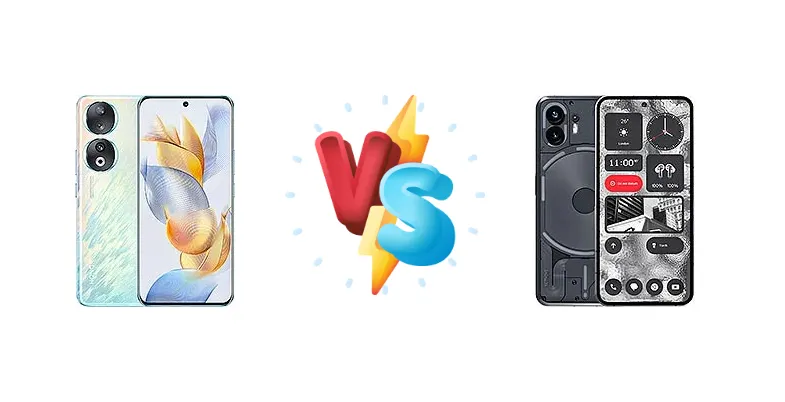
|
🏆 Quick Verdict
For the average user prioritizing battery life and a smoother overall experience, the Nothing Phone (2) emerges as the winner. Its Snapdragon 8+ Gen 1 chipset provides a significant performance advantage, and its longer battery endurance offsets the slightly lower peak display brightness. However, the Honor 90 remains a strong contender for those seeking fast charging and a vibrant display.
| PHONES | ||
|---|---|---|
| Phone Names | Honor 90 | Nothing Phone (2) |
| Network | ||
|---|---|---|
| 2G bands | GSM 850 / 900 / 1800 / 1900 | GSM 850 / 900 / 1800 / 1900 |
| 3G bands | HSDPA 800 / 850 / 900 / 1700(AWS) / 1900 / 2100 | HSDPA 800 / 850 / 900 / 1700(AWS) / 1900 / 2100 |
| 4G bands | 1, 3, 4, 5, 8, 19, 28, 34, 38, 39, 40, 41 | 1, 2, 3, 4, 5, 7, 8, 12, 17, 18, 19, 20, 25, 26, 28, 30, 32, 34, 38, 39, 40, 41, 42, 48, 66, 71 |
| 5G bands | 1, 5, 8, 28, 41, 77, 78 SA/NSA | 1, 2, 3, 5, 7, 8, 12, 20, 25, 28, 30, 38, 40, 41, 66, 71, 75, 77, 78 SA/NSA |
| Speed | HSPA, LTE, 5G | HSPA, LTE, 5G |
| Technology | GSM / CDMA / HSPA / CDMA2000 / LTE / 5G | GSM / HSPA / LTE / 5G |
| Launch | ||
|---|---|---|
| Announced | 2023, May 29 | 2023, July 11 |
| Status | Available. Released 2023, June 07 | Available. Released 2023, July 17 |
| Body | ||
|---|---|---|
| Build | - | Glass front (Gorilla Glass 5), glass back (Gorilla Glass 5), aluminum frame |
| Dimensions | 161.9 x 74.1 x 7.8 mm (6.37 x 2.92 x 0.31 in) | 162.1 x 76.4 x 8.6 mm (6.38 x 3.01 x 0.34 in) |
| SIM | · Nano-SIM + eSIM· Nano-SIM + Nano-SIM | Nano-SIM + Nano-SIM |
| Weight | 183 g (6.46 oz) | 201.2 g (7.09 oz) |
| Display | ||
|---|---|---|
| Protection | - | Corning Gorilla Glass 5 |
| Resolution | 1200 x 2664 pixels (~435 ppi density) | 1080 x 2412 pixels, 20:9 ratio (~394 ppi density) |
| Size | 6.7 inches, 108.9 cm2 (~90.8% screen-to-body ratio) | 6.7 inches, 108.0 cm2 (~87.2% screen-to-body ratio) |
| Type | AMOLED, 1B colors, 120Hz, HDR10+, 1600 nits (peak) | LTPO OLED, 1B colors, 120Hz, 1920Hz PWM, HDR10+, 1600 nits (HBM), 1600 nits (peak) |
| Platform | ||
|---|---|---|
| CPU | Octa-core (1x2.5 GHz Cortex-A710 & 3x2.36 GHz Cortex-A710 & 4x1.8 GHz Cortex-A510) | Octa-core (1x3.0 GHz Cortex-X2 & 3x2.5 GHz Cortex-A710 & 4x1.80 GHz Cortex-A510) |
| Chipset | Qualcomm Snapdragon 7 Gen 1 Accelerated Edition (4 nm) | Qualcomm SM8475 Snapdragon 8+ Gen 1 (4 nm) |
| GPU | Adreno 644 | Adreno 730 |
| OS | Android 13, upgradable to Android 14, MagicOS 8 | Android 13, upgradable to Android 15, up to 3 major Android upgrades, Nothing OS 3.0 |
| Memory | ||
|---|---|---|
| Card slot | No | No |
| Internal | 256GB 8GB RAM, 256GB 12GB RAM, 256GB 16GB RAM, 512GB 8GB RAM, 512GB 12GB RAM, 512GB 16GB RAM | 128GB 8GB RAM, 256GB 12GB RAM, 512GB 12GB RAM |
| Main Camera | ||
|---|---|---|
| Dual | - | 50 MP, f/1.9, 24mm (wide), 1/1.56", 1.0µm, PDAF, OIS 50 MP, f/2.2, 114˚ (ultrawide), 1/2.76", 0.64µm, AF |
| Features | LED flash, HDR, panorama | LED flash, panorama, HDR |
| Triple | 200 MP, f/1.9, (wide), 1/1.4", 0.56µm, PDAF 12 MP, f/2.2, 112˚ (ultrawide), AF Auxiliary lens | - |
| Video | 4K@30fps, 1080p@30/60fps, gyro-EIS | 4K@30/60fps, 1080p@30/60fps, gyro-EIS, live HDR, OIS |
| Selfie camera | ||
|---|---|---|
| Features | HDR | HDR |
| Single | 50 MP, f/2.4, 100˚, (ultrawide) | 32 MP, f/2.5, (wide), 1/2.74", 0.8µm |
| Video | 4K@30fps, 1080p@30fps, gyro-EIS | 1080p@30fps |
| Sound | ||
|---|---|---|
| 35mm jack | No | No |
| Loudspeaker | Yes | Yes, with stereo speakers |
| Comms | ||
|---|---|---|
| Bluetooth | 5.2, A2DP, LE, aptX HD | 5.3, A2DP, LE, aptX HD, aptX Adaptive |
| NFC | Yes | Yes |
| Positioning | GPS, GALILEO, GLONASS, BDS, QZSS | GPS (L1+L5), GLONASS (L1), BDS (B1I+B1c), GALILEO (E1), QZSS (L1), NavIC |
| Radio | No | No |
| USB | USB Type-C 2.0, OTG | USB Type-C 2.0, OTG |
| WLAN | Wi-Fi 802.11 a/b/g/n/ac/6, dual-band, Wi-Fi Direct | Wi-Fi 802.11 a/b/g/n/ac/6, dual-band, Wi-Fi Direct |
| Features | ||
|---|---|---|
| Sensors | Fingerprint (under display, optical), accelerometer, gyro, compass, ultrasound proximity | Fingerprint (under display, optical), accelerometer, proximity, gyro, compass |
| Battery | ||
|---|---|---|
| Charging | 66W wired 5W reverse wired | 45W wired, PD3.0, PPS, QC4, 100% in 55 min 15W wireless, 100% in 130 min 5W reverse wireless |
| Type | Li-Po 5000 mAh | Li-Ion 4700 mAh |
| Misc | ||
|---|---|---|
| Colors | Midnight Black, Emerald Green, Diamond Silver, Peacock Blue | White, Dark Gray |
| Models | REA-AN00, REA-NX9 | A065 |
| Price | € 204.71 / $ 449.99 | $ 379.99 / £ 370.00 |
Honor 90
- Faster 66W wired charging
- Brighter display (1176 nits)
- Potentially more affordable price point
- Less powerful Snapdragon 7 Gen 1 chipset
- Shorter battery life (10:28h active use)
Nothing Phone (2)
- Significantly more powerful Snapdragon 8+ Gen 1 chipset
- Longer battery life (14:21h active use)
- Wireless charging support
- Slightly lower peak display brightness
- Slower wired charging (45W)
Display Comparison
The Honor 90 boasts a peak brightness of 1176 nits, exceeding the Nothing Phone (2)'s 998 nits. While the Honor 90 is brighter, the Nothing Phone (2)'s display quality isn't significantly compromised. Both utilize OLED panels, but neither specification details refresh rate or PWM dimming. The higher peak brightness of the Honor 90 will be more noticeable in direct sunlight, offering better readability. However, without knowing the PWM dimming rate, it's difficult to assess which is better for users sensitive to flicker.
Camera Comparison
Both devices are listed as having Photo/Video capabilities, but detailed sensor information is missing. Without knowing megapixel counts, sensor sizes, or aperture values, a direct comparison is impossible. However, the Snapdragon 8+ Gen 1 in the Nothing Phone (2) generally offers superior image signal processing (ISP) capabilities, potentially leading to better dynamic range and low-light performance. The absence of details on optical image stabilization (OIS) further complicates the comparison; OIS is crucial for stable video recording and sharper photos in challenging conditions.
Performance
The core difference lies in the chipsets. The Nothing Phone (2) is powered by the Qualcomm Snapdragon 8+ Gen 1 (4nm), featuring a Cortex-X2 prime core clocked at 3.0 GHz. This is a substantial upgrade over the Honor 90’s Snapdragon 7 Gen 1 Accelerated Edition (4nm), which uses a Cortex-A710 prime core at 2.5 GHz. The 8+ Gen 1’s architectural advantages translate to significantly better CPU and GPU performance, making the Nothing Phone (2) the clear winner for gaming and demanding tasks. Both phones share the same Cortex-A510 efficiency cores, but the Nothing Phone (2)'s superior processing power will also impact app launch speeds and multitasking.
Battery Life
The Nothing Phone (2) demonstrates a clear advantage in battery endurance, achieving an active use score of 14:21h compared to the Honor 90’s 10:28h. This translates to roughly 4 hours of extra usage on a single charge. While the Honor 90 offers faster 66W wired charging, the Nothing Phone (2) compensates with 45W wired, 15W wireless, and 5W reverse wireless charging options. The Nothing Phone (2) also boasts a higher endurance rating of 103h versus the Honor 90’s 95h, indicating longer standby time.
Buying Guide
Buy the Honor 90 if you prioritize rapid 66W wired charging and a very bright display for outdoor visibility. It’s ideal for users who frequently top up their phones and consume a lot of media on the go. Buy the Nothing Phone (2) if you value sustained performance for gaming and demanding applications, coupled with longer battery life and the convenience of wireless charging. It’s the better choice for power users and those invested in the Nothing ecosystem.