
Honor 90 vs Google Pixel 7a: A Detailed Comparison of Mid-Range Champions
| Phones Images | |||||
|---|---|---|---|---|---|
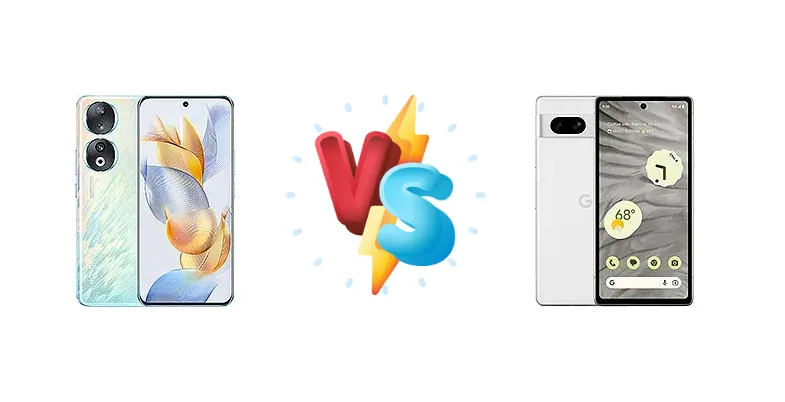
|
🏆 Quick Verdict
For the average user prioritizing display quality and charging speed, the Honor 90 emerges as the winner. Its significantly brighter 1176 nit display and 66W charging offer a tangible advantage. However, the Pixel 7a’s Tensor G2 chip and Google’s software experience remain strong contenders for those deeply invested in the Google ecosystem.
| PHONES | ||
|---|---|---|
| Phone Names | Honor 90 | Google Pixel 7a |
| Network | ||
|---|---|---|
| 2G bands | GSM 850 / 900 / 1800 / 1900 | GSM 850 / 900 / 1800 / 1900 |
| 3G bands | HSDPA 800 / 850 / 900 / 1700(AWS) / 1900 / 2100 | HSDPA 800 / 850 / 900 / 1700(AWS) / 1900 / 2100 |
| 4G bands | 1, 3, 4, 5, 8, 19, 28, 34, 38, 39, 40, 41 | 1, 2, 3, 4, 5, 7, 8, 12, 13, 14, 17, 20, 25, 26, 28, 29, 30, 38, 40, 41, 48, 66, 71 - GWKK3, G0DZQ |
| 5G bands | 1, 5, 8, 28, 41, 77, 78 SA/NSA | 1, 2, 3, 5, 7, 8, 12, 14, 20, 25, 28, 30, 38, 41, 48, 66, 71, 77, 78 SA/NSA/Sub6 - GWKK3 |
| Speed | HSPA, LTE, 5G | HSPA, LTE, 5G |
| Technology | GSM / CDMA / HSPA / CDMA2000 / LTE / 5G | GSM / HSPA / LTE / 5G |
| - | 1, 2, 3, 5, 7, 8, 12, 20, 25, 28, 38, 40, 41, 66, 75, 76, 77, 78, 79 SA/NSA/Sub6 - GHL1X, G82U8 | |
| Launch | ||
|---|---|---|
| Announced | 2023, May 29 | 2023, May 10 |
| Status | Available. Released 2023, June 07 | Available. Released 2023, May 10 |
| Body | ||
|---|---|---|
| Build | - | Glass front (Gorilla Glass 3), aluminum frame, plastic back |
| Dimensions | 161.9 x 74.1 x 7.8 mm (6.37 x 2.92 x 0.31 in) | 152 x 72.9 x 9 mm (5.98 x 2.87 x 0.35 in) |
| SIM | · Nano-SIM + eSIM· Nano-SIM + Nano-SIM | Nano-SIM + eSIM |
| Weight | 183 g (6.46 oz) | 193.5 g (6.84 oz) |
| - | IP67 dust/water resistant (up to 1m for 30 min) | |
| Display | ||
|---|---|---|
| Protection | - | Corning Gorilla Glass 3 |
| Resolution | 1200 x 2664 pixels (~435 ppi density) | 1080 x 2400 pixels, 20:9 ratio (~429 ppi density) |
| Size | 6.7 inches, 108.9 cm2 (~90.8% screen-to-body ratio) | 6.1 inches, 90.7 cm2 (~81.8% screen-to-body ratio) |
| Type | AMOLED, 1B colors, 120Hz, HDR10+, 1600 nits (peak) | OLED, HDR, 90Hz |
| - | Always-on display | |
| Platform | ||
|---|---|---|
| CPU | Octa-core (1x2.5 GHz Cortex-A710 & 3x2.36 GHz Cortex-A710 & 4x1.8 GHz Cortex-A510) | Octa-core (2x2.85 GHz Cortex-X1 & 2x2.35 GHz Cortex-A78 & 4x1.80 GHz Cortex-A55) |
| Chipset | Qualcomm Snapdragon 7 Gen 1 Accelerated Edition (4 nm) | Google Tensor G2 (5 nm) |
| GPU | Adreno 644 | Mali-G710 MP7 |
| OS | Android 13, upgradable to Android 14, MagicOS 8 | Android 13, upgradable to Android 15, up to 5 major Android upgrades |
| Memory | ||
|---|---|---|
| Card slot | No | No |
| Internal | 256GB 8GB RAM, 256GB 12GB RAM, 256GB 16GB RAM, 512GB 8GB RAM, 512GB 12GB RAM, 512GB 16GB RAM | 128GB 8GB RAM |
| - | UFS 3.1 | |
| Main Camera | ||
|---|---|---|
| Dual | - | 64 MP, f/1.9, 26mm (wide), 1/1.73", 0.8µm, dual pixel PDAF, OIS 13 MP, f/2.2, 120˚ (ultrawide), 1.12µm |
| Features | LED flash, HDR, panorama | Dual-LED flash, Pixel Shift, Auto-HDR, panorama |
| Triple | 200 MP, f/1.9, (wide), 1/1.4", 0.56µm, PDAF 12 MP, f/2.2, 112˚ (ultrawide), AF Auxiliary lens | - |
| Video | 4K@30fps, 1080p@30/60fps, gyro-EIS | 4K@30/60fps, 1080p@30/60/120/240fps, OIS |
| Selfie camera | ||
|---|---|---|
| Features | HDR | HDR, panorama |
| Single | 50 MP, f/2.4, 100˚, (ultrawide) | 13 MP, f/2.2, 20mm (ultrawide), 1.12µm |
| Video | 4K@30fps, 1080p@30fps, gyro-EIS | 4K@30fps, 1080p@30fps |
| Sound | ||
|---|---|---|
| 3.5mm jack | - | No |
| 35mm jack | No | No |
| Loudspeaker | Yes | Yes, with stereo speakers |
| Comms | ||
|---|---|---|
| Bluetooth | 5.2, A2DP, LE, aptX HD | 5.3, A2DP, LE |
| NFC | Yes | Yes |
| Positioning | GPS, GALILEO, GLONASS, BDS, QZSS | GPS, GLONASS, GALILEO, BDS, QZSS, NavIC |
| Radio | No | No |
| USB | USB Type-C 2.0, OTG | USB Type-C 3.2 |
| WLAN | Wi-Fi 802.11 a/b/g/n/ac/6, dual-band, Wi-Fi Direct | Wi-Fi 802.11 a/b/g/n/ac/6e, tri-band |
| Features | ||
|---|---|---|
| Sensors | Fingerprint (under display, optical), accelerometer, gyro, compass, ultrasound proximity | Fingerprint (under display, optical), accelerometer, gyro, proximity, compass, barometer |
| Battery | ||
|---|---|---|
| Charging | 66W wired 5W reverse wired | 18W wired, PD3.0 7.5W wireless |
| Type | Li-Po 5000 mAh | Li-Po 4385 mAh |
| Misc | ||
|---|---|---|
| Colors | Midnight Black, Emerald Green, Diamond Silver, Peacock Blue | Charcoal, Snow, Sea, Coral |
| Models | REA-AN00, REA-NX9 | GWKK3, GHL1X, G0DZQ, G82U8 |
| Price | € 204.71 / $ 449.99 | € 179.90 / $ 150.00 / £ 170.00 / ₹ 25,980 |
Honor 90
- Significantly faster 66W charging
- Brighter display for outdoor visibility
- Potentially better sustained performance due to 4nm Snapdragon chip
- Limited information on camera sensor specs
- Software experience may not be as refined as Pixel
Google Pixel 7a
- Google Tensor G2 chip with AI capabilities
- Exceptional computational photography
- Clean and updated Android experience
- Slower 18W charging
- Less bright display compared to Honor 90
- Potentially more thermal throttling under sustained load
Display Comparison
The Honor 90 boasts a notably brighter display, reaching a measured 1176 nits, compared to the Pixel 7a’s 1070 nits. This 9.4% difference translates to significantly improved visibility in direct sunlight. While both utilize OLED panels, Honor doesn’t specify refresh rate or PWM dimming, which are crucial for reducing eye strain. The Pixel 7a’s display, while excellent, is demonstrably less bright, potentially impacting outdoor usability. The Honor 90’s brightness advantage will be particularly appreciated by users who spend a lot of time outdoors or in brightly lit environments.
Camera Comparison
Both phones are marketed as having strong camera systems, but details are limited. Both support photo and video capture, but sensor sizes and lens apertures are not provided. The Pixel 7a benefits from Google’s renowned computational photography, leveraging the Tensor G2’s image signal processor (ISP) for exceptional dynamic range and detail. Without specific sensor information, it’s difficult to definitively declare a winner. However, Google’s software processing often compensates for hardware limitations, giving the Pixel 7a an edge in image quality, particularly in challenging lighting conditions. The Honor 90 will likely rely more on hardware capabilities, which remain unknown.
Performance
The chipset choice defines the performance profiles of these devices. The Pixel 7a’s Google Tensor G2 (5nm) features a Cortex-X1 prime core clocked at 2.85GHz, designed for demanding tasks. The Honor 90 utilizes the Qualcomm Snapdragon 7 Gen 1 Accelerated Edition (4nm), with a more complex core configuration (1x2.5 GHz Cortex-A710, 3x2.36 GHz Cortex-A710, 4x1.8 GHz Cortex-A510). While the Tensor G2’s X1 core offers peak performance advantages, the Snapdragon 7 Gen 1’s efficiency, built on a 4nm process, could lead to better sustained performance and thermal management during extended gaming sessions. The Pixel 7a’s Tensor G2 excels in AI-driven tasks, while the Honor 90 aims for a balanced approach.
Battery Life
The Honor 90 demonstrates a clear advantage in charging speed with its 66W wired charging capability, compared to the Pixel 7a’s 18W wired charging. This translates to significantly faster top-ups. While the Pixel 7a offers 7.5W wireless charging, the Honor 90 only provides 5W reverse wired charging. Battery endurance, based on older ratings, suggests the Honor 90 (95h) offers better longevity than the Pixel 7a (76h), but this is based on older testing methodologies. The Honor 90’s active use score of 10:28h provides a more realistic expectation of daily battery life, while the Pixel 7a’s active use data is unavailable.
Buying Guide
Buy the Honor 90 if you need a vibrant, easily viewable display for media consumption, and value incredibly fast charging to minimize downtime. It’s ideal for users who frequently watch videos, browse photos, or game on their phones. Buy the Google Pixel 7a if you prioritize a clean Android experience, exceptional camera processing, and seamless integration with Google services. It’s the better choice for photography enthusiasts and those who rely heavily on Google’s AI features.