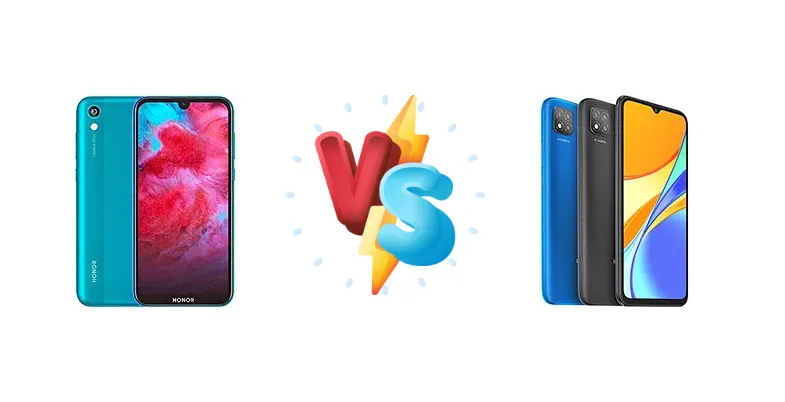
Both the Honor 8S 2020 and the Xiaomi Redmi 9C NFC occupy the ultra-budget smartphone segment, aiming to deliver essential functionality at the lowest possible price. However, a closer look reveals significant differences in processing power and features, particularly with the inclusion of NFC in the Redmi 9C. This comparison dissects these differences to determine which device offers the best value.
🏆 Quick Verdict
For the average user, the Xiaomi Redmi 9C NFC is the superior choice. Its Helio G35 chipset, featuring an octa-core CPU, provides a noticeably smoother experience for multitasking and app loading compared to the Honor 8S 2020’s quad-core Helio A22. The added convenience of NFC for contactless payments seals the deal.
| Network |
|---|
| 2G bands | GSM 850 / 900 / 1800 / 1900 | GSM 850 / 900 / 1800 / 1900 |
| 3G bands | HSDPA 850 / 900 / 2100 | HSDPA 850 / 900 / 1700(AWS) / 1900 / 2100 |
| 4G bands | LTE | 1, 2, 3, 4, 5, 7, 8, 20, 38, 40 |
| Speed | HSPA, LTE | HSPA, LTE |
| Technology | GSM / HSPA / LTE | GSM / HSPA / LTE |
| Launch |
|---|
| Announced | 2020, May 27. Released 2020, May 27 | 2020, August 27. Released 2020, August 27 |
| Status | Discontinued | Discontinued |
| Body |
|---|
| Build | Glass front, plastic back, plastic frame | - |
| Dimensions | 147.1 x 70.8 x 8.5 mm (5.79 x 2.79 x 0.33 in) | 164.9 x 77.1 x 9 mm (6.49 x 3.04 x 0.35 in) |
| SIM | · Nano-SIM· Nano-SIM + Nano-SIM | Nano-SIM + Nano-SIM |
| Weight | 146 g (5.15 oz) | 196 g (6.91 oz) |
| Display |
|---|
| Resolution | 720 x 1520 pixels, 19:9 ratio (~295 ppi density) | 720 x 1600 pixels, 20:9 ratio (~269 ppi density) |
| Size | 5.71 inches, 81.4 cm2 (~78.1% screen-to-body ratio) | 6.53 inches, 102.9 cm2 (~81.0% screen-to-body ratio) |
| Type | IPS LCD | IPS LCD, 400 nits (typ) |
| Platform |
|---|
| CPU | Quad-core 2.0 GHz Cortex-A53 | Octa-core (4x2.3 GHz Cortex-A53 & 4x1.8 GHz Cortex-A53) |
| Chipset | Mediatek MT6761 Helio A22 (12 nm) | Mediatek MT6765G Helio G35 (12 nm) |
| GPU | PowerVR GE8320 | PowerVR GE8320 |
| OS | Android 9.0 (Pie), EMUI 9, Google Play Services | Android 10, MIUI 12 |
| Memory |
|---|
| Card slot | microSDXC (dedicated slot) | microSDXC (dedicated slot) |
| Internal | 64GB 3GB RAM | 32GB 2GB RAM, 32GB 3GB RAM, 64GB 2GB RAM, 64GB 3GB RAM, 128GB 3GB RAM, 128GB 4GB RAM |
| | eMMC 5.1 | eMMC 5.1 |
| Main Camera |
|---|
| Dual | - | 13 MP, f/2.2, 28mm (wide), 1.0µm, PDAF
2 MP (macro) |
| Features | LED flash, HDR, panorama | LED flash, HDR |
| Single | 13 MP, f/1.8, PDAF | - |
| Video | 1080p@30fps | 1080p@30fps |
| Selfie camera |
|---|
| Features | - | HDR |
| Single | 5 MP, f/2.2 | 5 MP, f/2.2, (wide), 1.12µm |
| Video | - | 1080p@30fps |
| Sound |
|---|
| 3.5mm jack | Yes | Yes |
| 35mm jack | Yes | Yes |
| Loudspeaker | Yes | Yes |
| Comms |
|---|
| Bluetooth | 5.0, A2DP, LE | 5.0, A2DP, LE |
| NFC | No | Yes |
| Positioning | GPS, GLONASS, BDS | GPS, GLONASS, BDS |
| Radio | FM radio | FM radio |
| USB | microUSB 2.0 | microUSB 2.0, OTG |
| WLAN | Wi-Fi 802.11 b/g/n, Wi-Fi Direct | Wi-Fi 802.11 b/g/n, Wi-Fi Direct |
| Features |
|---|
| Sensors | Accelerometer, proximity | Fingerprint (rear-mounted), accelerometer, proximity |
| Battery |
|---|
| Charging | - | 10W wired |
| Type | Li-Po 3020 mAh | Li-Po 5000 mAh |
| Misc |
|---|
| Colors | Navy Blue, Midnight Black, Green | Midnight Gray, Sunshine Yellow, Twilight Blue |
| Models | - | M2006C3MNG |
| Price | About 110 EUR | About 100 EUR |
| SAR | - | 0.57 W/kg (head) 0.90 W/kg (body) |
| SAR EU | - | 0.37 W/kg (head) 1.14 W/kg (body) |
Honor 8S 2020
- Extremely affordable price point
- Simple and easy-to-use interface
- Decent battery life for basic usage
- Slow processor struggles with multitasking
- Lacks NFC for contactless payments
- Outdated chipset
Xiaomi Redmi 9C NFC
- Significantly faster processor for smoother performance
- Convenient NFC functionality for contactless payments
- More responsive user experience
- Slightly higher price than the Honor 8S 2020
- 10W charging is relatively slow
- Camera performance is still basic
Display Comparison
Neither device boasts a standout display. Both utilize standard LCD panels, and detailed specifications like brightness and color accuracy are unavailable. However, the focus here isn't display quality; it's functionality. Both are likely to offer adequate viewing for basic tasks, but neither will impress with vibrant colors or high peak brightness. Bezels are expected to be substantial on both, typical of this price bracket.
Camera Comparison
Camera performance is likely to be similar, with both devices featuring basic camera setups. Without detailed sensor information, it’s safe to assume both rely on budget sensors. The Redmi 9C NFC may have a slight edge due to the more powerful ISP (Image Signal Processor) integrated into the Helio G35, potentially leading to better image processing in favorable lighting conditions. The inclusion of a 2MP macro camera on the Redmi 9C NFC is unlikely to significantly impact image quality, serving more as a marketing feature than a practical improvement.
Performance
The core difference lies in the chipsets. The Redmi 9C NFC’s MediaTek Helio G35 is a significant upgrade over the Honor 8S 2020’s Helio A22. The G35’s octa-core configuration (4x2.3 GHz Cortex-A53 & 4x1.8 GHz Cortex-A53) provides substantially more processing power than the A22’s quad-core 2.0 GHz Cortex-A53. This translates to faster app launch times, smoother multitasking, and a more responsive user interface. While neither is a gaming powerhouse, the G35 will handle less demanding games with greater ease. The Redmi 9C NFC’s performance advantage is the most impactful difference between these two devices.
Battery Life
Both phones likely feature similar battery capacities, typical of the budget segment (around 4000-5000 mAh). However, the Redmi 9C NFC’s 10W wired charging offers a slight advantage. While not fast charging by any means, it’s still a benefit over potentially slower or non-standard charging solutions that might be found on the Honor 8S 2020. Real-world battery life will depend heavily on usage, but the more efficient Helio G35 in the Redmi 9C NFC could contribute to slightly longer runtimes.
Buying Guide
Buy the Honor 8S 2020 if your primary need is a basic, extremely affordable phone for calls, texts, and light web browsing, and NFC isn't a requirement. Buy the Xiaomi Redmi 9C NFC if you prioritize smoother performance, occasional gaming, and the convenience of contactless payments via NFC, even if it means spending slightly more.
Frequently Asked Questions
❓ Does the Redmi 9C NFC support Google Pay or other contactless payment services?
Yes, the Redmi 9C NFC’s integrated NFC chip allows it to work seamlessly with Google Pay and other NFC-enabled contactless payment services, providing a convenient and secure way to make purchases.
❓ Will the Redmi 9C NFC be able to run popular social media apps like Facebook and WhatsApp smoothly?
Yes, the Helio G35 chipset in the Redmi 9C NFC is capable of running popular social media apps like Facebook, WhatsApp, and Instagram without significant lag. The octa-core processor provides enough processing power for these everyday tasks.
❓ Is the Honor 8S 2020 a good choice for someone who primarily uses their phone for calls and texts?
Yes, the Honor 8S 2020 is a suitable option for users who primarily need a phone for basic communication. Its affordability and simple interface make it a functional device for calls and texts, but it will struggle with more demanding tasks.
❓ Can I play games like PUBG Mobile on the Redmi 9C NFC?
While you can *launch* PUBG Mobile on the Redmi 9C NFC, the experience will likely be limited to the lowest graphics settings and frame rates. The Helio G35 isn't a gaming-focused chipset, and performance will be significantly constrained.