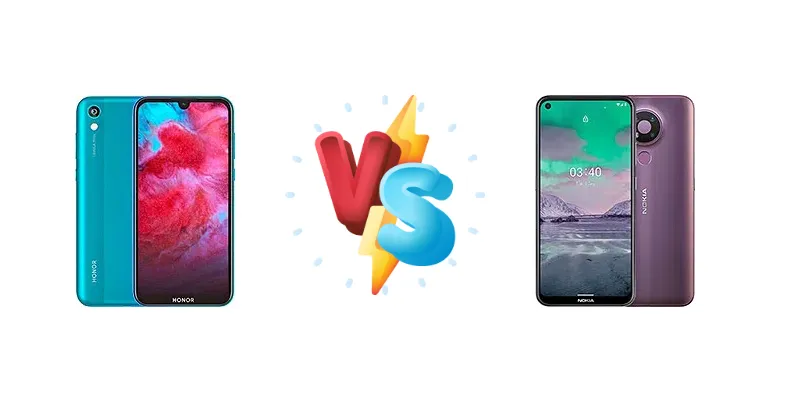
The Honor 8S 2020 and Nokia 3.4 represent two approaches to the ultra-budget smartphone market. The Honor 8S 2020, a refresh of an older model, aims for extreme affordability, while the Nokia 3.4 attempts to offer a more modern experience with a more powerful chipset. This comparison dissects their key differences to help you determine which device delivers the best value.
🏆 Quick Verdict
For most users, the Nokia 3.4 is the superior choice. Its Qualcomm Snapdragon 460 chipset, featuring an octa-core CPU, provides a significantly smoother and more responsive experience than the Honor 8S 2020’s quad-core Helio A22. While charging is slow at 10W, the overall performance uplift justifies the potential price difference.
| Network |
|---|
| 2G bands | GSM 850 / 900 / 1800 / 1900 | GSM 850 / 900 / 1800 / 1900 |
| 3G bands | HSDPA 850 / 900 / 2100 | HSDPA 850 / 900 / 1700(AWS) / 1900 / 2100 |
| 4G bands | LTE | 1, 2, 3, 4, 5, 7, 8, 12, 17, 13, 28, 66 |
| Speed | HSPA, LTE | HSPA, LTE |
| Technology | GSM / HSPA / LTE | GSM / HSPA / LTE |
| Launch |
|---|
| Announced | 2020, May 27. Released 2020, May 27 | 2020, September 22. Released 2020, October 26 |
| Status | Discontinued | Discontinued |
| Body |
|---|
| Build | Glass front, plastic back, plastic frame | - |
| Dimensions | 147.1 x 70.8 x 8.5 mm (5.79 x 2.79 x 0.33 in) | 161 x 76 x 8.7 mm (6.34 x 2.99 x 0.34 in) |
| SIM | · Nano-SIM· Nano-SIM + Nano-SIM | · Nano-SIM· Nano-SIM + Nano-SIM |
| Weight | 146 g (5.15 oz) | 180 g (6.35 oz) |
| Display |
|---|
| Resolution | 720 x 1520 pixels, 19:9 ratio (~295 ppi density) | 720 x 1560 pixels, 19.5:9 ratio (~269 ppi density) |
| Size | 5.71 inches, 81.4 cm2 (~78.1% screen-to-body ratio) | 6.39 inches, 100.2 cm2 (~81.9% screen-to-body ratio) |
| Type | IPS LCD | IPS LCD, 400 nits (typ) |
| Platform |
|---|
| CPU | Quad-core 2.0 GHz Cortex-A53 | Octa-core (4x1.8 GHz Cortex-A73 & 4x1.8 GHz Cortex-A53) |
| Chipset | Mediatek MT6761 Helio A22 (12 nm) | Qualcomm SM4250 Snapdragon 460 (11 nm) |
| GPU | PowerVR GE8320 | Adreno 610 |
| OS | Android 9.0 (Pie), EMUI 9, Google Play Services | Android 10, upgradable to Android 11 |
| Memory |
|---|
| Card slot | microSDXC (dedicated slot) | microSDXC (dedicated slot) |
| Internal | 64GB 3GB RAM | 32GB 3GB RAM, 64GB 3GB RAM, 64GB 4GB RAM |
| | eMMC 5.1 | eMMC 5.1 |
| Main Camera |
|---|
| Features | LED flash, HDR, panorama | LED flash, HDR, panorama |
| Single | 13 MP, f/1.8, PDAF | - |
| Triple | - | 13 MP, (wide), PDAF
5 MP, (ultrawide)
Auxiliary lens |
| Video | 1080p@30fps | 1080p@30fps |
| Selfie camera |
|---|
| Single | 5 MP, f/2.2 | 8 MP, (wide) |
| Video | - | 1080p@30fps |
| Sound |
|---|
| 3.5mm jack | Yes | Yes |
| 35mm jack | Yes | Yes |
| Loudspeaker | Yes | Yes |
| Comms |
|---|
| Bluetooth | 5.0, A2DP, LE | 4.2, A2DP, aptX |
| NFC | No | Yes (market/region dependent) |
| Positioning | GPS, GLONASS, BDS | GPS, GLONASS, GALILEO, BDS |
| Radio | FM radio | FM radio |
| USB | microUSB 2.0 | USB Type-C 2.0 |
| WLAN | Wi-Fi 802.11 b/g/n, Wi-Fi Direct | Wi-Fi 802.11 b/g/n |
| Features |
|---|
| Sensors | Accelerometer, proximity | Fingerprint (rear-mounted), accelerometer, gyro, proximity |
| Battery |
|---|
| Charging | - | 10W wired |
| Type | Li-Po 3020 mAh | Li-Po 4000 mAh |
| Misc |
|---|
| Colors | Navy Blue, Midnight Black, Green | Fjord, Dusk, Charcoal |
| Models | - | TA-1288, TA-1285, TA-1283 |
| Price | About 110 EUR | About 100 EUR |
| SAR | - | 0.83 W/kg (head) 1.05 W/kg (body) |
| SAR EU | - | 0.36 W/kg (head) 1.56 W/kg (body) |
Honor 8S 2020
- Extremely affordable price point
- Potentially longer battery life during idle use due to less powerful chipset
- Simple and straightforward user experience
- Significantly slower performance compared to the Nokia 3.4
- Outdated chipset architecture
- Likely larger bezels and less modern design
Nokia 3.4
- Much faster and more responsive performance thanks to the Snapdragon 460
- Octa-core CPU enables better multitasking
- More efficient chipset potentially leading to better battery life under load
- Slower 10W charging
- Potentially higher price compared to the Honor 8S 2020
- May require more frequent software updates
Display Comparison
Neither device boasts a standout display. Both likely utilize LCD panels, typical for this price bracket. However, detailed specs like resolution and brightness are missing. The Nokia 3.4’s advantage lies in its potential for a slightly more refined software experience that could optimize display performance. The Honor 8S 2020, being an older design, may have larger bezels, impacting the screen-to-body ratio.
Camera Comparison
Camera performance is likely to be similar in real-world usage, given the focus on affordability. Both devices likely feature basic camera setups. Without specific sensor details, it’s difficult to make a definitive judgment. However, the Snapdragon 460’s image signal processor (ISP) is generally more advanced than the Helio A22’s, potentially leading to slightly better image processing and noise reduction in the Nokia 3.4. Expect limited low-light performance from both.
Performance
The performance gap is the most significant differentiator. The Nokia 3.4’s Qualcomm Snapdragon 460, built on an 11nm process, is a substantial upgrade over the Honor 8S 2020’s Mediatek Helio A22 (12nm). The Snapdragon 460’s octa-core configuration – combining four Cortex-A73 cores at 1.8GHz with four Cortex-A53 cores – provides a much more capable CPU for multitasking and app responsiveness. The Helio A22’s quad-core Cortex-A53 at 2.0GHz will struggle with anything beyond basic usage. The 11nm process also contributes to better power efficiency in the Nokia 3.4, potentially extending battery life under load.
Battery Life
Battery capacity is not specified for either device. However, the Nokia 3.4’s 10W charging is a notable limitation. While the Helio A22’s lower power draw might mean slightly slower battery depletion during idle use, the Snapdragon 460’s efficiency gains could offset this during active use. The 10W charging on the Nokia 3.4 will result in a significantly longer 0-100% charge time compared to faster-charging alternatives.
Buying Guide
Buy the Honor 8S 2020 if your primary need is an extremely affordable device for basic tasks like calls, texts, and light social media, and you prioritize minimizing upfront cost above all else. Buy the Nokia 3.4 if you prefer a more fluid user experience, better multitasking capabilities, and a chipset capable of handling more demanding applications, even if it means spending a bit more.
Frequently Asked Questions
❓ Will the Nokia 3.4 struggle with popular apps like Facebook or WhatsApp?
While the Snapdragon 460 isn't a powerhouse, it's more than capable of handling everyday apps like Facebook, WhatsApp, and basic web browsing. You'll experience a smoother and more responsive experience compared to the Honor 8S 2020, which may exhibit noticeable lag with these apps.
❓ Is the 10W charging on the Nokia 3.4 a significant drawback?
Yes, 10W charging is relatively slow by today's standards. Expect a full charge to take several hours. This is a trade-off for the more powerful chipset, but it means you'll need to plan ahead and charge the phone overnight or during downtime.
❓ Can the Honor 8S 2020 handle basic mobile games?
The Honor 8S 2020 can run some basic mobile games, but expect low frame rates and potential stuttering, especially in more demanding titles. The Helio A22 simply lacks the graphical processing power for a smooth gaming experience.
❓ Does the Nokia 3.4 receive regular software updates?
Nokia is known for providing relatively clean and timely Android updates, even on their budget devices. This is a significant advantage over the Honor 8S 2020, which may receive fewer or no software updates.