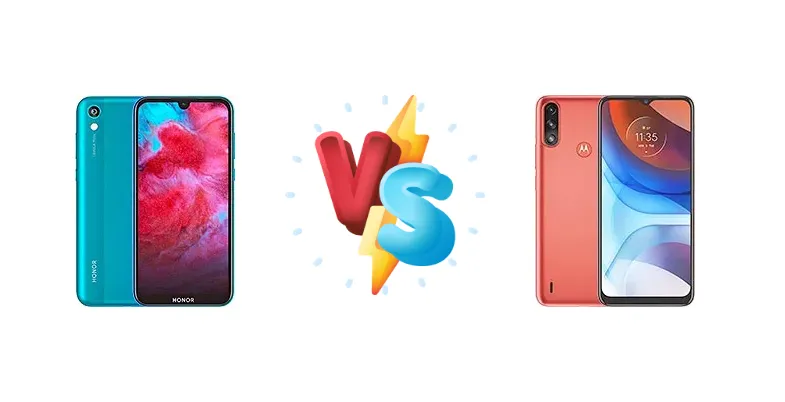
Both the Honor 8S 2020 and the Motorola Moto E7i Power occupy the ultra-budget smartphone segment, aiming to deliver essential functionality at the lowest possible price. However, they take distinctly different approaches to achieving this, with Honor prioritizing a more efficient, albeit less powerful, chipset, while Motorola opts for an octa-core processor built on an older manufacturing process. This comparison dissects these choices to determine which phone offers the best value.
🏆 Quick Verdict
For the average user prioritizing smooth, everyday tasks and longer battery life, the Honor 8S 2020 emerges as the better choice. Its Mediatek Helio A22, despite having fewer cores, benefits from a more modern 12nm process, resulting in superior power efficiency and a more responsive user experience than the Motorola Moto E7i Power.
| Network |
|---|
| 2G bands | GSM 850 / 900 / 1800 / 1900 | GSM 850 / 900 / 1800 / 1900 |
| 3G bands | HSDPA 850 / 900 / 2100 | HSDPA 850 / 900 / 1700(AWS) / 1900 / 2100 |
| 4G bands | LTE | LTE |
| Speed | HSPA, LTE | HSPA, LTE |
| Technology | GSM / HSPA / LTE | GSM / HSPA / LTE |
| Launch |
|---|
| Announced | 2020, May 27. Released 2020, May 27 | 2021, February 23 |
| Status | Discontinued | Available. Released 2021, March 15 |
| Body |
|---|
| Build | Glass front, plastic back, plastic frame | Glass front, plastic back, plastic frame |
| Dimensions | 147.1 x 70.8 x 8.5 mm (5.79 x 2.79 x 0.33 in) | 165.1 x 75.9 x 9.2 mm (6.5 x 2.99 x 0.36 in) |
| SIM | · Nano-SIM· Nano-SIM + Nano-SIM | Nano-SIM + Nano-SIM |
| Weight | 146 g (5.15 oz) | 200 g (7.05 oz) |
| | - | Water-repellent design |
| Display |
|---|
| Resolution | 720 x 1520 pixels, 19:9 ratio (~295 ppi density) | 720 x 1600 pixels, 20:9 ratio (~270 ppi density) |
| Size | 5.71 inches, 81.4 cm2 (~78.1% screen-to-body ratio) | 6.51 inches, 102.3 cm2 (~81.7% screen-to-body ratio) |
| Type | IPS LCD | IPS LCD, 380 nits (typ) |
| Platform |
|---|
| CPU | Quad-core 2.0 GHz Cortex-A53 | Octa-core (4x1.6 GHz Cortex-A55 & 4x1.2 GHz Cortex-A55) |
| Chipset | Mediatek MT6761 Helio A22 (12 nm) | Unisoc SC9863A (28 nm) |
| GPU | PowerVR GE8320 | IMG8322 |
| OS | Android 9.0 (Pie), EMUI 9, Google Play Services | Android 10 (Go edition) |
| Memory |
|---|
| Card slot | microSDXC (dedicated slot) | microSDXC (uses shared SIM slot) |
| Internal | 64GB 3GB RAM | 32GB 2GB RAM |
| | eMMC 5.1 | eMMC 5.1 |
| Main Camera |
|---|
| Dual | - | 13 MP, f/2.0, 26mm (wide), 1/3.1", 1.12µm, PDAF
2 MP (macro) |
| Features | LED flash, HDR, panorama | LED flash, HDR, panorama |
| Single | 13 MP, f/1.8, PDAF | - |
| Video | 1080p@30fps | 1080p@30fps |
| Selfie camera |
|---|
| Features | - | HDR |
| Single | 5 MP, f/2.2 | 5 MP, f/2.2, 27mm (wide), 1.12µm |
| Video | - | 1080p@30fps |
| Sound |
|---|
| 3.5mm jack | Yes | Yes |
| 35mm jack | Yes | Yes |
| Loudspeaker | Yes | Yes |
| Comms |
|---|
| Bluetooth | 5.0, A2DP, LE | 4.2, A2DP |
| NFC | No | No |
| Positioning | GPS, GLONASS, BDS | GPS, GLONASS, GALILEO |
| Radio | FM radio | Unspecified |
| USB | microUSB 2.0 | USB Type-C 2.0 |
| WLAN | Wi-Fi 802.11 b/g/n, Wi-Fi Direct | Wi-Fi 802.11 b/g/n |
| Features |
|---|
| Sensors | Accelerometer, proximity | Fingerprint (rear-mounted), accelerometer, proximity |
| Battery |
|---|
| Charging | - | 10W wired |
| Type | Li-Po 3020 mAh | Li-Ion 5000 mAh |
| Misc |
|---|
| Colors | Navy Blue, Midnight Black, Green | Tahiti Blue, Coral Red |
| Models | - | XT2097-13 |
| Price | About 110 EUR | About 120 EUR |
Honor 8S 2020
- More power-efficient chipset (12nm)
- Likely longer battery life
- Potentially smoother performance for basic tasks
- Fewer CPU cores
- May struggle with demanding multitasking
Motorola Moto E7i Power
- Octa-core processor for potential multitasking
- 10W wired charging
- May handle slightly more complex apps
- Less efficient chipset (28nm)
- Shorter battery life
- Potential for thermal throttling
Display Comparison
Neither device is expected to boast a high-end display. Details are limited, but both likely feature 720p+ resolution panels. The key difference lies beneath the surface: the manufacturing process of the underlying chipsets will indirectly affect display performance. A more efficient chipset like the Helio A22 can dedicate more power to maintaining consistent brightness and color accuracy, potentially offering a slightly better viewing experience, even with similar panel specifications.
Camera Comparison
Both phones are expected to feature basic camera setups. Without specific sensor details, it's difficult to make a definitive judgment. However, given the price point, image quality will likely be similar, relying heavily on software processing. The presence of a 28nm chipset in the Moto E7i Power may slightly hinder image processing speed, potentially leading to longer processing times for HDR or night mode shots. Expect both to struggle in low-light conditions.
Performance
The core architectural difference is stark. The Honor 8S 2020 utilizes a Mediatek Helio A22 with a quad-core Cortex-A53 CPU, fabricated on a 12nm process. This translates to a focus on efficiency. Conversely, the Motorola Moto E7i Power features a Unisoc SC9863A, an octa-core processor (4x1.6 GHz Cortex-A55 & 4x1.2 GHz Cortex-A55) built on a significantly older 28nm process. While the E7i Power has more cores, the older node means higher power consumption and potentially more heat generation, negating some of the benefits of the additional cores. The Cortex-A55 cores in the E7i Power are more efficient *per core* than the A53, but the sheer number of cores and the inefficient process likely result in lower overall performance-per-watt.
Battery Life
While battery capacity isn't specified, the Honor 8S 2020's more efficient chipset will undoubtedly translate to longer battery life. The 12nm process of the Helio A22 consumes less power than the 28nm Unisoc SC9863A in the Moto E7i Power. The E7i Power does offer 10W wired charging, which is a slight advantage, but the larger power draw of the chipset will mean it takes longer to replenish the battery from empty, even with the charging capability.
Buying Guide
Buy the Honor 8S 2020 if you need a phone primarily for basic communication – calls, texts, and light social media – and value battery longevity above all else. Its efficient chipset will stretch a single charge further. Buy the Motorola Moto E7i Power if you anticipate needing to run multiple apps simultaneously or engage in slightly more demanding tasks, and are willing to trade some battery life for the potential of increased multitasking capability, though the older 28nm process will impact efficiency.
Frequently Asked Questions
❓ Will the Motorola Moto E7i Power's octa-core processor make a noticeable difference in app loading times compared to the Honor 8S 2020?
While the Moto E7i Power has more cores, the older 28nm process and the less efficient architecture likely negate much of that advantage. For basic app loading, the difference will be minimal. The Honor 8S 2020's more efficient chipset may even feel snappier for simple tasks due to better thermal management and consistent performance.
❓ I frequently travel and need a phone that can last a full day on a single charge. Which phone should I choose?
The Honor 8S 2020 is the clear winner for battery life. Its Mediatek Helio A22, built on a 12nm process, is significantly more power-efficient than the Unisoc SC9863A in the Moto E7i Power. This translates to longer standby times and more hours of usage on a single charge, making it ideal for travelers.
❓ Does the Moto E7i Power's 10W charging make a significant difference in how quickly the phone charges?
While 10W charging is better than nothing, the Moto E7i Power's less efficient chipset means it will take longer to fully charge compared to the Honor 8S 2020, even with the same charging wattage. The E7i Power consumes more power, requiring more time to replenish the battery.