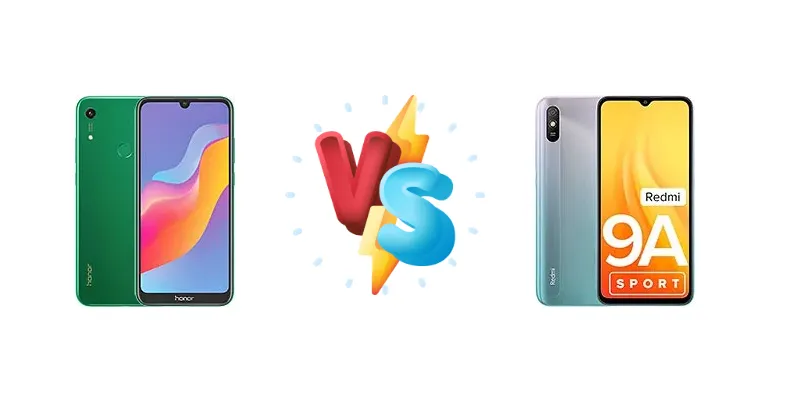
The Honor 8A Prime and Xiaomi Redmi 9A Sport represent the fiercely competitive sub-$150 smartphone market. Both devices aim to deliver essential smartphone functionality at an incredibly accessible price point. However, subtle differences in their chipsets and features can significantly impact the user experience. This comparison dissects these differences to determine which phone offers the best value for budget-conscious consumers.
🏆 Quick Verdict
For the average user prioritizing basic tasks and occasional light gaming, the Xiaomi Redmi 9A Sport edges out the Honor 8A Prime. The Helio G25 chipset, while not a powerhouse, offers a slight performance advantage and the inclusion of 10W charging provides a more convenient user experience, despite both phones being limited in overall capabilities.
| Network |
|---|
| 2G bands | GSM 850 / 900 / 1800 / 1900 | GSM 850 / 900 / 1800 / 1900 |
| 3G bands | HSDPA 850 / 900 / 1900 / 2100 | HSDPA 850 / 900 / 2100 |
| 4G bands | 1, 3, 5, 7, 8, 20 | 1, 3, 5, 8, 40, 41 |
| Speed | HSPA 42.2/5.76 Mbps, LTE Cat4 150/50 Mbps | HSPA, LTE |
| Technology | GSM / HSPA / LTE | GSM / HSPA / LTE |
| Launch |
|---|
| Announced | 2020, March 30. Released 2020, March 30 | 2021, September 28 |
| Status | Discontinued | Available. Released 2021, September 28 |
| Body |
|---|
| Dimensions | 156.3 x 73.5 x 8.2 mm (6.15 x 2.89 x 0.32 in) | 164.9 x 77.1 x 9 mm (6.49 x 3.04 x 0.35 in) |
| SIM | Nano-SIM + Nano-SIM | Nano-SIM + Nano-SIM |
| Weight | 150 g (5.29 oz) | 194 g (6.84 oz) |
| | - | Water-repellent coating |
| Display |
|---|
| Resolution | 720 x 1560 pixels, 19.5:9 ratio (~282 ppi density) | 720 x 1600 pixels, 20:9 ratio (~269 ppi density) |
| Size | 6.09 inches, 91.0 cm2 (~79.2% screen-to-body ratio) | 6.53 inches, 102.9 cm2 (~81.0% screen-to-body ratio) |
| Type | IPS LCD | IPS LCD, 400 nits (typ) |
| Platform |
|---|
| CPU | Octa-core (4x2.3 GHz Cortex-A53 & 4x1.8 GHz Cortex-A53) | Octa-core (4x2.0 GHz Cortex-A53 & 4x1.5 GHz Cortex-A53) |
| Chipset | Mediatek MT6765 Helio P35 (12 nm) | Mediatek MT6762G Helio G25 (12 nm) |
| GPU | PowerVR GE8320 | PowerVR GE8320 |
| OS | Android 9.0 (Pie), EMUI 9 | Android 10, MIUI 12 |
| Memory |
|---|
| Card slot | microSDXC (dedicated slot) | microSDXC (dedicated slot) |
| Internal | 64GB 3GB RAM | 32GB 2GB RAM, 32GB 3GB RAM |
| | eMMC 5.1 | eMMC 5.1 |
| Main Camera |
|---|
| Features | LED flash, HDR, panorama | LED flash, HDR |
| Single | 13 MP, f/1.8, PDAF | 13 MP, f/2.2, 28mm (wide), 1.0µm, PDAF |
| Video | 1080p@30fps | 1080p@30/60fps |
| Selfie camera |
|---|
| Features | HDR | HDR |
| Single | 8 MP, f/2.0 | 5 MP, f/2.2, (wide), 1.12µm |
| Video | 1080p@30fps | 1080p@30fps |
| Sound |
|---|
| 3.5mm jack | Yes | Yes |
| 35mm jack | Yes | Yes |
| Loudspeaker | Yes | Yes |
| Comms |
|---|
| Bluetooth | 4.2, A2DP, LE | 5.0, A2DP, LE |
| NFC | Yes | No |
| Positioning | GPS, GLONASS, BDS | GPS, GLONASS, BDS |
| Radio | FM radio | FM radio |
| USB | microUSB 2.0 | microUSB 2.0, OTG |
| WLAN | Wi-Fi 802.11 b/g/n, Wi-Fi Direct | Wi-Fi 802.11 a/b/g/n, Wi-Fi Direct |
| Features |
|---|
| Sensors | Fingerprint (rear-mounted), accelerometer, proximity | Accelerometer, proximity |
| Battery |
|---|
| Charging | - | 10W wired |
| Type | Li-Po 3020 mAh | Li-Po 5000 mAh |
| Misc |
|---|
| Colors | Black, Blue, Green | Carbon Black, Coral Green, Metallic Blue |
| Models | JAT-LX1 | - |
| Price | About 110 EUR | About 100 EUR |
Honor 8A Prime
- Potentially slightly faster single-core performance due to higher CPU clock speed.
- Established brand reputation (Honor).
- Likely similar battery life to the Redmi 9A Sport.
- Slower charging speeds.
- Less optimized chipset for gaming compared to the Helio G25.
Xiaomi Redmi 9A Sport
- Helio G25 chipset offers better GPU performance for light gaming.
- 10W wired charging for faster top-ups.
- Xiaomi’s MIUI software often includes useful features.
- Potentially slightly slower single-core performance.
- Xiaomi’s MIUI can include bloatware.
Display Comparison
Neither device boasts a standout display. Both likely utilize LCD panels, typical for this price bracket. Detailed display specs (resolution, brightness) are unavailable, but we can infer similar performance. The focus here isn't on visual fidelity, but rather basic readability. Bezels are expected to be noticeable on both, maximizing screen real estate within the budget constraints. Color accuracy is unlikely to be a strong point on either device.
Camera Comparison
Camera performance on both devices will be basic. Detailed sensor information is missing, but it’s safe to assume both feature a primary sensor paired with depth or macro sensors of limited utility. Image quality will be acceptable in good lighting conditions, but expect significant noise and a lack of detail in low light. The Redmi 9A Sport may have a slight edge due to potential software optimizations within Xiaomi’s camera app, but the difference will be minimal. Focusing on the primary sensor’s megapixel count is misleading; sensor size and image processing are far more important, and data on these is unavailable.
Performance
The core difference lies in the chipsets. The Redmi 9A Sport’s Mediatek Helio G25 (12nm) features a slightly lower clocked CPU (2.0 GHz vs 2.3 GHz on the 8A Prime’s Helio P35) but benefits from architectural improvements within the 'G' series, geared towards gaming. While both use Cortex-A53 cores, the G25’s GPU is more capable. This translates to a smoother experience with graphically demanding apps, even if both phones struggle with modern, high-end titles. The 8A Prime’s higher CPU clock speed might offer a marginal advantage in single-core tasks, but the G25’s overall system optimization likely provides a more consistent experience. Both devices will likely be paired with limited RAM (likely 2GB or 3GB), further impacting multitasking performance.
Battery Life
Both phones likely feature batteries in the 5000mAh range, providing all-day battery life with moderate usage. However, the Redmi 9A Sport’s inclusion of 10W wired charging is a significant advantage. The Honor 8A Prime likely relies on slower charging speeds (potentially 5W), resulting in considerably longer charge times. This difference impacts convenience; the Redmi 9A Sport can be topped up more quickly when needed, while the 8A Prime requires a longer commitment to the charger.
Buying Guide
Buy the Honor 8A Prime if you prioritize a slightly more established brand reputation and are comfortable with slower charging speeds. It's a solid choice for users who primarily need a phone for calls, texts, and basic social media. Buy the Xiaomi Redmi 9A Sport if you prefer a marginally faster processor for smoother app switching and a more standard charging experience, making it better suited for users who occasionally engage in light mobile gaming or video streaming.
Frequently Asked Questions
❓ Will the Redmi 9A Sport handle PUBG Mobile or Call of Duty Mobile?
While the Helio G25 is geared towards gaming, both phones will struggle with PUBG Mobile or Call of Duty Mobile at higher settings. You'll likely need to play at the lowest graphics settings and frame rates to achieve a playable experience. Expect occasional stuttering and lag.
❓ How long will it take to fully charge the Honor 8A Prime?
Given the likely 5W charging, fully charging the Honor 8A Prime will take approximately 4-5 hours. This is significantly longer than the Redmi 9A Sport's 10W charging, which will take around 2.5-3 hours.
❓ Is the storage expandable on either device?
Both the Honor 8A Prime and Xiaomi Redmi 9A Sport typically include a dedicated microSD card slot, allowing you to expand the storage capacity. This is crucial given the limited internal storage options often found in this price range.
❓ Which phone is better for watching videos?
Neither phone excels in video playback. The LCD panels will offer acceptable viewing angles and color reproduction, but don't expect vibrant colors or high contrast. The Redmi 9A Sport's slightly more efficient chipset might translate to marginally longer video playback time.