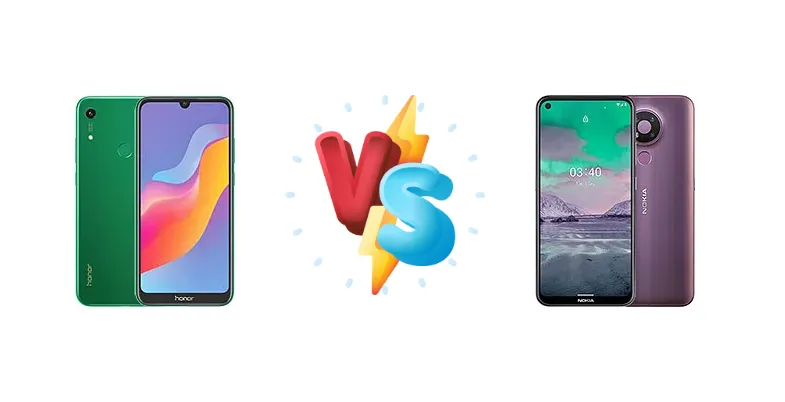
The Honor 8A Prime and Nokia 3.4 represent the lower end of the smartphone market, targeting users prioritizing affordability. However, beneath the similar price points lie significant differences in their core components, particularly the chipsets. This comparison dives deep into the Mediatek Helio P35 powering the Honor 8A Prime and the Qualcomm Snapdragon 460 in the Nokia 3.4, analyzing their impact on performance, efficiency, and overall user experience.
🏆 Quick Verdict
For the average user, the Nokia 3.4 is the better choice. While both phones target the budget segment, the Snapdragon 460’s 11nm process and more modern Cortex-A73 cores provide a noticeable performance advantage and improved power efficiency over the Honor 8A Prime’s older Helio P35. The 10W charging is a minor drawback, but the overall experience is smoother.
| Network |
|---|
| 2G bands | GSM 850 / 900 / 1800 / 1900 | GSM 850 / 900 / 1800 / 1900 |
| 3G bands | HSDPA 850 / 900 / 1900 / 2100 | HSDPA 850 / 900 / 1700(AWS) / 1900 / 2100 |
| 4G bands | 1, 3, 5, 7, 8, 20 | 1, 2, 3, 4, 5, 7, 8, 12, 17, 13, 28, 66 |
| Speed | HSPA 42.2/5.76 Mbps, LTE Cat4 150/50 Mbps | HSPA, LTE |
| Technology | GSM / HSPA / LTE | GSM / HSPA / LTE |
| Launch |
|---|
| Announced | 2020, March 30. Released 2020, March 30 | 2020, September 22. Released 2020, October 26 |
| Status | Discontinued | Discontinued |
| Body |
|---|
| Dimensions | 156.3 x 73.5 x 8.2 mm (6.15 x 2.89 x 0.32 in) | 161 x 76 x 8.7 mm (6.34 x 2.99 x 0.34 in) |
| SIM | Nano-SIM + Nano-SIM | · Nano-SIM· Nano-SIM + Nano-SIM |
| Weight | 150 g (5.29 oz) | 180 g (6.35 oz) |
| Display |
|---|
| Resolution | 720 x 1560 pixels, 19.5:9 ratio (~282 ppi density) | 720 x 1560 pixels, 19.5:9 ratio (~269 ppi density) |
| Size | 6.09 inches, 91.0 cm2 (~79.2% screen-to-body ratio) | 6.39 inches, 100.2 cm2 (~81.9% screen-to-body ratio) |
| Type | IPS LCD | IPS LCD, 400 nits (typ) |
| Platform |
|---|
| CPU | Octa-core (4x2.3 GHz Cortex-A53 & 4x1.8 GHz Cortex-A53) | Octa-core (4x1.8 GHz Cortex-A73 & 4x1.8 GHz Cortex-A53) |
| Chipset | Mediatek MT6765 Helio P35 (12 nm) | Qualcomm SM4250 Snapdragon 460 (11 nm) |
| GPU | PowerVR GE8320 | Adreno 610 |
| OS | Android 9.0 (Pie), EMUI 9 | Android 10, upgradable to Android 11 |
| Memory |
|---|
| Card slot | microSDXC (dedicated slot) | microSDXC (dedicated slot) |
| Internal | 64GB 3GB RAM | 32GB 3GB RAM, 64GB 3GB RAM, 64GB 4GB RAM |
| | eMMC 5.1 | eMMC 5.1 |
| Main Camera |
|---|
| Features | LED flash, HDR, panorama | LED flash, HDR, panorama |
| Single | 13 MP, f/1.8, PDAF | - |
| Triple | - | 13 MP, (wide), PDAF
5 MP, (ultrawide)
Auxiliary lens |
| Video | 1080p@30fps | 1080p@30fps |
| Selfie camera |
|---|
| Features | HDR | - |
| Single | 8 MP, f/2.0 | 8 MP, (wide) |
| Video | 1080p@30fps | 1080p@30fps |
| Sound |
|---|
| 3.5mm jack | Yes | Yes |
| 35mm jack | Yes | Yes |
| Loudspeaker | Yes | Yes |
| Comms |
|---|
| Bluetooth | 4.2, A2DP, LE | 4.2, A2DP, aptX |
| NFC | Yes | Yes (market/region dependent) |
| Positioning | GPS, GLONASS, BDS | GPS, GLONASS, GALILEO, BDS |
| Radio | FM radio | FM radio |
| USB | microUSB 2.0 | USB Type-C 2.0 |
| WLAN | Wi-Fi 802.11 b/g/n, Wi-Fi Direct | Wi-Fi 802.11 b/g/n |
| Features |
|---|
| Sensors | Fingerprint (rear-mounted), accelerometer, proximity | Fingerprint (rear-mounted), accelerometer, gyro, proximity |
| Battery |
|---|
| Charging | - | 10W wired |
| Type | Li-Po 3020 mAh | Li-Po 4000 mAh |
| Misc |
|---|
| Colors | Black, Blue, Green | Fjord, Dusk, Charcoal |
| Models | JAT-LX1 | TA-1288, TA-1285, TA-1283 |
| Price | About 110 EUR | About 100 EUR |
| SAR | - | 0.83 W/kg (head) 1.05 W/kg (body) |
| SAR EU | - | 0.36 W/kg (head) 1.56 W/kg (body) |
Honor 8A Prime
- Potentially lower price point
- May have slightly larger battery capacity (unconfirmed)
- Simple and straightforward Android experience
- Less powerful and efficient chipset
- Older CPU architecture
- Likely slower app launch times
Nokia 3.4
- More efficient Snapdragon 460 chipset
- Modern Cortex-A73 cores for improved performance
- Better thermal management
- Potentially longer software support
- Slower 10W charging
- May be slightly more expensive
- Stock Android may lack some custom features
Display Comparison
Neither device boasts a standout display. Specifications are not provided, so we must rely on market positioning. Both likely feature 720p+ LCD panels. However, the Nokia 3.4, being a slightly newer device, may benefit from minor improvements in color accuracy and viewing angles. The Honor 8A Prime’s display is likely to be more susceptible to wash-out under direct sunlight due to potentially lower peak brightness.
Camera Comparison
Without detailed sensor information, a direct comparison is difficult. Both phones likely feature a primary camera paired with depth or macro sensors of limited utility. The Nokia 3.4, given its slightly higher market positioning, *may* have a slightly larger primary sensor, allowing for better low-light performance. However, image processing algorithms play a significant role, and without sample images, it’s impossible to definitively declare a winner. The inclusion of a 2MP macro lens on either device is largely a marketing gimmick and unlikely to produce compelling results.
Performance
The core difference lies in the chipsets. The Honor 8A Prime’s Mediatek Helio P35, built on a 12nm process, utilizes a combination of Cortex-A53 cores clocked at 2.3GHz and 1.8GHz. The Nokia 3.4’s Qualcomm Snapdragon 460, fabricated on a more efficient 11nm process, features four Cortex-A73 cores at 1.8GHz alongside four Cortex-A53 cores at the same speed. The A73 cores represent a significant architectural improvement over the A53, offering better single-core performance, crucial for app launch times and general responsiveness. This translates to a smoother user experience on the Nokia 3.4, especially when multitasking. The 11nm process also contributes to better thermal management, reducing the likelihood of throttling during sustained workloads.
Battery Life
Battery capacity is not specified. However, the Nokia 3.4’s Snapdragon 460’s superior power efficiency is a key advantage. While the Honor 8A Prime may have a slightly larger battery, the Helio P35’s less efficient architecture will likely result in shorter real-world battery life. The Nokia 3.4 supports 10W wired charging, which is slow by modern standards, but the more efficient chipset means it will likely reach a full charge in a comparable timeframe to the Honor 8A Prime, even if the latter has a larger battery.
Buying Guide
Buy the Honor 8A Prime if you need a phone primarily for basic tasks like calls, texts, and light social media, and are extremely price-sensitive. Its older chipset will struggle with demanding apps. Buy the Nokia 3.4 if you prefer a more responsive experience, even for moderate multitasking, and value a chipset built on a more efficient manufacturing process, offering better long-term performance and potentially longer software support.
Frequently Asked Questions
❓ Will the Snapdragon 460 in the Nokia 3.4 handle popular games like PUBG Mobile?
While the Snapdragon 460 isn't a gaming powerhouse, it can run PUBG Mobile at lower settings. Expect frame rate dips during intense action. The Helio P35 in the Honor 8A Prime will struggle significantly more, requiring even lower settings and potentially resulting in an unplayable experience.
❓ Does the Nokia 3.4 benefit from Qualcomm’s Quick Charge technology, despite the 10W charger?
The Snapdragon 460 supports Quick Charge, but the included 10W charger doesn't utilize this feature. You could potentially use a compatible Quick Charge charger for faster charging speeds, but the Nokia 3.4's power delivery capabilities are limited.
❓ Is the Honor 8A Prime a good choice for someone upgrading from a feature phone?
The Honor 8A Prime is a viable option for a first smartphone, especially if budget is the primary concern. However, be aware of its performance limitations. The Nokia 3.4 offers a smoother and more future-proof experience, even for a first-time smartphone user.