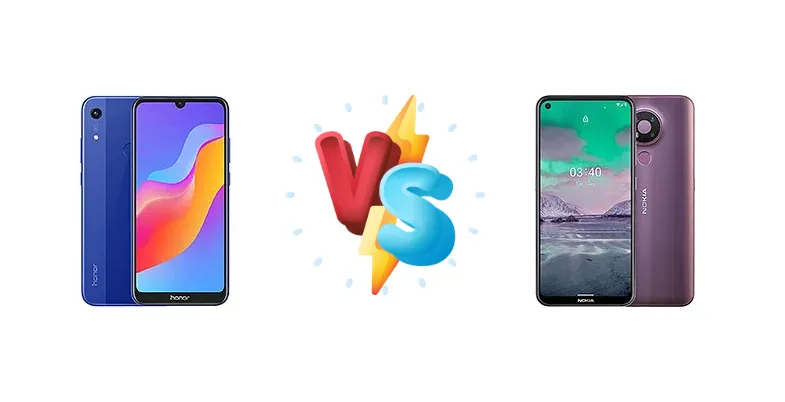
The Honor 8A 2020 and Nokia 3.4 represent two distinct approaches to the ultra-budget smartphone market. The Honor 8A 2020, a slightly older model, aims for affordability, while the Nokia 3.4 leverages a newer Qualcomm chipset for improved performance. This comparison dissects their key differences to help you choose the best option for your needs.
🏆 Quick Verdict
For most users, the Nokia 3.4 is the better choice. Its Qualcomm Snapdragon 460 chipset, built on an 11nm process, delivers noticeably smoother performance than the Honor 8A 2020’s Mediatek Helio P35. While both phones target the budget segment, the Nokia 3.4 offers a more future-proof experience.
| Network |
|---|
| 2G bands | GSM 850 / 900 / 1800 / 1900 | GSM 850 / 900 / 1800 / 1900 |
| 3G bands | HSDPA 850 / 900 / 1900 / 2100 | HSDPA 850 / 900 / 1700(AWS) / 1900 / 2100 |
| 4G bands | 1, 3, 5, 7, 8, 20, 38, 40, 41 | 1, 2, 3, 4, 5, 7, 8, 12, 17, 13, 28, 66 |
| Speed | HSPA 42.2/5.76 Mbps, LTE Cat4 150/50 Mbps | HSPA, LTE |
| Technology | GSM / HSPA / LTE | GSM / HSPA / LTE |
| Launch |
|---|
| Announced | 2020, April 10. Released 2020, April 15 | 2020, September 22. Released 2020, October 26 |
| Status | Discontinued | Discontinued |
| Body |
|---|
| Dimensions | 156.3 x 73.5 x 8.2 mm (6.15 x 2.89 x 0.32 in) | 161 x 76 x 8.7 mm (6.34 x 2.99 x 0.34 in) |
| SIM | Nano-SIM + Nano-SIM | · Nano-SIM· Nano-SIM + Nano-SIM |
| Weight | 150 g (5.29 oz) | 180 g (6.35 oz) |
| Display |
|---|
| Resolution | 720 x 1560 pixels, 19.5:9 ratio (~282 ppi density) | 720 x 1560 pixels, 19.5:9 ratio (~269 ppi density) |
| Size | 6.09 inches, 91.0 cm2 (~79.2% screen-to-body ratio) | 6.39 inches, 100.2 cm2 (~81.9% screen-to-body ratio) |
| Type | IPS LCD | IPS LCD, 400 nits (typ) |
| Platform |
|---|
| CPU | Octa-core (4x2.3 GHz Cortex-A53 & 4x1.8 GHz Cortex-A53) | Octa-core (4x1.8 GHz Cortex-A73 & 4x1.8 GHz Cortex-A53) |
| Chipset | Mediatek MT6765 Helio P35 (12 nm) | Qualcomm SM4250 Snapdragon 460 (11 nm) |
| GPU | PowerVR GE8320 | Adreno 610 |
| OS | Android 9.0 (Pie), EMUI 9 | Android 10, upgradable to Android 11 |
| Memory |
|---|
| Card slot | microSDXC (dedicated slot) | microSDXC (dedicated slot) |
| Internal | 64GB 3GB RAM | 32GB 3GB RAM, 64GB 3GB RAM, 64GB 4GB RAM |
| | eMMC 5.1 | eMMC 5.1 |
| Main Camera |
|---|
| Features | LED flash, HDR, panorama | LED flash, HDR, panorama |
| Single | 13 MP, f/1.8, PDAF | - |
| Triple | - | 13 MP, (wide), PDAF
5 MP, (ultrawide)
Auxiliary lens |
| Video | 1080p@30fps | 1080p@30fps |
| Selfie camera |
|---|
| Features | HDR | - |
| Single | 8 MP, f/2.0 | 8 MP, (wide) |
| Video | 1080p@30fps | 1080p@30fps |
| Sound |
|---|
| 3.5mm jack | Yes | Yes |
| 35mm jack | Yes | Yes |
| Loudspeaker | Yes | Yes |
| Comms |
|---|
| Bluetooth | 4.2, A2DP, LE | 4.2, A2DP, aptX |
| NFC | Yes | Yes (market/region dependent) |
| Positioning | GPS, GLONASS, GALILEO, BDS | GPS, GLONASS, GALILEO, BDS |
| Radio | FM radio | FM radio |
| USB | USB Type-C 2.0, OTG | USB Type-C 2.0 |
| WLAN | Wi-Fi 802.11 b/g/n, Wi-Fi Direct | Wi-Fi 802.11 b/g/n |
| Features |
|---|
| Sensors | Fingerprint (rear-mounted), accelerometer, gyro, proximity, compass | Fingerprint (rear-mounted), accelerometer, gyro, proximity |
| Battery |
|---|
| Charging | - | 10W wired |
| Type | Li-Po 3020 mAh | Li-Po 4000 mAh |
| Misc |
|---|
| Colors | Black, Blue | Fjord, Dusk, Charcoal |
| Models | - | TA-1288, TA-1285, TA-1283 |
| Price | About 150 EUR | About 100 EUR |
| SAR | - | 0.83 W/kg (head) 1.05 W/kg (body) |
| SAR EU | - | 0.36 W/kg (head) 1.56 W/kg (body) |
Honor 8A 2020
- Potentially lower price point
- Large battery capacity (estimated)
- Simple and straightforward user experience
- Older, less efficient chipset
- Slower performance
- Less future-proof
Nokia 3.4
- More powerful Snapdragon 460 chipset
- Better performance for multitasking and apps
- More efficient 11nm process
- 10W charging
- Slightly higher price
- May not have significantly better camera performance
- Charging speed is relatively slow
Display Comparison
Neither device boasts a standout display. Both likely feature 720p+ resolution LCD panels, typical for this price point. However, the Nokia 3.4 benefits from a more modern chipset potentially allowing for better image processing. The Honor 8A 2020’s display specifications are less readily available, but given its market positioning, it’s unlikely to offer superior color accuracy or brightness compared to the Nokia 3.4. Bezels are expected to be substantial on both devices.
Camera Comparison
Camera performance is likely to be similar on both devices, with both likely featuring a primary sensor paired with depth or macro lenses of limited utility. Without specific sensor size information, it’s difficult to definitively declare a winner. However, the Nokia 3.4’s image signal processor (ISP) within the Snapdragon 460 likely offers more advanced image processing capabilities, potentially resulting in slightly better dynamic range and noise reduction. The Honor 8A 2020’s camera system is likely more basic, relying on software enhancements to improve image quality.
Performance
The core difference lies in the chipsets. The Nokia 3.4’s Qualcomm Snapdragon 460 (11nm) is a significant upgrade over the Honor 8A 2020’s Mediatek Helio P35 (12nm). The Snapdragon 460 utilizes more efficient Cortex-A73 cores alongside A53 cores, resulting in a more responsive experience for multitasking and app loading. The Helio P35 relies solely on Cortex-A53 cores, which are less performant. While both are octa-core, the architectural advantage of the Snapdragon 460 translates to a tangible performance boost, particularly for users running multiple apps or playing less demanding games. The 11nm process node of the Snapdragon 460 also contributes to better thermal efficiency, reducing the likelihood of throttling under sustained load.
Battery Life
Both phones likely feature around 4000-5000mAh batteries, providing all-day battery life for moderate usage. The Nokia 3.4 includes 10W wired charging, which is relatively slow. The Honor 8A 2020’s charging speed is not explicitly stated, but is likely similar. The difference in chipset efficiency – the Snapdragon 460’s 11nm process – may result in slightly longer battery life on the Nokia 3.4, offsetting any potential advantage from a larger battery on the Honor 8A 2020.
Buying Guide
Buy the Honor 8A 2020 if your primary need is an extremely affordable phone for basic tasks like calls, texts, and light social media. It’s a viable option for first-time smartphone users or as a temporary device. Buy the Nokia 3.4 if you prioritize a more responsive user experience, better app performance, and a slightly more modern chipset, even if it means spending a bit more.
Frequently Asked Questions
❓ Will the Nokia 3.4 handle popular games like PUBG Mobile?
The Snapdragon 460 in the Nokia 3.4 can run PUBG Mobile, but likely at lower graphics settings and frame rates. Expect playable performance at balanced or low settings to maintain a stable experience. The Honor 8A 2020’s Helio P35 will struggle more with demanding titles.
❓ How does the Snapdragon 460’s efficiency impact daily usage on the Nokia 3.4?
The Snapdragon 460’s 11nm process node is more power-efficient than the Helio P35’s 12nm process. This translates to slightly longer battery life during typical usage, such as browsing, social media, and streaming video. You may notice a difference in standby time as well.
❓ Is the Nokia 3.4 likely to receive software updates?
Nokia is known for providing relatively timely Android updates, even on its budget devices. The Nokia 3.4 is likely to receive at least one major Android version update and regular security patches, offering a longer software support lifespan compared to the Honor 8A 2020.