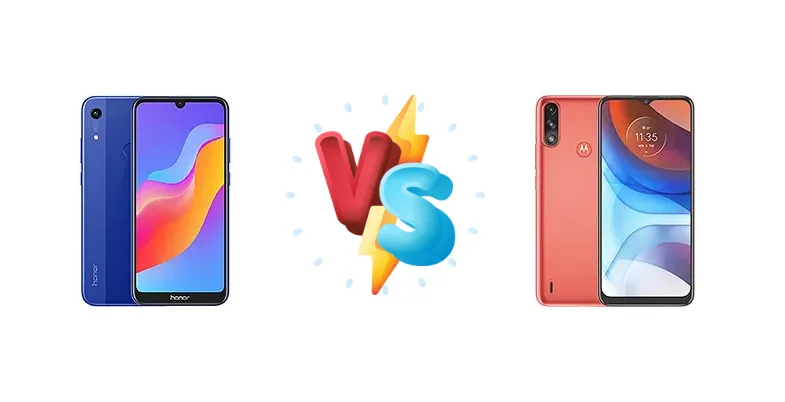
The Honor 8A 2020 and Motorola Moto E7i Power represent the extreme end of the budget smartphone spectrum. While both aim to deliver essential smartphone functionality at a low price, they take drastically different approaches to achieving this, particularly in their core processing power and efficiency. This comparison dissects these differences to determine which device offers the best value for users prioritizing performance versus battery longevity.
🏆 Quick Verdict
For users needing a slightly more responsive experience for basic tasks and occasional light gaming, the Honor 8A 2020 is the better choice. Its Mediatek Helio P35, despite being older, offers a performance edge over the Unisoc SC9863A in the Moto E7i Power. However, the Moto E7i Power’s 10W charging and potentially better power efficiency may appeal to those prioritizing extended battery life.
| Network |
|---|
| 2G bands | GSM 850 / 900 / 1800 / 1900 | GSM 850 / 900 / 1800 / 1900 |
| 3G bands | HSDPA 850 / 900 / 1900 / 2100 | HSDPA 850 / 900 / 1700(AWS) / 1900 / 2100 |
| 4G bands | 1, 3, 5, 7, 8, 20, 38, 40, 41 | LTE |
| Speed | HSPA 42.2/5.76 Mbps, LTE Cat4 150/50 Mbps | HSPA, LTE |
| Technology | GSM / HSPA / LTE | GSM / HSPA / LTE |
| Launch |
|---|
| Announced | 2020, April 10. Released 2020, April 15 | 2021, February 23 |
| Status | Discontinued | Available. Released 2021, March 15 |
| Body |
|---|
| Build | - | Glass front, plastic back, plastic frame |
| Dimensions | 156.3 x 73.5 x 8.2 mm (6.15 x 2.89 x 0.32 in) | 165.1 x 75.9 x 9.2 mm (6.5 x 2.99 x 0.36 in) |
| SIM | Nano-SIM + Nano-SIM | Nano-SIM + Nano-SIM |
| Weight | 150 g (5.29 oz) | 200 g (7.05 oz) |
| | - | Water-repellent design |
| Display |
|---|
| Resolution | 720 x 1560 pixels, 19.5:9 ratio (~282 ppi density) | 720 x 1600 pixels, 20:9 ratio (~270 ppi density) |
| Size | 6.09 inches, 91.0 cm2 (~79.2% screen-to-body ratio) | 6.51 inches, 102.3 cm2 (~81.7% screen-to-body ratio) |
| Type | IPS LCD | IPS LCD, 380 nits (typ) |
| Platform |
|---|
| CPU | Octa-core (4x2.3 GHz Cortex-A53 & 4x1.8 GHz Cortex-A53) | Octa-core (4x1.6 GHz Cortex-A55 & 4x1.2 GHz Cortex-A55) |
| Chipset | Mediatek MT6765 Helio P35 (12 nm) | Unisoc SC9863A (28 nm) |
| GPU | PowerVR GE8320 | IMG8322 |
| OS | Android 9.0 (Pie), EMUI 9 | Android 10 (Go edition) |
| Memory |
|---|
| Card slot | microSDXC (dedicated slot) | microSDXC (uses shared SIM slot) |
| Internal | 64GB 3GB RAM | 32GB 2GB RAM |
| | eMMC 5.1 | eMMC 5.1 |
| Main Camera |
|---|
| Dual | - | 13 MP, f/2.0, 26mm (wide), 1/3.1", 1.12µm, PDAF
2 MP (macro) |
| Features | LED flash, HDR, panorama | LED flash, HDR, panorama |
| Single | 13 MP, f/1.8, PDAF | - |
| Video | 1080p@30fps | 1080p@30fps |
| Selfie camera |
|---|
| Features | HDR | HDR |
| Single | 8 MP, f/2.0 | 5 MP, f/2.2, 27mm (wide), 1.12µm |
| Video | 1080p@30fps | 1080p@30fps |
| Sound |
|---|
| 3.5mm jack | Yes | Yes |
| 35mm jack | Yes | Yes |
| Loudspeaker | Yes | Yes |
| Comms |
|---|
| Bluetooth | 4.2, A2DP, LE | 4.2, A2DP |
| NFC | Yes | No |
| Positioning | GPS, GLONASS, GALILEO, BDS | GPS, GLONASS, GALILEO |
| Radio | FM radio | Unspecified |
| USB | USB Type-C 2.0, OTG | USB Type-C 2.0 |
| WLAN | Wi-Fi 802.11 b/g/n, Wi-Fi Direct | Wi-Fi 802.11 b/g/n |
| Features |
|---|
| Sensors | Fingerprint (rear-mounted), accelerometer, gyro, proximity, compass | Fingerprint (rear-mounted), accelerometer, proximity |
| Battery |
|---|
| Charging | - | 10W wired |
| Type | Li-Po 3020 mAh | Li-Ion 5000 mAh |
| Misc |
|---|
| Colors | Black, Blue | Tahiti Blue, Coral Red |
| Models | - | XT2097-13 |
| Price | About 150 EUR | About 120 EUR |
Honor 8A 2020
- More powerful processor for smoother performance
- More efficient chipset (12nm process)
- Potentially faster app loading times
- May have shorter battery life compared to Moto E7i Power
- Charging speed not specified, likely slower than modern standards
Motorola Moto E7i Power
- Potentially longer battery life due to chipset efficiency (despite 28nm)
- Lower price point (likely)
- 10W charging, while slow, provides a consistent trickle charge
- Significantly less powerful processor
- Less responsive user experience
- 28nm process node is less energy efficient
Display Comparison
Neither device is expected to boast a high-end display. Details on panel type and resolution are missing, but given the price point, both likely utilize LCD panels. The key difference lies under the hood: the processing power driving the display. A more powerful chipset, like the Helio P35 in the Honor 8A 2020, can contribute to smoother animations and faster response times, even on a similar panel. Bezels are likely substantial on both devices, reflecting their budget nature.
Camera Comparison
Camera performance is likely to be similar on both devices, leaning towards basic functionality. Details on sensor sizes and apertures are unavailable, but given the market segment, expect 13MP or similar main sensors. Image processing will likely be heavily reliant on software optimization, and neither device is expected to excel in low-light conditions. Any additional cameras (likely 2MP depth or macro sensors) will offer limited utility due to their small sensor size and lack of optical image stabilization (OIS).
Performance
The core of the difference lies in the chipsets. The Honor 8A 2020’s Mediatek Helio P35 (12nm) features an octa-core CPU with a split configuration of 4x2.3 GHz Cortex-A53 and 4x1.8 GHz Cortex-A53 cores. This offers a higher clock speed and, crucially, a more advanced manufacturing process (12nm) compared to the Motorola Moto E7i Power’s Unisoc SC9863A (28nm). The SC9863A’s CPU consists of 4x1.6 GHz Cortex-A55 and 4x1.2 GHz Cortex-A55 cores. While both are octa-core, the Cortex-A55 architecture is more efficient but generally less powerful than the A53. The 28nm process node on the Unisoc chip is significantly less efficient, meaning it will generate more heat and consume more power for the same level of performance. This translates to a noticeable performance advantage for the Honor 8A 2020 in most tasks.
Battery Life
The Motorola Moto E7i Power’s 10W wired charging is a significant limitation. While battery capacity isn’t specified, the Unisoc SC9863A’s lower efficiency suggests a larger battery might be necessary to achieve comparable battery life to the Honor 8A 2020. The Honor 8A 2020’s Helio P35, despite its higher performance, benefits from a more efficient manufacturing process, potentially allowing for longer runtimes on a smaller battery. Expect a full charge on the Moto E7i Power to take considerably longer than on a device with faster charging capabilities.
Buying Guide
Buy the Honor 8A 2020 if you need a phone that feels a bit snappier for everyday tasks like browsing, social media, and light app usage. It’s suited for users who occasionally play less demanding mobile games. Buy the Motorola Moto E7i Power if you prioritize maximizing battery life above all else, and your usage primarily consists of calls, texts, and very basic app usage. It’s ideal for users who need a phone that can reliably last through a full day (or more) on a single charge, even with limited access to power outlets.
Frequently Asked Questions
❓ Will the Unisoc SC9863A in the Moto E7i Power struggle with multitasking?
Yes, the Unisoc SC9863A is a very entry-level chipset. While it can handle basic tasks like calling, texting, and light browsing, it will likely struggle with running multiple apps simultaneously or switching between them quickly. Expect noticeable lag and slowdowns when multitasking.
❓ Is the Helio P35 in the Honor 8A 2020 capable of playing any mobile games?
The Helio P35 can handle less demanding mobile games like older titles or games with simplified graphics. However, it won't be able to run graphically intensive games like PUBG or Genshin Impact at high settings. Expect to lower the graphics settings and resolution for a playable experience.
❓ How long will it take to fully charge the Motorola Moto E7i Power with its 10W charging?
With 10W charging, expect a full charge to take approximately 3-4 hours, potentially longer depending on the battery capacity. This is significantly slower than modern fast-charging technologies.
❓ Does either phone support software updates beyond the initial Android version?
Given the budget nature of both devices, long-term software support is unlikely. Expect limited updates, potentially only security patches for a short period. Don't rely on receiving major Android version upgrades.