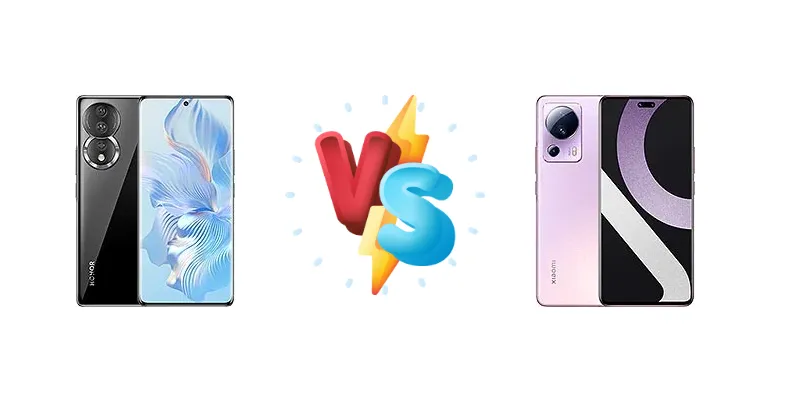
The Honor 80 and Xiaomi Civi 2 represent compelling options in the increasingly competitive mid-range smartphone market. While both aim for a stylish design and capable performance, they diverge in their core hardware choices, specifically the chipset and its implications for power efficiency and speed. This comparison dissects these differences to determine which device delivers the best overall experience.
🏆 Quick Verdict
For most users, the Xiaomi Civi 2 emerges as the slightly stronger choice. Its Snapdragon 7 Gen 1, built on a more efficient 4nm process, offers a performance edge and potentially better thermal management compared to the Honor 80’s Snapdragon 782G. However, the Honor 80 remains a viable option for those prioritizing a potentially more established brand reputation.
| Network |
|---|
| 2G bands | GSM 850 / 900 / 1800 / 1900 | GSM 850 / 900 / 1800 / 1900 |
| 3G bands | HSDPA 800 / 850 / 900 / 1700(AWS) / 1900 / 2100 | HSDPA 800 / 850 / 900 / 1700(AWS) / 1900 / 2100 |
| 4G bands | LTE | 1, 2, 3, 4, 5, 7, 8, 18, 19, 26, 34, 38, 39, 40, 41, 42 |
| 5G bands | SA/NSA | 1, 3, 5, 8, 28, 38, 41, 77, 78 SA/NSA |
| Speed | HSPA, LTE, 5G | HSPA, LTE, 5G |
| Technology | GSM / CDMA / HSPA / CDMA2000 / LTE / 5G | GSM / CDMA / HSPA / CDMA2000 / LTE / 5G |
| | CDMA2000 1x | CDMA2000 1x |
| Launch |
|---|
| Announced | 2022, November 23 | 2022, September 27 |
| Status | Available. Released 2022, December 02 | Available. Released 2022, September 27 |
| Body |
|---|
| Build | - | Glass front (Gorilla Glass 5), glass back, aluminum frame |
| Dimensions | 161.1 x 73.9 x 7.7 mm (6.34 x 2.91 x 0.30 in) | 159.2 x 72.7 x 7.2 mm (6.27 x 2.86 x 0.28 in) |
| SIM | Nano-SIM + Nano-SIM | Nano-SIM + Nano-SIM |
| Weight | 180 g (6.35 oz) | 171.8 g (6.07 oz) |
| Display |
|---|
| Protection | - | Corning Gorilla Glass 5 |
| Resolution | 1080 x 2400 pixels (~444 ppi density) | 1080 x 2400 pixels, 20:9 ratio (~402 ppi density) |
| Size | 6.67 inches, 107.9 cm2 (~90.7% screen-to-body ratio) | 6.55 inches, 103.6 cm2 (~89.5% screen-to-body ratio) |
| Type | OLED, 1B colors, 120Hz, 1000 nits (peak) | AMOLED, 1B colors, Dolby Vision, HDR10+, 120Hz, 1000 nits (peak) |
| Platform |
|---|
| CPU | Octa-core (1x2.7 GHz Cortex-A78 & 3x2.4 GHz Cortex-A78 & 4x1.8 GHz Cortex-A55) | Octa-core (1x2.4 GHz Cortex-A710 & 3x2.36 GHz Cortex-A710 & 4x1.8 GHz Cortex-A510) |
| Chipset | Qualcomm Snapdragon 782G (6 nm) | Qualcomm SM7450-AB Snapdragon 7 Gen 1 (4 nm) |
| GPU | Adreno 642L | Adreno 644 |
| OS | Android 12, MagicOS 7 | Android 12, MIUI 13 |
| Memory |
|---|
| Card slot | No | No |
| Internal | 256GB 8GB RAM, 256GB 12GB RAM, 512GB 12GB RAM | 128GB 8GB RAM, 256GB 8GB RAM, 256GB 12GB RAM |
| | - | UFS 2.2 |
| Main Camera |
|---|
| Features | LED flash, HDR, panorama | Color spectrum sensor, Dual-LED dual-tone flash, HDR, panorama |
| Single | 32 MP, f/2.4, (wide) | - |
| Triple | 160 MP, f/1.8, (wide), 1/1.56", 0.75µm, PDAF
8 MP, f/2.2, (ultrawide), AF
2 MP (macro) | 50 MP, f/1.8, (wide), 1/1.56", 1.0µm, PDAF
20 MP, f/2.2, 115˚ (ultrawide), 1/2.78", 1.0µm
2 MP (macro) |
| Video | 4K@30fps, 1080p@30/60fps, gyro-EIS | 4K@30fps, 1080p@30/60/120fps, 720p@960fps; gyro-EIS |
| Selfie camera |
|---|
| Dual | - | 32 MP, f/2.0, (wide), 1/2.8", 0.8µm, AF
32 MP, 100˚ (ultrawide), 1/2.8", 0.8µm |
| Features | HDR | 2 Dual-LED dual-tone flash, HDR, panorama |
| Single | 32 MP, f/2.4, (wide) | - |
| Video | 1080p@30fps, gyro-EIS | 1080p@30/60fps |
| Sound |
|---|
| 3.5mm jack | No | No |
| 35mm jack | No | No |
| Loudspeaker | Yes | Yes |
| | - | 24-bit/192kHz audio |
| Comms |
|---|
| Bluetooth | 5.2, A2DP, LE, aptX HD | 5.2, A2DP, LE |
| Infrared port | - | Yes |
| NFC | Yes | Yes |
| Positioning | GPS, GALILEO, GLONASS, BDS, QZSS | GPS (L1), GLONASS (G1), BDS (B1I+B1c), GALILEO (E1), QZSS (L1) |
| Radio | No | No |
| USB | USB Type-C 2.0, OTG | USB Type-C 2.0, OTG |
| WLAN | Wi-Fi 802.11 a/b/g/n/ac/6, dual-band, Wi-Fi Direct | Wi-Fi 802.11 a/b/g/n/ac/6, dual-band, Wi-Fi Direct |
| Features |
|---|
| Sensors | Fingerprint (under display, optical), accelerometer, gyro, compass | Fingerprint (under display, optical), accelerometer, gyro, proximity, compass |
| | Virtual proximity sensing | - |
| Battery |
|---|
| Charging | 66W wired, 3-50% in 15 min
5W reverse wired | 67W wired, PD3.0, 100% in 40 min |
| Type | Li-Po 4800 mAh | Li-Po 4500 mAh |
| Misc |
|---|
| Colors | Black, Green, Blue, Pink | Black, Blue, Violet, Silver, Hello Kitty |
| Models | ANN-AN00 | 2209129SC |
| Price | About 370 EUR | About 350 EUR |
Honor 80
- Potentially more established brand reputation.
- 66W fast charging is competitive.
- Reverse wired charging offers added convenience.
- Snapdragon 782G is less efficient than the 7 Gen 1.
- 6nm process may lead to more thermal throttling.
Xiaomi Civi 2
- Snapdragon 7 Gen 1 offers superior performance.
- 4nm process improves power efficiency.
- PD3.0 charging compatibility.
- Xiaomi's software experience can be polarizing.
- Brand recognition may be lower in some markets.
Display Comparison
Neither device's display specifications are provided, so a direct comparison is limited. However, given the market positioning, both likely feature OLED panels. The Civi 2's focus on aesthetics suggests a potentially higher emphasis on color accuracy and peak brightness to enhance visual appeal. Honor, historically, has focused on color science, so a comparable experience is expected. Bezels are likely similar, aiming for a modern, immersive viewing experience. Without specific data, it's reasonable to assume both offer good, but not class-leading, display quality.
Camera Comparison
Without detailed camera specifications, a precise comparison is difficult. However, the chipset plays a role in image signal processing (ISP) capabilities. The newer Snapdragon 7 Gen 1 in the Civi 2 likely offers more advanced ISP features, potentially leading to better dynamic range and noise reduction in photos and videos. Both phones likely feature a multi-camera setup, but the quality will depend heavily on sensor size and lens apertures, which are currently unknown. We can assume both will offer acceptable image quality for social media and casual photography, but the Civi 2 has the potential for superior results in challenging lighting conditions.
Performance
The core difference lies in the chipsets. The Xiaomi Civi 2’s Snapdragon 7 Gen 1 (4nm) boasts a more modern architecture and a smaller fabrication process compared to the Honor 80’s Snapdragon 782G (6nm). The 7 Gen 1 utilizes Cortex-A710 cores, offering a performance uplift over the 782G’s Cortex-A78 cores. While both are octa-core CPUs, the 4nm process of the 7 Gen 1 translates to improved power efficiency and potentially less thermal throttling during sustained workloads. The Honor 80's CPU configuration (1x2.7 GHz Cortex-A78, 3x2.4 GHz Cortex-A78, 4x1.8 GHz Cortex-A55) is slightly unusual with the repetition of the A78 core, potentially indicating a focus on sustained performance at the expense of peak efficiency. Users who frequently game or run demanding applications will likely see a tangible benefit from the Civi 2’s chipset.
Battery Life
Both devices offer fast charging – 66W for the Honor 80 and 67W for the Xiaomi Civi 2. The Civi 2’s support for PD3.0 is a minor advantage, offering broader compatibility with chargers. While the Honor 80 claims 3-50% charge in 15 minutes, the Civi 2 advertises 100% in 40 minutes. The 4nm process of the Snapdragon 7 Gen 1 in the Civi 2 should also contribute to better battery life during typical usage, offsetting any potential difference in battery capacity (which is currently unknown). The Civi 2’s combination of faster charging and potentially better efficiency gives it an edge in this category.
Buying Guide
Buy the Honor 80 if you prioritize a brand with a longer track record and are comfortable with a slightly older chipset. It’s a solid all-rounder for everyday tasks and casual gaming. Buy the Xiaomi Civi 2 if you value raw performance and efficiency, particularly if you engage in more demanding mobile gaming or multitasking. The 4nm Snapdragon 7 Gen 1 provides a noticeable advantage in these scenarios.
Frequently Asked Questions
❓ Will the Snapdragon 7 Gen 1 in the Xiaomi Civi 2 handle demanding games like Genshin Impact at high settings?
The Snapdragon 7 Gen 1 is capable of running Genshin Impact, but expect to make some compromises on graphics settings. While it won't deliver a flagship-level experience, it should provide a playable experience at medium to high settings with reasonable frame rates. The 4nm process will help mitigate thermal throttling during extended gaming sessions.
❓ Does the Honor 80's 66W charging significantly impact battery health over the long term?
While 66W charging is fast, modern smartphones employ battery management systems to minimize the impact of fast charging on long-term battery health. However, consistently using the fastest charging speeds *can* contribute to slightly faster battery degradation over several years. Using slower charging methods occasionally can help prolong battery lifespan.
❓ Is the difference in chipset performance between the Snapdragon 782G and 7 Gen 1 noticeable in everyday tasks like browsing and social media?
For basic tasks like browsing, social media, and messaging, the difference in performance between the two chipsets will be minimal and likely unnoticeable to most users. The benefits of the Snapdragon 7 Gen 1 become more apparent during more demanding tasks like gaming, video editing, or multitasking.