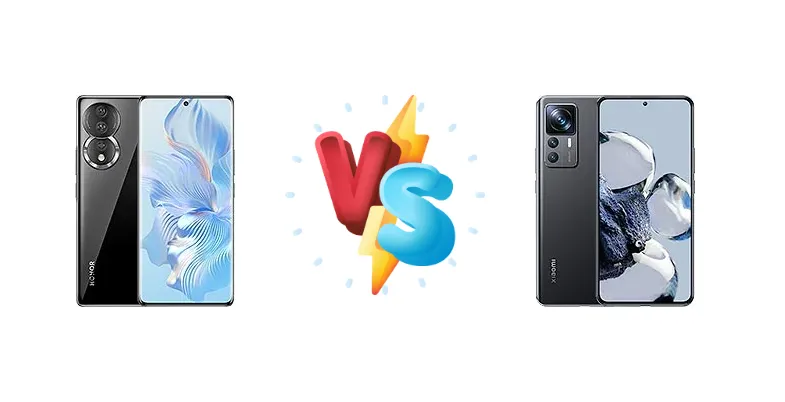
The Honor 80 and Xiaomi 12T Pro represent compelling options in the increasingly competitive mid-range smartphone market. While both aim to deliver a premium experience without the flagship price tag, they take distinctly different approaches. The Honor 80 focuses on a balanced package with a refined design, while the Xiaomi 12T Pro aggressively targets performance with a previous-generation flagship chipset and blazing-fast charging.
🏆 Quick Verdict
For the average user prioritizing raw performance and incredibly fast charging, the Xiaomi 12T Pro is the clear winner. Its Snapdragon 8+ Gen 1 offers a significant leap in processing power over the Honor 80’s Snapdragon 782G. However, the Honor 80 provides a more balanced experience with a potentially more efficient chipset and a sleek design.
| Network |
|---|
| 2G bands | GSM 850 / 900 / 1800 / 1900 | GSM 850 / 900 / 1800 / 1900 |
| 3G bands | HSDPA 800 / 850 / 900 / 1700(AWS) / 1900 / 2100 | HSDPA 800 / 850 / 900 / 1700(AWS) / 1900 / 2100 |
| 4G bands | LTE | 1, 2, 3, 4, 5, 7, 8, 12, 13, 17, 18, 19, 20, 25, 26, 28, 32, 38, 39, 40, 41, 42, 48, 66 |
| 5G bands | SA/NSA | 1, 3, 5, 7, 8, 20, 28, 38, 40, 41, 66, 77, 78, 75 SA/NSA |
| Speed | HSPA, LTE, 5G | HSPA, LTE, 5G |
| Technology | GSM / CDMA / HSPA / CDMA2000 / LTE / 5G | GSM / HSPA / LTE / 5G |
| | CDMA2000 1x | - |
| Launch |
|---|
| Announced | 2022, November 23 | 2022, October 04 |
| Status | Available. Released 2022, December 02 | Available. Released 2022, October 06 |
| Body |
|---|
| Dimensions | 161.1 x 73.9 x 7.7 mm (6.34 x 2.91 x 0.30 in) | 163.1 x 75.9 x 8.6 mm (6.42 x 2.99 x 0.34 in) |
| SIM | Nano-SIM + Nano-SIM | · Nano-SIM + eSIM· Nano-SIM + Nano-SIM |
| Weight | 180 g (6.35 oz) | 205 g (7.23 oz) |
| | - | IP53, dust and splash resistant |
| Display |
|---|
| Protection | - | Corning Gorilla Glass 5 |
| Resolution | 1080 x 2400 pixels (~444 ppi density) | 1220 x 2712 pixels, 20:9 ratio (~446 ppi density) |
| Size | 6.67 inches, 107.9 cm2 (~90.7% screen-to-body ratio) | 6.67 inches, 107.4 cm2 (~86.7% screen-to-body ratio) |
| Type | OLED, 1B colors, 120Hz, 1000 nits (peak) | AMOLED, 68B colors, 120Hz, Dolby Vision, HDR10+, 500 nits (typ), 900 nits (peak) |
| Platform |
|---|
| CPU | Octa-core (1x2.7 GHz Cortex-A78 & 3x2.4 GHz Cortex-A78 & 4x1.8 GHz Cortex-A55) | Octa-core (1x3.19 GHz Cortex-X2 & 3x2.75 GHz Cortex-A710 & 4x2.0 GHz Cortex-A510) |
| Chipset | Qualcomm Snapdragon 782G (6 nm) | Qualcomm SM8475 Snapdragon 8+ Gen 1 (4 nm) |
| GPU | Adreno 642L | Adreno 730 |
| OS | Android 12, MagicOS 7 | Android 12, upgradable to Android 14, HyperOS |
| Memory |
|---|
| Card slot | No | No |
| Internal | 256GB 8GB RAM, 256GB 12GB RAM, 512GB 12GB RAM | 128GB 8GB RAM, 256GB 8GB RAM, 256GB 12GB RAM |
| | - | UFS 3.1 |
| Main Camera |
|---|
| Features | LED flash, HDR, panorama | Color spectrum sensor, Dual-LED dual-tone flash, HDR, panorama |
| Single | 32 MP, f/2.4, (wide) | - |
| Triple | 160 MP, f/1.8, (wide), 1/1.56", 0.75µm, PDAF
8 MP, f/2.2, (ultrawide), AF
2 MP (macro) | 200 MP, f/1.7, (wide), 1/1.22", 0.64µm, PDAF, OIS
8 MP, f/2.2, 120˚ (ultrawide), 1/4.0", 1.12µm
2 MP (macro) |
| Video | 4K@30fps, 1080p@30/60fps, gyro-EIS | 8K@24fps, 4K@30/60fps, 1080p@30/60/120/240fps, HDR10+ |
| Selfie camera |
|---|
| Features | HDR | HDR, panorama |
| Single | 32 MP, f/2.4, (wide) | 20 MP, f/2.2, (wide), 1/3.47", 0.8µm |
| Video | 1080p@30fps, gyro-EIS | 1080p@30/60fps, HDR |
| Sound |
|---|
| 3.5mm jack | No | No |
| 35mm jack | No | No |
| Loudspeaker | Yes | Yes, with stereo speakers |
| | - | Tuned by Harman Kardon
24-bit/192kHz audio |
| Comms |
|---|
| Bluetooth | 5.2, A2DP, LE, aptX HD | 5.2, A2DP, LE, aptX HD |
| Infrared port | - | Yes |
| NFC | Yes | Yes (market/region dependent) |
| Positioning | GPS, GALILEO, GLONASS, BDS, QZSS | GPS (L1+L5), GLONASS (L1), BDS (B1I+B1c+B2a), GALILEO (E1+E5a), QZSS (L1+L5), NavIC (L5) |
| Radio | No | No |
| USB | USB Type-C 2.0, OTG | USB Type-C 2.0, OTG |
| WLAN | Wi-Fi 802.11 a/b/g/n/ac/6, dual-band, Wi-Fi Direct | Wi-Fi 802.11 a/b/g/n/ac/6, dual-band, Wi-Fi Direct |
| Features |
|---|
| Sensors | Fingerprint (under display, optical), accelerometer, gyro, compass | Fingerprint (under display, optical), accelerometer, gyro, proximity, compass |
| | Virtual proximity sensing | - |
| Battery |
|---|
| Charging | 66W wired, 3-50% in 15 min
5W reverse wired | 120W wired, 100% in 19 min |
| Type | Li-Po 4800 mAh | Li-Po 5000 mAh |
| Misc |
|---|
| Colors | Black, Green, Blue, Pink | Black, Silver, Blue |
| Models | ANN-AN00 | 22081212UG, 22081212G |
| Price | About 370 EUR | $ 208.76 / € 167.62 |
| SAR | - | 1.08 W/kg (head) 1.07 W/kg (body) |
| SAR EU | - | 1.00 W/kg (head) 1.00 W/kg (body) |
| Tests |
|---|
| Battery life | - | Endurance rating 91h |
| Camera | - | Photo / Video |
| Display | - | Contrast ratio: Infinite (nominal) |
| Loudspeaker | - | -24.1 LUFS (Very good) |
| Performance | - | AnTuTu: 1032185 (v9)
GeekBench: 4081 (v5.1)
GFXBench: 65fps (ES 3.1 onscreen) |
Honor 80
- Sleek and modern design
- Potentially more efficient chipset (Snapdragon 782G)
- 5W reverse wired charging
- Less powerful processor than the 12T Pro
- Limited display specifications available
- Slower charging speed
Xiaomi 12T Pro
- Flagship-level performance (Snapdragon 8+ Gen 1)
- Extremely fast 120W charging
- Brighter display (913 nits)
- Potentially more thermal throttling under heavy load
- No reverse wireless charging
- May be less power efficient in everyday use
Display Comparison
The Xiaomi 12T Pro boasts a brighter display, reaching a measured peak brightness of 913 nits, which will provide superior visibility in direct sunlight compared to the Honor 80 (brightness data unavailable). While both displays likely feature high contrast ratios (Xiaomi advertises 'Infinite'), the 12T Pro’s higher peak brightness is a tangible advantage. The Honor 80’s display specifications are less detailed, leaving questions about panel technology (LTPO or not) unanswered, potentially impacting power efficiency and refresh rate adaptability.
Camera Comparison
Both devices are advertised as having capable photo and video capabilities, but detailed sensor information is lacking for the Honor 80. The Xiaomi 12T Pro likely benefits from a larger main sensor (specifications unavailable) and potentially more advanced image processing algorithms. The absence of details regarding OIS (Optical Image Stabilization) on the Honor 80 is a concern, potentially leading to less stable videos and blurry low-light photos compared to the 12T Pro, assuming it includes OIS. It's crucial to note that focusing on the main sensor is key; the presence of low-resolution auxiliary cameras (like 2MP macros) on either device adds little practical value.
Performance
The core difference lies in the chipsets. The Xiaomi 12T Pro’s Snapdragon 8+ Gen 1 (4nm) is a significant upgrade over the Honor 80’s Snapdragon 782G (6nm). The 8+ Gen 1 features a Cortex-X2 prime core clocked at 3.19 GHz, alongside Cortex-A710 performance cores, offering substantially higher CPU and GPU performance. The 782G, while capable, utilizes older Cortex-A78 cores and a less efficient 6nm process. This translates to faster app loading, smoother multitasking, and a better gaming experience on the 12T Pro. However, the 4nm process of the 8+ Gen 1 should offer better thermal efficiency, mitigating potential throttling during sustained loads.
Battery Life
Both phones achieve an endurance rating of 91 hours, suggesting similar real-world battery life despite differing battery capacities (not specified for the Honor 80). However, the charging speeds are drastically different. The Xiaomi 12T Pro’s 120W wired charging can fully charge the battery in just 19 minutes, a massive advantage over the Honor 80’s 66W charging (3-50% in 15 minutes). The 5W reverse wired charging on the Honor 80 is a niche feature, useful for topping up accessories, while the 12T Pro lacks this functionality. The faster charging of the 12T Pro significantly reduces downtime.
Buying Guide
Buy the Honor 80 if you need a stylish, well-rounded smartphone with a focus on everyday usability and a refined user experience. It’s ideal for social media enthusiasts, casual gamers, and those who value design. Buy the Xiaomi 12T Pro if you prioritize maximum performance for demanding tasks like gaming, video editing, or heavy multitasking, and if you absolutely need the fastest possible charging speeds available.
Frequently Asked Questions
❓ Will the Snapdragon 8+ Gen 1 in the Xiaomi 12T Pro overheat during prolonged gaming sessions?
While the Snapdragon 8+ Gen 1 is a powerful chip, it can generate significant heat under sustained load. However, the 4nm manufacturing process is more efficient than older nodes, and Xiaomi likely employs thermal management solutions (heat pipes, graphite sheets) to mitigate throttling. Expect some performance reduction after extended gaming, but it shouldn't be severe enough to render the phone unusable.
❓ Is the 66W charging on the Honor 80 fast enough for most users?
66W charging is still considered fast and will charge the phone relatively quickly. While it doesn't match the 120W speed of the Xiaomi 12T Pro, it's still significantly faster than standard charging and should provide a full charge in under an hour. It's a reasonable trade-off for potentially better power efficiency.
❓ Does the Honor 80 support high refresh rate displays for smoother scrolling and gaming?
The context data does not specify the refresh rate of the Honor 80's display. However, given its positioning, it's likely to support at least a 90Hz or 120Hz refresh rate. This would contribute to a smoother user experience, especially when scrolling through content or playing games. Confirming this specification is crucial before purchase.