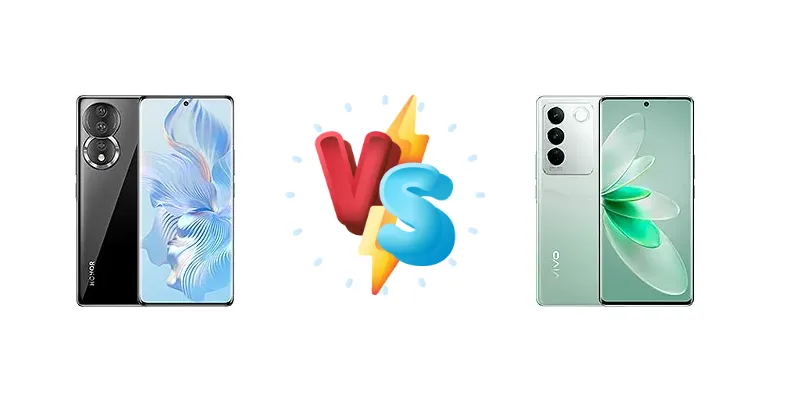
The Honor 80 and vivo S16 Pro represent compelling options in the increasingly competitive mid-range smartphone market. While both aim for a premium feel without the flagship price tag, they take different approaches to achieving this. The Honor 80 leverages Qualcomm’s Snapdragon 782G, while the vivo S16 Pro opts for MediaTek’s Dimensity 8200, creating a fascinating chipset battle that dictates overall performance and efficiency.
🏆 Quick Verdict
For the average user prioritizing sustained performance and future-proofing, the vivo S16 Pro is the stronger choice. Its Dimensity 8200, built on a more efficient 4nm process, delivers a noticeable performance uplift over the Honor 80’s Snapdragon 782G, despite similar charging speeds. However, the Honor 80 remains a viable option for those seeking a balanced experience at a potentially lower price point.
| Network |
|---|
| 2G bands | GSM 850 / 900 / 1800 / 1900 | GSM 850 / 900 / 1800 / 1900 |
| 3G bands | HSDPA 800 / 850 / 900 / 1700(AWS) / 1900 / 2100 | HSDPA 850 / 900 / 1700(AWS) / 1900 / 2100 |
| 4G bands | LTE | 1, 2, 3, 4, 5, 7, 8, 28, 34, 38, 39, 40, 41 |
| 5G bands | SA/NSA | 1, 3, 5, 8, 28, 41, 77, 78 SA/NSA |
| Speed | HSPA, LTE, 5G | HSPA, LTE, 5G |
| Technology | GSM / CDMA / HSPA / CDMA2000 / LTE / 5G | GSM / CDMA / HSPA / CDMA2000 / LTE / 5G |
| | CDMA2000 1x | CDMA2000 1x |
| Launch |
|---|
| Announced | 2022, November 23 | 2022, December 22 |
| Status | Available. Released 2022, December 02 | Available. Released 2022, December 30 |
| Body |
|---|
| Dimensions | 161.1 x 73.9 x 7.7 mm (6.34 x 2.91 x 0.30 in) | 164.1 x 74.8 x 7.4 mm (6.46 x 2.94 x 0.29 in) |
| SIM | Nano-SIM + Nano-SIM | Nano-SIM + Nano-SIM |
| Weight | 180 g (6.35 oz) | 182 g (6.42 oz) |
| Display |
|---|
| Resolution | 1080 x 2400 pixels (~444 ppi density) | 1080 x 2400 pixels, 20:9 ratio (~388 ppi density) |
| Size | 6.67 inches, 107.9 cm2 (~90.7% screen-to-body ratio) | 6.78 inches, 111.0 cm2 (~90.4% screen-to-body ratio) |
| Type | OLED, 1B colors, 120Hz, 1000 nits (peak) | AMOLED, 120Hz, HDR10+ |
| Platform |
|---|
| CPU | Octa-core (1x2.7 GHz Cortex-A78 & 3x2.4 GHz Cortex-A78 & 4x1.8 GHz Cortex-A55) | Octa-core (1x3.1 GHz Cortex-A78 & 3x3.0 GHz Cortex-A78 & 4x2.0 GHz Cortex-A55) |
| Chipset | Qualcomm Snapdragon 782G (6 nm) | Mediatek Dimensity 8200 (4 nm) |
| GPU | Adreno 642L | Mali-G610 MC6 |
| OS | Android 12, MagicOS 7 | Android 13, OriginOS 3 |
| Memory |
|---|
| Card slot | No | No |
| Internal | 256GB 8GB RAM, 256GB 12GB RAM, 512GB 12GB RAM | 256GB 8GB RAM, 256GB 12GB RAM, 512GB 12GB RAM |
| | - | UFS 3.1 |
| Main Camera |
|---|
| Features | LED flash, HDR, panorama | Color spectrum sensor, Ring-LED flash, panorama, HDR |
| Single | 32 MP, f/2.4, (wide) | 50 MP, f/2.5, (wide), AF |
| Triple | 160 MP, f/1.8, (wide), 1/1.56", 0.75µm, PDAF
8 MP, f/2.2, (ultrawide), AF
2 MP (macro) | 50 MP, f/1.9, (wide), 1/1.56", 1.0µm, PDAF, OIS
8 MP, f/2.2, (ultrawide)
2 MP (macro) |
| Video | 4K@30fps, 1080p@30/60fps, gyro-EIS | 4K@30fps, 1080p@30fps |
| Selfie camera |
|---|
| Features | HDR | Dual-LED flash, HDR |
| Single | 32 MP, f/2.4, (wide) | 50 MP, f/2.5, (wide), AF |
| Video | 1080p@30fps, gyro-EIS | 1080p@30fps |
| Sound |
|---|
| 3.5mm jack | No | No |
| 35mm jack | No | No |
| Loudspeaker | Yes | Yes, (unconfirmed stereo speakers) |
| | - | 24-bit/192kHz audio |
| Comms |
|---|
| Bluetooth | 5.2, A2DP, LE, aptX HD | 5.3, A2DP, LE, aptX HD |
| NFC | Yes | Yes |
| Positioning | GPS, GALILEO, GLONASS, BDS, QZSS | GPS, GLONASS, GALILEO, BDS, NavIC |
| Radio | No | No |
| USB | USB Type-C 2.0, OTG | USB Type-C 2.0, OTG |
| WLAN | Wi-Fi 802.11 a/b/g/n/ac/6, dual-band, Wi-Fi Direct | Wi-Fi 802.11 a/b/g/n/ac/6, dual-band, Wi-Fi Direct |
| Features |
|---|
| Sensors | Fingerprint (under display, optical), accelerometer, gyro, compass | Fingerprint (under display, optical), accelerometer, gyro, proximity, compass |
| | Virtual proximity sensing | - |
| Battery |
|---|
| Charging | 66W wired, 3-50% in 15 min
5W reverse wired | 66W wired, 50% in 19 min |
| Type | Li-Po 4800 mAh | 4600 mAh |
| Misc |
|---|
| Colors | Black, Green, Blue, Pink | Black, Mint |
| Models | ANN-AN00 | V2245A |
| Price | About 370 EUR | About 400 EUR |
Honor 80
- Potentially lower price point
- Faster 66W charging (to 50%)
- Familiar Qualcomm Snapdragon chipset
- Less powerful chipset compared to Dimensity 8200
- 6nm process may lead to more thermal throttling
- Potentially lower sustained performance
vivo S16 Pro
- More powerful and efficient Dimensity 8200 chipset
- 4nm process for better thermal management
- Superior ISP for potentially better image quality
- Slightly slower 66W charging (to 50%)
- May be priced higher than the Honor 80
- MediaTek chipset may not appeal to all users
Display Comparison
Context data lacks display specifics, but given the market positioning, both likely feature OLED panels. However, the chipset difference hints at potential display driver optimizations on the vivo S16 Pro. The Dimensity 8200’s ISP could translate to more accurate color reproduction. Expect both to target 120Hz refresh rates, but the S16 Pro’s more powerful GPU may allow for higher sustained frame rates in graphically intensive applications. Bezels are likely comparable, focusing on maximizing screen real estate within their respective form factors.
Camera Comparison
Without detailed camera specs, it’s difficult to make definitive claims. However, the Dimensity 8200’s image signal processor (ISP) is generally considered more advanced than the Snapdragon 782G’s, potentially leading to better dynamic range, noise reduction, and overall image quality. The S16 Pro likely benefits from more sophisticated computational photography algorithms. Both phones will likely feature a multi-camera setup, but the S16 Pro’s chipset gives it an edge in processing those images quickly and effectively. We anticipate both will offer capable main sensors, but the S16 Pro’s ISP could extract more detail and clarity.
Performance
The core difference lies in the chipsets. The vivo S16 Pro’s MediaTek Dimensity 8200 (4nm) boasts a faster prime core (3.1 GHz Cortex-A78) compared to the Honor 80’s Snapdragon 782G (6nm) (2.7 GHz Cortex-A78). The Dimensity 8200 also features three 3.0 GHz Cortex-A78 cores versus the Snapdragon’s three 2.4 GHz cores, resulting in a significant advantage in multi-core performance. The 4nm process node of the Dimensity 8200 is more efficient, leading to better thermal management and sustained performance under load. While both utilize Cortex-A55 efficiency cores, the Dimensity’s superior overall architecture will benefit demanding tasks like video editing and high-end gaming.
Battery Life
Both devices feature 66W wired charging, with the vivo S16 Pro reaching 50% charge in 19 minutes, slightly slower than the Honor 80’s 15 minutes. This difference is likely due to battery capacity optimization and charging curve management. While the exact battery capacities are unknown, the Dimensity 8200’s superior efficiency should translate to longer battery life for the S16 Pro, offsetting the potentially slower charging speed. The Honor 80’s 5W reverse wired charging is a useful, albeit slow, feature for topping up accessories.
Buying Guide
Buy the Honor 80 if you prioritize a potentially lower price and a familiar Qualcomm chipset experience, and your usage primarily revolves around everyday tasks and casual gaming. Buy the vivo S16 Pro if you demand smoother multitasking, more demanding gaming performance, and a chipset built on a more advanced manufacturing process for improved efficiency and longevity.
Frequently Asked Questions
❓ Will the Snapdragon 782G in the Honor 80 struggle with demanding games like Genshin Impact?
While the Snapdragon 782G can run Genshin Impact, you'll likely need to lower graphics settings to maintain a stable frame rate. The Dimensity 8200 in the vivo S16 Pro offers a significantly smoother experience at higher settings due to its superior GPU and thermal management.
❓ Does the Dimensity 8200 in the vivo S16 Pro get noticeably warmer during extended gaming sessions compared to the Honor 80?
The Dimensity 8200’s 4nm process is inherently more efficient, meaning it generates less heat than the Snapdragon 782G’s 6nm process. This translates to better thermal management and less throttling during prolonged gaming, allowing the S16 Pro to maintain peak performance for longer.
❓ Is the 19-minute 0-50% charge time on the vivo S16 Pro a significant drawback compared to the Honor 80's 15 minutes?
The 4-minute difference is unlikely to be noticeable in everyday use. The Dimensity 8200’s efficiency means you’ll likely need to charge less frequently, mitigating the slightly slower initial charging speed. Both phones offer rapid charging capabilities.