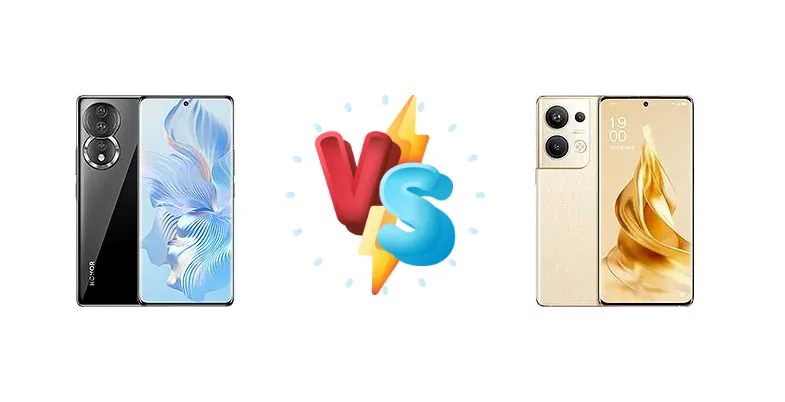
The Honor 80 and Oppo Reno9 Pro+ both target the competitive mid-range smartphone market, but approach it from different angles. The Honor 80 focuses on a balance of style and efficiency with the Snapdragon 782G, while the Reno9 Pro+ aims for near-flagship performance with the older, but still potent, Snapdragon 8+ Gen 1. This comparison dissects the key differences to determine which device delivers the best experience for your needs.
🏆 Quick Verdict
For most users, the Oppo Reno9 Pro+ is the superior choice. Its Snapdragon 8+ Gen 1 chipset provides significantly faster performance, making it ideal for demanding tasks and gaming. While the Honor 80 offers respectable performance and a sleek design, the Reno9 Pro+'s processing power and faster 80W charging justify the price difference.
| Network |
|---|
| 2G bands | GSM 850 / 900 / 1800 / 1900 | GSM 850 / 900 / 1800 / 1900 - SIM 1 & SIM 2 |
| 3G bands | HSDPA 800 / 850 / 900 / 1700(AWS) / 1900 / 2100 | HSDPA 850 / 900 / 1700(AWS) / 2100 |
| 4G bands | LTE | 1, 3, 4, 5, 7, 8, 18, 19, 26, 28, 34, 38, 39, 40, 41 |
| 5G bands | SA/NSA | 1, 5, 8, 28, 41, 77, 78 SA/NSA |
| Speed | HSPA, LTE, 5G | HSPA, LTE-A (CA), 5G |
| Technology | GSM / CDMA / HSPA / CDMA2000 / LTE / 5G | GSM / CDMA / HSPA / CDMA2000 / LTE / 5G |
| | CDMA2000 1x | CDMA2000 1x |
| Launch |
|---|
| Announced | 2022, November 23 | 2022, November 24 |
| Status | Available. Released 2022, December 02 | Available. Released 2022, December 02 |
| Body |
|---|
| Build | - | Glass front (Asahi Glass), aluminum frame |
| Dimensions | 161.1 x 73.9 x 7.7 mm (6.34 x 2.91 x 0.30 in) | 161.5 x 73.6 x 8 mm (6.36 x 2.90 x 0.31 in) |
| SIM | Nano-SIM + Nano-SIM | Dual SIM (Nano-SIM, dual stand-by) |
| Weight | 180 g (6.35 oz) | 192 g (6.77 oz) |
| Display |
|---|
| Protection | - | Asahi Glass AGC DT-Star2 |
| Resolution | 1080 x 2400 pixels (~444 ppi density) | 1080 x 2412 pixels, 20:9 ratio (~394 ppi density) |
| Size | 6.67 inches, 107.9 cm2 (~90.7% screen-to-body ratio) | 6.7 inches, 108.0 cm2 (~90.9% screen-to-body ratio) |
| Type | OLED, 1B colors, 120Hz, 1000 nits (peak) | AMOLED, 1B colors, 120Hz, HDR10+, 500 nits (typ), 800 nits (HBM), 950 nits (peak) |
| Platform |
|---|
| CPU | Octa-core (1x2.7 GHz Cortex-A78 & 3x2.4 GHz Cortex-A78 & 4x1.8 GHz Cortex-A55) | Octa-core (1x3.0 GHz Cortex-X2 & 3x2.75 GHz Cortex-A710 & 4x2.0 GHz Cortex-A510) |
| Chipset | Qualcomm Snapdragon 782G (6 nm) | Qualcomm SM8475 Snapdragon 8+ Gen 1 (4 nm) |
| GPU | Adreno 642L | Adreno 730 |
| OS | Android 12, MagicOS 7 | Android 13, ColorOS 13 |
| Memory |
|---|
| Card slot | No | No |
| Internal | 256GB 8GB RAM, 256GB 12GB RAM, 512GB 12GB RAM | 256GB 16GB RAM, 512GB 16GB RAM |
| | - | UFS 3.1 |
| Main Camera |
|---|
| Features | LED flash, HDR, panorama | LED flash, HDR, panorama |
| Single | 32 MP, f/2.4, (wide) | 32 MP, f/2.4, 22mm (wide), 1/2.74", 0.8µm, AF |
| Triple | 160 MP, f/1.8, (wide), 1/1.56", 0.75µm, PDAF
8 MP, f/2.2, (ultrawide), AF
2 MP (macro) | 50 MP, f/1.8, 24mm (wide), 1/1.56", 1.0µm, multi-directional PDAF, OIS
8 MP, f/2.2, 120˚ (ultrawide), 1/4.0", 1.12µm
2 MP, f/2.4, (depth) |
| Video | 4K@30fps, 1080p@30/60fps, gyro-EIS | 4K@30/60fps, 1080p@30/60/120/240fps, gyro-EIS, OIS, HDR |
| Selfie camera |
|---|
| Features | HDR | Panorama, HDR |
| Single | 32 MP, f/2.4, (wide) | 32 MP, f/2.4, 22mm (wide), 1/2.74", 0.8µm, AF |
| Video | 1080p@30fps, gyro-EIS | 1080p@30fps, gyro-EIS |
| Sound |
|---|
| 3.5mm jack | No | No |
| 35mm jack | No | - |
| Loudspeaker | Yes | Yes, with stereo speakers |
| | - | 24-bit/192kHz audio |
| Comms |
|---|
| Bluetooth | 5.2, A2DP, LE, aptX HD | 5.2, A2DP, LE, aptX HD |
| Infrared port | - | Yes |
| NFC | Yes | Yes, eSE, HCE, UICC, NFC-SIM |
| Positioning | GPS, GALILEO, GLONASS, BDS, QZSS | GPS (L1+L5), GLONASS (L1), BDS (B1I+B2a+Bc), GALILEO (E1+E5a), QZSS (L1+L5) |
| Radio | No | No |
| USB | USB Type-C 2.0, OTG | USB Type-C 2.0, OTG |
| WLAN | Wi-Fi 802.11 a/b/g/n/ac/6, dual-band, Wi-Fi Direct | Wi-Fi 802.11 a/b/g/n/ac/6, dual-band, Wi-Fi Direct |
| Features |
|---|
| Sensors | Fingerprint (under display, optical), accelerometer, gyro, compass | Fingerprint (under display, optical), accelerometer, gyro, proximity, compass, color spectrum |
| | Virtual proximity sensing | - |
| Battery |
|---|
| Charging | 66W wired, 3-50% in 15 min
5W reverse wired | 80W wired, PD, QC3, 45% in 1-10 min, 1-100% in 31 min (advertised)
Reverse wired |
| Type | Li-Po 4800 mAh | Li-Po 4700 mAh, non-removable |
| Misc |
|---|
| Colors | Black, Green, Blue, Pink | Black, Gold, Mint |
| Models | ANN-AN00 | PGW110 |
| Price | About 370 EUR | About 740 EUR |
Honor 80
- More affordable price point
- Sleek and stylish design
- Efficient Snapdragon 782G for everyday tasks
- Significantly slower performance than the Reno9 Pro+
- Slower charging speeds (66W vs 80W)
Oppo Reno9 Pro+
- Flagship-level performance with Snapdragon 8+ Gen 1
- Faster 80W charging
- Superior gaming capabilities
- Higher price tag
- Potentially slightly lower battery life (depending on capacity)
Display Comparison
While both phones likely feature OLED panels (data not provided), the core difference lies in the processing power driving them. The Honor 80’s Snapdragon 782G will handle display tasks efficiently, but the Reno9 Pro+’s Snapdragon 8+ Gen 1 offers headroom for smoother animations and faster response times, particularly beneficial for high-refresh-rate gaming. The Reno9 Pro+’s chipset also allows for more sophisticated image processing for display calibration, potentially resulting in more accurate colors. Without specific display specs, it's difficult to assess brightness or resolution, but the chipset advantage leans towards the Oppo.
Camera Comparison
Without detailed camera specifications, a direct comparison is limited. However, the processing power of the Snapdragon 8+ Gen 1 in the Reno9 Pro+ allows for more advanced image processing algorithms, potentially resulting in better dynamic range, noise reduction, and overall image quality. The Honor 80’s Snapdragon 782G is capable, but will likely struggle to match the Reno9 Pro+ in challenging lighting conditions. The Reno9 Pro+’s ISP (Image Signal Processor) is more powerful, enabling faster image capture and more complex computational photography features. We can assume Oppo will leverage this advantage.
Performance
The performance gap is the most significant differentiator. The Oppo Reno9 Pro+’s Snapdragon 8+ Gen 1 (4nm) is a substantial upgrade over the Honor 80’s Snapdragon 782G (6nm). The 8+ Gen 1 features a Cortex-X2 prime core clocked at 3.0 GHz, compared to the 782G’s Cortex-A78 core at 2.7 GHz. This translates to a noticeable difference in CPU-intensive tasks. Furthermore, the 8+ Gen 1’s Adreno 730 GPU is far more capable than the 782G’s Adreno 642L, delivering a superior gaming experience. The 4nm process node of the 8+ Gen 1 also contributes to better thermal efficiency, reducing the likelihood of throttling during sustained workloads. The Reno9 Pro+ is the clear winner for users prioritizing performance.
Battery Life
The Honor 80’s 66W charging is respectable, offering a 3-50% charge in 15 minutes. However, the Oppo Reno9 Pro+’s 80W charging is significantly faster, achieving 45% in 1-10 minutes and a full charge in 31 minutes (advertised). While battery capacity isn’t specified, the faster charging of the Reno9 Pro+ is a major convenience factor. The more efficient 4nm process of the Snapdragon 8+ Gen 1 may also contribute to slightly better battery life, despite potentially higher power draw during intensive tasks. The Reno9 Pro+’s charging speed offsets any potential battery capacity disadvantage.
Buying Guide
Buy the Honor 80 if you prioritize a stylish design, efficient power consumption for all-day use, and a more affordable price point. It’s a solid option for everyday tasks and casual gaming. Buy the Oppo Reno9 Pro+ if you demand flagship-level performance for gaming, video editing, or multitasking, and value faster charging speeds. It’s the better choice for power users who want a responsive and capable device.
Frequently Asked Questions
❓ Will the Snapdragon 782G in the Honor 80 struggle with graphically demanding games like Genshin Impact?
The Snapdragon 782G can run Genshin Impact, but you’ll likely need to lower the graphics settings to medium or low to maintain a stable frame rate. The Oppo Reno9 Pro+'s Snapdragon 8+ Gen 1 will handle Genshin Impact at maximum settings with ease, providing a smoother and more immersive gaming experience.
❓ How much faster is the 80W charging on the Oppo Reno9 Pro+ compared to the 66W charging on the Honor 80 in real-world use?
The Oppo Reno9 Pro+’s 80W charging can add a significant amount of battery life in a short period. While the Honor 80’s 66W is still fast, the Reno9 Pro+ can realistically go from 0-50% in under 20 minutes, while the Honor 80 will take closer to 30 minutes. This difference is noticeable for users who frequently need to top up their battery quickly.
❓ Does the Snapdragon 8+ Gen 1 in the Oppo Reno9 Pro+ get noticeably hotter than the Snapdragon 782G in the Honor 80 during extended gaming sessions?
While the Snapdragon 8+ Gen 1 is more powerful, its 4nm process node is also more efficient. This means it *should* generate less heat than the 6nm Snapdragon 782G under sustained load. However, thermal management also depends on the phone's cooling system. The Reno9 Pro+ is likely to maintain higher sustained performance due to its superior thermal efficiency.