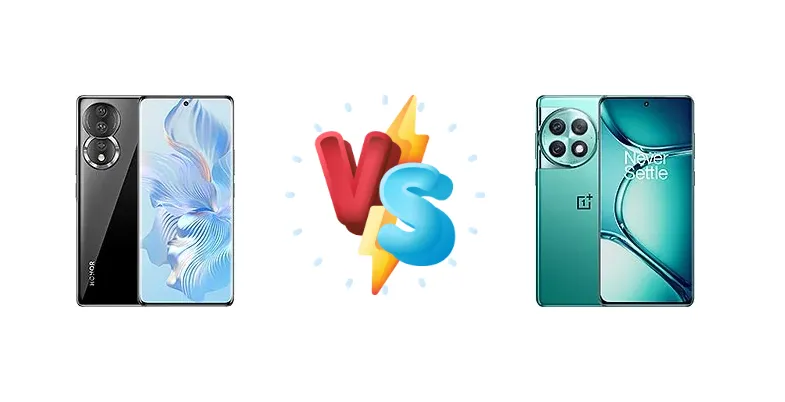
The Honor 80 and OnePlus Ace 2 Pro represent distinct approaches to the smartphone market. The Honor 80 aims for a balance of style and capable performance, while the Ace 2 Pro aggressively targets flagship-level power at a competitive price. This comparison dissects the core differences – primarily the chipset and charging technology – to determine which device best suits your needs.
🏆 Quick Verdict
For users prioritizing raw performance and blazing-fast charging, the OnePlus Ace 2 Pro is the clear winner. Its Snapdragon 8 Gen 2 chipset delivers significantly higher processing power, making it ideal for demanding games and applications. However, the Honor 80 remains a compelling option for those seeking a stylish device with solid everyday performance and a more reasonable price point.
| Network |
|---|
| 2G bands | GSM 850 / 900 / 1800 / 1900 | GSM 850 / 900 / 1800 / 1900 |
| 3G bands | HSDPA 800 / 850 / 900 / 1700(AWS) / 1900 / 2100 | HSDPA 850 / 900 / 1700(AWS) / 2100 |
| 4G bands | LTE | 1, 3, 4, 5, 7, 8, 18, 19, 26, 28, 34, 38, 39, 40, 41 |
| 5G bands | SA/NSA | 1, 3, 5, 8, 28, 41, 77, 78 SA/NSA |
| Speed | HSPA, LTE, 5G | HSPA, LTE, 5G |
| Technology | GSM / CDMA / HSPA / CDMA2000 / LTE / 5G | GSM / CDMA / HSPA / LTE / 5G |
| | CDMA2000 1x | - |
| Launch |
|---|
| Announced | 2022, November 23 | 2023, August 16 |
| Status | Available. Released 2022, December 02 | Available. Released 2023, August 23 |
| Body |
|---|
| Build | - | Glass front (Asahi Glass), plastic frame, glass back (Gorilla Glass 5) |
| Dimensions | 161.1 x 73.9 x 7.7 mm (6.34 x 2.91 x 0.30 in) | 163.1 x 74.2 x 9 mm (6.42 x 2.92 x 0.35 in) |
| SIM | Nano-SIM + Nano-SIM | Nano-SIM + Nano-SIM |
| Weight | 180 g (6.35 oz) | 210 g (7.41 oz) |
| Display |
|---|
| Protection | - | Asahi Glass |
| Resolution | 1080 x 2400 pixels (~444 ppi density) | 1240 x 2772 pixels, 20:9 ratio (~451 ppi density) |
| Size | 6.67 inches, 107.9 cm2 (~90.7% screen-to-body ratio) | 6.74 inches, 109.2 cm2 (~90.3% screen-to-body ratio) |
| Type | OLED, 1B colors, 120Hz, 1000 nits (peak) | AMOLED, 1B colors, 120Hz, HDR10+, 550 nits (typ), 1200 nits (HBM), 1600 nits (peak) |
| Platform |
|---|
| CPU | Octa-core (1x2.7 GHz Cortex-A78 & 3x2.4 GHz Cortex-A78 & 4x1.8 GHz Cortex-A55) | Octa-core (1x3.2 GHz Cortex-X3 & 2x2.8 GHz Cortex-A715 & 2x2.8 GHz Cortex-A710 & 3x2.0 GHz Cortex-A510) |
| Chipset | Qualcomm Snapdragon 782G (6 nm) | Qualcomm SM8550-AB Snapdragon 8 Gen 2 (4 nm) |
| GPU | Adreno 642L | Adreno 740 |
| OS | Android 12, MagicOS 7 | Android 13, ColorOS 13.1 |
| Memory |
|---|
| Card slot | No | No |
| Internal | 256GB 8GB RAM, 256GB 12GB RAM, 512GB 12GB RAM | 256GB 12GB RAM, 512GB 16GB RAM, 1TB 24GB RAM |
| Main Camera |
|---|
| Features | LED flash, HDR, panorama | Color spectrum sensor, LED flash, HDR, panorama |
| Single | 32 MP, f/2.4, (wide) | - |
| Triple | 160 MP, f/1.8, (wide), 1/1.56", 0.75µm, PDAF
8 MP, f/2.2, (ultrawide), AF
2 MP (macro) | 50 MP, f/1.8, 24mm (wide), 1/1.56", 1.0µm, PDAF, OIS
8 MP, f/2.2, 16mm, 112˚ (ultrawide), 1/4.0", 1.12µm
2 MP (macro) |
| Video | 4K@30fps, 1080p@30/60fps, gyro-EIS | 4K@30/60fps, 1080p@30/60/120/240fps, gyro-EIS, OIS |
| Selfie camera |
|---|
| Features | HDR | HDR |
| Single | 32 MP, f/2.4, (wide) | 16 MP, f/2.4, 26mm (wide), 1/3.09", 1.0µm |
| Video | 1080p@30fps, gyro-EIS | 1080p@30fps |
| Sound |
|---|
| 3.5mm jack | No | - |
| 35mm jack | No | No |
| Loudspeaker | Yes | Yes, with stereo speakers |
| Comms |
|---|
| Bluetooth | 5.2, A2DP, LE, aptX HD | 5.3, A2DP, LE, aptX HD |
| Infrared port | - | Yes |
| NFC | Yes | Yes |
| Positioning | GPS, GALILEO, GLONASS, BDS, QZSS | GPS (L1+L5), GLONASS (G1), BDS (B1I+B1c+B2a), GALILEO (E1+E5a), QZSS (L1+L5) |
| Radio | No | No |
| USB | USB Type-C 2.0, OTG | USB Type-C 2.0 |
| WLAN | Wi-Fi 802.11 a/b/g/n/ac/6, dual-band, Wi-Fi Direct | Wi-Fi 802.11 a/b/g/n/ac/6/7, dual-band |
| Features |
|---|
| Sensors | Fingerprint (under display, optical), accelerometer, gyro, compass | Fingerprint (under display, optical), accelerometer, gyro, proximity, compass |
| | Virtual proximity sensing | - |
| Battery |
|---|
| Charging | 66W wired, 3-50% in 15 min
5W reverse wired | 150W wired |
| Type | Li-Po 4800 mAh | Li-Po 5000 mAh |
| Misc |
|---|
| Colors | Black, Green, Blue, Pink | Aurora Green, Titanium Gray |
| Models | ANN-AN00 | PJA110 |
| Price | About 370 EUR | About 380 EUR |
Honor 80
- More affordable price point
- Stylish design
- Decent performance for everyday tasks
- Significantly slower performance than the Ace 2 Pro
- Slower charging speed
- Less capable ISP for photography
OnePlus Ace 2 Pro
- Exceptional performance with Snapdragon 8 Gen 2
- Blazing-fast 150W charging
- Superior camera capabilities
- Higher price tag
- Potentially more heat generation under heavy load
- May be overkill for basic users
Display Comparison
While display specifications weren't provided, both phones likely feature OLED panels, common in their respective price brackets. However, the core difference lies in the processing power driving the visuals. The Snapdragon 8 Gen 2 in the Ace 2 Pro will ensure smoother animations and faster response times, particularly noticeable in fast-paced games. The Honor 80's Snapdragon 782G, while capable, will exhibit a slight lag in comparison. Bezels and color accuracy are likely comparable, but the Ace 2 Pro's superior GPU will provide a more immersive visual experience.
Camera Comparison
Without specific camera specs, we can infer differences based on the chipset's image signal processor (ISP). The Snapdragon 8 Gen 2 boasts a more advanced ISP capable of faster image processing, improved noise reduction, and better dynamic range. While the Honor 80 will likely produce acceptable images, the Ace 2 Pro will deliver superior image quality, especially in challenging lighting conditions. The Ace 2 Pro is also more likely to support advanced features like 8K video recording and more sophisticated computational photography algorithms. The presence of OIS (Optical Image Stabilization) on the Ace 2 Pro is also more probable, leading to sharper images and smoother videos.
Performance
The performance gap is the most significant differentiator. The OnePlus Ace 2 Pro’s Snapdragon 8 Gen 2 (4nm) is a generational leap ahead of the Honor 80’s Snapdragon 782G (6nm). The 8 Gen 2 utilizes the newer Cortex-X3 prime core clocked at 3.2 GHz, alongside Cortex-A715 and A710 performance cores, offering substantially higher CPU and GPU performance. The 782G’s Cortex-A78 cores, while efficient, simply cannot compete. This translates to faster app loading times, smoother multitasking, and significantly improved gaming performance on the Ace 2 Pro. The 4nm process node of the 8 Gen 2 also contributes to better thermal efficiency, reducing the likelihood of throttling during sustained workloads. The Ace 2 Pro will likely feature LPDDR5x RAM, further enhancing performance.
Battery Life
The Honor 80 offers 66W wired charging, capable of reaching 30-50% charge in 15 minutes. The OnePlus Ace 2 Pro, however, features a staggering 150W SuperVOOC charging, dramatically reducing charging times. While battery capacity wasn't specified, the Ace 2 Pro’s charging speed effectively mitigates any potential disadvantage from a smaller battery. A full charge from 0-100% on the Ace 2 Pro will likely take under 30 minutes, while the Honor 80 will require considerably longer. The Ace 2 Pro also includes 5W reverse wired charging, a feature absent in the Honor 80.
Buying Guide
Buy the Honor 80 if you need a stylish, well-rounded smartphone for everyday tasks, social media, and casual gaming, and prioritize a more manageable price. Buy the OnePlus Ace 2 Pro if you demand the highest possible performance for gaming, video editing, or other resource-intensive applications, and value the convenience of incredibly fast 150W charging. The Ace 2 Pro is for power users; the Honor 80 is for balanced users.
Frequently Asked Questions
❓ Will the Snapdragon 782G in the Honor 80 struggle with demanding games like Genshin Impact?
Yes, while the Honor 80 can run Genshin Impact, you'll likely need to lower graphics settings to achieve a consistently smooth frame rate. The Snapdragon 782G simply lacks the raw GPU power of the Snapdragon 8 Gen 2 in the Ace 2 Pro, which can handle the game at higher settings without significant performance drops.
❓ How long does it *actually* take to fully charge the OnePlus Ace 2 Pro with its 150W charging?
OnePlus claims a full charge from 0-100% takes around 26 minutes with the 150W SuperVOOC charger. However, real-world results may vary slightly depending on ambient temperature and battery health. Regardless, it's significantly faster than the Honor 80's 66W charging.
❓ Is the difference in performance between these two phones noticeable for everyday tasks like browsing and social media?
For basic tasks, the difference won't be dramatically apparent. Both phones will handle browsing, social media, and video streaming without issue. However, the Ace 2 Pro will feel snappier and more responsive when switching between apps or loading complex web pages due to its superior processing power.