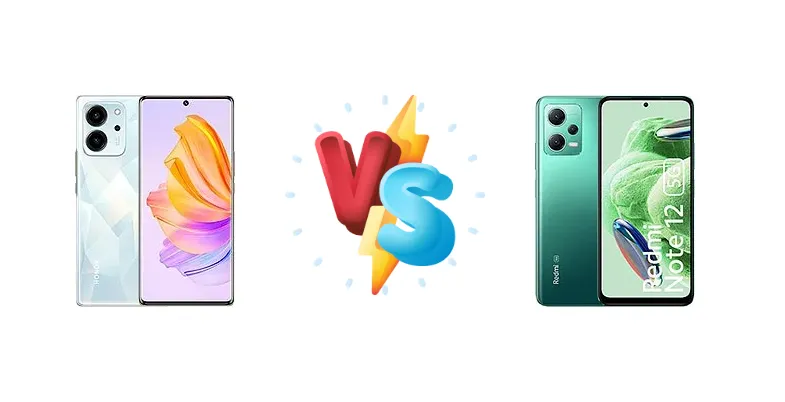
The mid-range smartphone market is fiercely competitive, and the Honor 80 SE and Xiaomi Redmi Note 12 are two strong contenders. Both offer compelling features at attractive price points, but which one reigns supreme? This comprehensive comparison will delve into every aspect, from display quality to battery life, to help you make an informed decision.
🏆 Quick Verdict
The Redmi Note 12 takes the crown for overall value, boasting exceptional battery life and a bright display. While the Honor 80 SE offers faster charging and a slightly more powerful chipset, the Redmi Note 12's endurance and price make it a more practical choice for most users.
| Network |
|---|
| 2G bands | GSM 850 / 900 / 1800 / 1900 | GSM 850 / 900 / 1800 / 1900 |
| 3G bands | HSDPA 800 / 850 / 900 / 1700(AWS) / 1900 / 2100 | HSDPA 850 / 900 / 2100 |
| 4G bands | LTE | 1, 3, 5, 8, 40, 41 |
| 5G bands | SA/NSA | 1, 3, 5, 8, 28, 40, 78 SA/NSA |
| Speed | HSPA, LTE, 5G | HSPA, LTE, 5G |
| Technology | GSM / CDMA / HSPA / CDMA2000 / LTE / 5G | GSM / HSPA / LTE / 5G |
| | CDMA2000 1x | - |
| Launch |
|---|
| Announced | 2022, November 23 | 2022, October 27 |
| Status | Available. Released 2022, December 09 | Available. Released 2023, January 11 |
| Body |
|---|
| Dimensions | 161.3 x 73.4 x 7.7 mm (6.35 x 2.89 x 0.30 in) | 165.9 x 76.2 x 8 mm (6.53 x 3.00 x 0.31 in) |
| SIM | Nano-SIM + Nano-SIM | Nano-SIM + Nano-SIM |
| Weight | 175 g (6.17 oz) | 188 g (6.63 oz) |
| | - | IP53, dust and splash resistant |
| Display |
|---|
| Protection | - | Corning Gorilla Glass 3 |
| Resolution | 1080 x 2400 pixels (~444 ppi density) | 1080 x 2400 pixels, 20:9 ratio (~395 ppi density) |
| Size | 6.67 inches, 107.9 cm2 (~91.2% screen-to-body ratio) | 6.67 inches, 107.4 cm2 (~85.0% screen-to-body ratio) |
| Type | OLED, 1B colors, 120Hz | AMOLED, 120Hz, 1200 nits (peak) |
| Platform |
|---|
| CPU | Octa-core (2x2.4 GHz Cortex-A78 & 6x2.0 GHz Cortex-A55) | Octa-core (2x2.0 GHz Cortex-A78 & 6x1.8 GHz Cortex-A55) |
| Chipset | Mediatek Dimensity 900 (6 nm) | Qualcomm SM4375 Snapdragon 4 Gen 1 (6 nm) |
| GPU | Mali-G68 MC4 | Adreno 619 |
| OS | Android 12, MagicOS 7 | Android 12, MIUI 14 (International), MIUI 13 (India) |
| Memory |
|---|
| Card slot | No | microSDXC (uses shared SIM slot) |
| Internal | 256GB 8GB RAM, 256GB 12GB RAM | 128GB 4GB RAM, 128GB 6GB RAM, 256GB 8GB RAM |
| | - | UFS 2.2 |
| Main Camera |
|---|
| Features | LED flash, HDR, panorama | Dual-LED dual-tone flash, HDR, panorama |
| Single | 32 MP, f/2.4, (wide) | - |
| Triple | 64 MP, f/1.8, (wide), PDAF
5 MP, f/2.2, (ultrawide)
2 MP (macro) | 48 MP, f/1.8, (wide), PDAF
8 MP, f/2.2, 120˚ (ultrawide), 1/4.0", 1.12µm
2 MP (macro) |
| Video | 4K@30fps, 1080p@30/60fps | 1080p@30fps |
| Selfie camera |
|---|
| Features | HDR | HDR |
| Single | 32 MP, f/2.4, (wide) | 13 MP, f/2.5, (wide), 1/3.0" |
| Video | 1080p@30fps | 1080p@30fps |
| Sound |
|---|
| 3.5mm jack | No | Yes |
| 35mm jack | No | Yes |
| Loudspeaker | Yes | Yes |
| | 24-bit/192kHz audio | 24-bit/192kHz audio |
| Comms |
|---|
| Bluetooth | 5.1, A2DP, LE | 5.1, A2DP, LE |
| Infrared port | - | Yes |
| NFC | No | Yes (market/region dependent) |
| Positioning | GPS, GLONASS, BDS | GPS, GLONASS |
| Radio | No | Unspecified |
| USB | USB Type-C 2.0, OTG | USB Type-C 2.0, OTG |
| WLAN | Wi-Fi 802.11 a/b/g/n/ac, dual-band, Wi-Fi Direct | Wi-Fi 802.11 a/b/g/n/ac, dual-band |
| Features |
|---|
| Sensors | Fingerprint (under display, optical), accelerometer, proximity, compass | Fingerprint (side-mounted), accelerometer, gyro, proximity, compass |
| Battery |
|---|
| Charging | 66W wired, 3-80% in 30 min | 33W wired, 50% in 22 min |
| Type | Li-Po 4600 mAh | Li-Po 5000 mAh |
| Misc |
|---|
| Colors | Black, Blue, Pink, Crystal Blue | Frosted Green, Matte Black, Mystique Blue |
| Models | GIA-AN8 | 22111317I, 22111317G |
| Price | About 370 EUR | € 151.99 / $ 219.99 / ₹ 11,999 |
| SAR | - | 1.09 W/kg (head) 1.05 W/kg (body) |
| SAR EU | - | 0.68 W/kg (head) 0.91 W/kg (body) |
| Tests |
|---|
| Battery life | - |
Endurance rating 101h
|
| Camera | - |
Photo / Video |
| Display | - |
Contrast ratio: Infinite (nominal) |
| Loudspeaker | - |
-28.0 LUFS (Good)
|
| Performance | - |
AnTuTu: 360745 (v9)
GeekBench: 1998 (v5.1), 2017 (v6) |
Honor 80 SE
- Faster Charging (66W)
- Slightly More Powerful Chipset
- Potentially Better Low-Light Camera Performance
- Stylish Design
- Lower Battery Life
- Less Bright Display
- Potentially Higher Price
Xiaomi Redmi Note 12
- Exceptional Battery Life (101h Endurance)
- Bright Display (706 nits)
- Excellent Value for Money
- Consistent Camera Performance
- Slower Charging (33W)
- Less Powerful Chipset
- IPS LCD Display (potentially less vibrant than AMOLED)
Display Comparison
The Redmi Note 12's 706 nits max brightness gives it a noticeable edge in outdoor visibility. While the Honor 80 SE's display is good, it doesn't reach the same level of brightness. The Redmi Note 12's 'infinite' contrast ratio (though nominal) suggests excellent blacks and vibrant colors. Both phones likely feature similar resolution and panel technology (likely AMOLED for the Honor and IPS LCD for the Redmi).
Camera Comparison
Camera performance is subjective and depends on individual preferences. Both phones offer decent camera systems for their price range. The Honor 80 SE likely has a more versatile camera setup, potentially including a telephoto lens. The Redmi Note 12's camera is known for producing consistent and pleasing images in good lighting conditions. Low-light performance will likely be a differentiating factor, with the Honor potentially having a slight advantage.
Performance
The Honor 80 SE's Dimensity 900 chipset generally outperforms the Redmi Note 12's Snapdragon 4 Gen 1 in benchmarks and real-world usage. Expect smoother multitasking and slightly better gaming performance on the Honor. However, the difference might not be significant for everyday tasks.
Battery Life
The Redmi Note 12 absolutely dominates in battery life. Its endurance rating of 101 hours is exceptional, offering multiple days of use on a single charge. The Honor 80 SE, while offering faster charging (66W vs 33W), simply can't match the Redmi Note 12's overall battery capacity and efficiency.
Buying Guide
The Honor 80 SE is ideal for users prioritizing fast charging and a bit more processing power for gaming or demanding apps. The Xiaomi Redmi Note 12 is perfect for those who need all-day (and then some) battery life, a vibrant display for media consumption, and a budget-friendly price tag.
Frequently Asked Questions
❓ Which phone is better for gaming?
The Honor 80 SE's Dimensity 900 chipset offers slightly better gaming performance, but both phones are capable of handling most mobile games at reasonable settings.
❓ How long does it take to fully charge each phone?
The Honor 80 SE charges significantly faster, reaching 80% in 30 minutes with its 66W charger. The Redmi Note 12 takes around 50 minutes to reach 50% with its 33W charger.
❓ Which phone has a better camera for selfies?
Both phones likely have decent front-facing cameras. The Honor 80 SE is known for its selfie capabilities, but the Redmi Note 12's front camera is also quite capable.