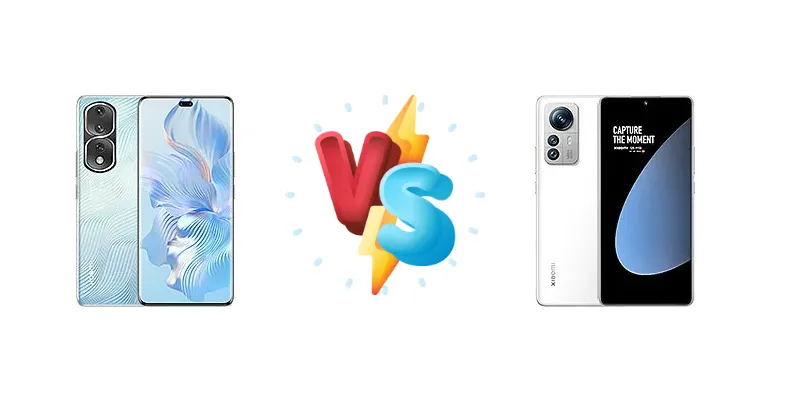
The Honor 80 Pro and Xiaomi 12S Pro represent compelling options in the flagship smartphone space, both powered by Qualcomm’s Snapdragon 8+ Gen 1. However, they diverge in key areas like charging technology and potentially, software optimization. This comparison dissects these differences to determine which device delivers the superior experience for various user needs.
🏆 Quick Verdict
For most users, the Xiaomi 12S Pro emerges as the stronger choice. Its significantly faster 120W wired and 50W wireless charging capabilities, coupled with a similar performance profile thanks to the Snapdragon 8+ Gen 1, provide a more convenient and time-saving experience. While the Honor 80 Pro is a capable device, it can't match the charging prowess of its rival.
| Network |
|---|
| 2G bands | GSM 850 / 900 / 1800 / 1900 | GSM 850 / 900 / 1800 / 1900 |
| 3G bands | HSDPA 800 / 850 / 900 / 1700(AWS) / 1900 / 2100 | HSDPA 800 / 850 / 900 / 1700(AWS) / 1900 / 2100 |
| 4G bands | LTE | 1, 2, 3, 4, 5, 7, 8, 12, 17, 18, 19, 26, 34, 38, 39, 40, 41, 42 |
| 5G bands | SA/NSA | 1, 3, 5, 8, 28, 38, 40, 41, 77, 78, 79 SA/NSA |
| Speed | HSPA, LTE, 5G | HSPA, LTE, 5G |
| Technology | GSM / CDMA / HSPA / CDMA2000 / LTE / 5G | GSM / CDMA / HSPA / EVDO / LTE / 5G |
| | CDMA2000 1x | CDMA2000 1xEV-DO |
| Launch |
|---|
| Announced | 2022, November 23 | 2022, July 04 |
| Status | Available. Released 2022, December 02 | Available. Released 2022, July 07 |
| Body |
|---|
| Build | - | Glass front (Gorilla Glass Victus), glass back or eco leather back, aluminum frame |
| Dimensions | 163.3 x 74.9 x 7.8 mm (6.43 x 2.95 x 0.31 in) | 163.6 x 74.6 x 8.2 mm or 8.7 mm |
| SIM | Nano-SIM + Nano-SIM | Nano-SIM + Nano-SIM |
| Weight | 188 g (6.63 oz) | 203 g / 204 g (7.16 oz) |
| Display |
|---|
| Protection | - | Corning Gorilla Glass Victus |
| Resolution | 1224 x 2700 pixels (~437 ppi density) | 1440 x 3200 pixels, 20:9 ratio (~521 ppi density) |
| Size | 6.78 inches, 111.5 cm2 (~91.2% screen-to-body ratio) | 6.73 inches, 109.4 cm2 (~89.6% screen-to-body ratio) |
| Type | OLED, 1B colors, 120Hz, HDR, 1000 nits (peak) | LTPO AMOLED, 1B colors, 120Hz, Dolby Vision, HDR10+, 1000 nits (HBM), 1500 nits (peak) |
| Platform |
|---|
| CPU | Octa-core (1x3.0 GHz Cortex-X2 & 3x2.5 GHz Cortex-A710 & 4x1.80 GHz Cortex-A510) | Octa-core (1x3.19 GHz Cortex-X2 & 3x2.75 GHz Cortex-A710 & 4x1.80 GHz Cortex-A510) |
| Chipset | Qualcomm SM8475 Snapdragon 8+ Gen 1 (4 nm) | Qualcomm SM8475 Snapdragon 8+ Gen 1 (4 nm) |
| GPU | Adreno 730 | Adreno 730 |
| OS | Android 12, MagicOS 7 | Android 12, MIUI 13 |
| Memory |
|---|
| Card slot | No | No |
| Internal | 256GB 8GB RAM, 256GB 12GB RAM, 512GB 12GB RAM | 128GB 8GB RAM, 256GB 8GB RAM, 256GB 12GB RAM, 512GB 12GB RAM |
| | - | UFS 3.1 |
| Main Camera |
|---|
| Dual | 50 MP, f/2.4, 100˚, (ultrawide)
2 MP, f/2.4, (depth) | - |
| Features | LED flash, HDR, panorama | Leica lens, color spectrum sensor, Dual-LED dual-tone flash, HDR, panorama |
| Single | - | 32 MP, f/2.5, 26mm (wide), 0.7µm |
| Triple | 160 MP, f/1.8, (wide), 1/1.56", 0.75µm, PDAF
50 MP, f/2.0, 122˚ (ultrawide), AF
Auxiliary lens | 50 MP, f/1.9, 24mm (wide), 1/1.28", 1.22µm, dual pixel PDAF, OIS
50 MP, f/1.9, 50mm (telephoto), PDAF, 2x optical zoom
50 MP, f/2.2, 115˚ (ultrawide) |
| Video | 4K@30fps, 1080p@30/60fps, gyro-EIS | 8K@24fps (HDR), 4K@30/60fps (HDR10+), 1080p@30/120/240/960fps, 720p@1920fps, gyro-EIS |
| Selfie camera |
|---|
| Dual | 50 MP, f/2.4, 100˚, (ultrawide)
2 MP, f/2.4, (depth) | - |
| Features | HDR | HDR, panorama |
| Single | - | 32 MP, f/2.5, 26mm (wide), 0.7µm |
| Video | 4K@30fps, 1080p@30fps, gyro-EIS | 1080p@30/60fps, 720p@120fps, HDR10+ |
| Sound |
|---|
| 3.5mm jack | No | No |
| 35mm jack | No | No |
| Loudspeaker | Yes, with stereo speakers | Yes, with stereo speakers |
| | - | 24-bit/192kHz audio
Tuned by Harman Kardon |
| Comms |
|---|
| Bluetooth | 5.2, A2DP, LE, aptX HD | 5.2, A2DP, LE, aptX HD, aptX Adaptive |
| Infrared port | - | Yes |
| NFC | Yes | Yes |
| Positioning | GPS, GALILEO, GLONASS, BDS, QZSS | GPS (L1+L5), GLONASS (L1), BDS (B1I+B1c+B2a), GALILEO (E1+E5a), QZSS (L1+L5), NavIC (L5) |
| Radio | No | No |
| USB | USB Type-C 2.0, OTG | USB Type-C 2.0, OTG |
| WLAN | Wi-Fi 802.11 a/b/g/n/ac/6, dual-band, Wi-Fi Direct | Wi-Fi 802.11 a/b/g/n/ac/6e, dual-band, Wi-Fi Direct |
| Features |
|---|
| Sensors | Fingerprint (under display, optical), accelerometer, gyro, compass | Fingerprint (under display, optical), accelerometer, gyro, compass |
| | Virtual proximity sensing | Virtual proximity sensing |
| Battery |
|---|
| Charging | 66W wired, 3-50% in 15 min
5W reverse wired | 120W wired, PD3.0, QC4, 100% in 19 min
50W wireless, 100% in 42 min
10W reverse wireless |
| Type | Li-Po 4800 mAh | Li-Po 4600 mAh |
| Misc |
|---|
| Colors | Black, Green, Blue, Pink | Gray, White, Purple, Green |
| Models | ANP-AN00 | 2206122SC |
| Price | About 420 EUR | About 670 EUR |
Honor 80 Pro
- Potentially refined software experience with MagicOS
- Solid all-around performance with Snapdragon 8+ Gen 1
- Competitively priced within the flagship segment
- Significantly slower charging speeds compared to Xiaomi 12S Pro
- Limited wireless charging capabilities
Xiaomi 12S Pro
- Ultra-fast 120W wired charging
- Convenient 50W wireless charging
- Slightly higher CPU clock speed for potential performance gains
- MIUI software can be polarizing
- Potential for more aggressive thermal throttling under sustained load
Display Comparison
While both devices likely feature high-quality AMOLED panels, specific details like peak brightness and refresh rate are missing. However, the core display technology is similar. The absence of LTPO in either specification suggests both will rely on adaptive refresh rates to balance smoothness and power consumption. Bezels are likely comparable given the flagship positioning, and color accuracy will depend on software calibration, a potential differentiator between Honor’s MagicOS and Xiaomi’s MIUI.
Camera Comparison
Detailed camera specifications are absent, making a direct comparison challenging. However, both phones are expected to feature capable camera systems befitting their flagship status. The Xiaomi 12S Pro’s potential for faster image processing due to its slightly more powerful CPU could give it an edge in computational photography. The absence of information regarding sensor sizes and OIS implementation makes it difficult to assess image quality definitively. We can assume both will offer a versatile set of lenses, but the quality of the image processing algorithms will be a key differentiator.
Performance
Both the Honor 80 Pro and Xiaomi 12S Pro utilize the Qualcomm SM8475 Snapdragon 8+ Gen 1 (4 nm) chipset. The Xiaomi 12S Pro boasts a slightly higher peak CPU clock speed (3.19 GHz vs 3.0 GHz on the Honor 80 Pro), but this difference is unlikely to translate into a noticeable real-world performance gap for most tasks. Both phones feature the same CPU core configuration (1x Cortex-X2, 3x Cortex-A710, 4x Cortex-A510). Thermal management will be crucial; the 4nm process helps, but sustained loads could lead to throttling. The RAM type (likely LPDDR5x on both) will also influence performance, but specifics are unavailable.
Battery Life
The Xiaomi 12S Pro’s charging capabilities are the standout feature. Its 120W wired charging promises a full charge in just 19 minutes, a significant advantage over the Honor 80 Pro’s 66W charging (3-50% in 15 min). The addition of 50W wireless charging on the Xiaomi 12S Pro, completing a full charge in 42 minutes, further widens the gap. While battery capacity isn’t specified, the faster charging speeds of the Xiaomi 12S Pro effectively mitigate any potential disadvantage from a slightly smaller battery size. The 10W reverse wireless charging on the Xiaomi 12S Pro is also more useful than the Honor 80 Pro's 5W offering.
Buying Guide
Buy the Honor 80 Pro if you prioritize a potentially more refined software experience (depending on MagicOS version) and are less concerned with ultra-fast charging. It’s a solid all-rounder for everyday use. Buy the Xiaomi 12S Pro if you demand the quickest possible charging – both wired and wireless – and value the convenience of topping up your battery in under 20 minutes. This phone is ideal for power users and those frequently on the go.
Frequently Asked Questions
❓ Does the Xiaomi 12S Pro's 120W charging degrade the battery health faster?
While extremely fast charging can theoretically contribute to faster battery degradation over the long term, Xiaomi incorporates intelligent charging algorithms and safety mechanisms to minimize this effect. The phone dynamically adjusts charging speed based on battery condition and usage patterns, mitigating potential damage.
❓ Is the difference in CPU clock speed between the Honor 80 Pro and Xiaomi 12S Pro noticeable in gaming?
The 0.19 GHz difference in CPU clock speed is unlikely to result in a significant performance difference in gaming. Both phones are powered by the same Snapdragon 8+ Gen 1 chipset, and GPU performance is the primary factor in gaming. Thermal throttling, if it occurs, will have a greater impact than the minor CPU clock speed variation.
❓ How does MagicOS on the Honor 80 Pro compare to MIUI on the Xiaomi 12S Pro in terms of bloatware?
MIUI has historically been criticized for including pre-installed bloatware, although Xiaomi has made efforts to reduce this in recent versions. MagicOS generally offers a cleaner software experience with less pre-installed software, but this can vary depending on the region and carrier.
❓ Can I use the Xiaomi 12S Pro's reverse wireless charging to charge my earbuds or smartwatch?
Yes, the Xiaomi 12S Pro supports reverse wireless charging, allowing you to wirelessly charge compatible devices like earbuds or smartwatches. However, the 10W output is relatively slow, so it's best suited for topping up smaller devices rather than fully charging them.