
Honor 80 Pro vs Samsung Galaxy S22+: A Deep Dive into Flagship Performance and Value
| Phones Images | |||||
|---|---|---|---|---|---|
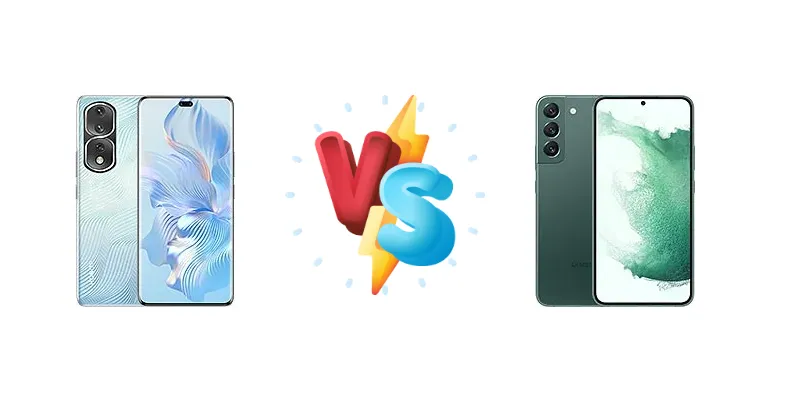
|
🏆 Quick Verdict
For most users, the Honor 80 Pro offers a more compelling package. Its Snapdragon 8+ Gen 1 chipset delivers excellent performance and efficiency, coupled with faster 66W charging. While the S22+ boasts a brighter display and a more established brand reputation, the Honor 80 Pro provides comparable features at a potentially lower price point.
| PHONES | ||
|---|---|---|
| Phone Names | Honor 80 Pro | Samsung Galaxy S22+ 5G |
| Network | ||
|---|---|---|
| 2G bands | GSM 850 / 900 / 1800 / 1900 | GSM 850 / 900 / 1800 / 1900 |
| 3G bands | HSDPA 800 / 850 / 900 / 1700(AWS) / 1900 / 2100 | HSDPA 850 / 900 / 1700(AWS) / 1900 / 2100 |
| 4G bands | LTE | 1, 2, 3, 4, 5, 7, 8, 12, 13, 17, 18, 19, 20, 25, 26, 28, 32, 38, 39, 40, 41, 66 - International |
| 5G bands | SA/NSA | 1, 2, 3, 5, 7, 8, 12, 20, 25, 28, 38, 40, 41, 66, 75, 77, 78 SA/NSA/Sub6 - International |
| Speed | HSPA, LTE, 5G | HSPA 42.2/5.76 Mbps, LTE (7CA) Cat20 2000/200 Mbps, 5G (5+ Gbps DL) |
| Technology | GSM / CDMA / HSPA / CDMA2000 / LTE / 5G | GSM / CDMA / HSPA / EVDO / LTE / 5G |
| CDMA2000 1x | 1, 3, 5, 7, 8, 20, 28, 38, 41, 66, 71, 260, 261 SA/NSA/Sub6/mmWave - USA | |
| Launch | ||
|---|---|---|
| Announced | 2022, November 23 | 2022, February 09 |
| Status | Available. Released 2022, December 02 | Available. Released 2022, February 25 |
| Body | ||
|---|---|---|
| Build | - | Glass front (Gorilla Glass Victus+), glass back (Gorilla Glass Victus+), aluminum frame |
| Dimensions | 163.3 x 74.9 x 7.8 mm (6.43 x 2.95 x 0.31 in) | 157.4 x 75.8 x 7.6 mm (6.20 x 2.98 x 0.30 in) |
| SIM | Nano-SIM + Nano-SIM | · Nano-SIM + eSIM· Nano-SIM + Nano-SIM + eSIM (max 2 at a time) |
| Weight | 188 g (6.63 oz) | 195 g / 196 g (mmWave) (6.88 oz) |
| - | IP68 dust/water resistant (up to 1.5m for 30 min) Armor aluminum frame with tougher drop and scratch resistance (advertised) | |
| Display | ||
|---|---|---|
| Protection | - | Corning Gorilla Glass Victus+ |
| Resolution | 1224 x 2700 pixels (~437 ppi density) | 1080 x 2340 pixels, 19.5:9 ratio (~393 ppi density) |
| Size | 6.78 inches, 111.5 cm2 (~91.2% screen-to-body ratio) | 6.6 inches, 105.3 cm2 (~88.3% screen-to-body ratio) |
| Type | OLED, 1B colors, 120Hz, HDR, 1000 nits (peak) | Dynamic AMOLED 2X, 120Hz, HDR10+, 1750 nits (peak) |
| - | Always-on display | |
| Platform | ||
|---|---|---|
| CPU | Octa-core (1x3.0 GHz Cortex-X2 & 3x2.5 GHz Cortex-A710 & 4x1.80 GHz Cortex-A510) | Octa-core (1x2.8 GHz Cortex-X2 & 3x2.50 GHz Cortex-A710 & 4x1.8 GHz Cortex-A510) - EuropeOcta-core (1x3.00 GHz Cortex-X2 & 3x2.50 GHz Cortex-A710 & 4x1.80 GHz Cortex-A510) - ROW |
| Chipset | Qualcomm SM8475 Snapdragon 8+ Gen 1 (4 nm) | Exynos 2200 (4 nm) - EuropeQualcomm SM8450 Snapdragon 8 Gen 1 (4 nm) - ROW |
| GPU | Adreno 730 | Xclipse 920 - EuropeAdreno 730 - ROW |
| OS | Android 12, MagicOS 7 | Android 12, up to 4 major Android upgrades, One UI 6.1.1 |
| Memory | ||
|---|---|---|
| Card slot | No | No |
| Internal | 256GB 8GB RAM, 256GB 12GB RAM, 512GB 12GB RAM | 128GB 8GB RAM, 256GB 8GB RAM |
| - | UFS 3.1 | |
| Main Camera | ||
|---|---|---|
| Dual | 50 MP, f/2.4, 100˚, (ultrawide) 2 MP, f/2.4, (depth) | - |
| Features | LED flash, HDR, panorama | LED flash, auto-HDR, panorama |
| Triple | 160 MP, f/1.8, (wide), 1/1.56", 0.75µm, PDAF 50 MP, f/2.0, 122˚ (ultrawide), AF Auxiliary lens | 50 MP, f/1.8, 23mm (wide), 1/1.56", 1.0µm, dual pixel PDAF, OIS 10 MP, f/2.4, 70mm (telephoto), 1/3.94", 1.0µm, PDAF, OIS, 3x optical zoom 12 MP, f/2.2, 13mm, 120˚ (ultrawide), 1/2.55" 1.4µm, Super Steady video |
| Video | 4K@30fps, 1080p@30/60fps, gyro-EIS | 8K@24fps, 4K@30/60fps, 1080p@30/60/120/240fps, HDR10+, stereo sound rec., gyro-EIS |
| Selfie camera | ||
|---|---|---|
| Dual | 50 MP, f/2.4, 100˚, (ultrawide) 2 MP, f/2.4, (depth) | - |
| Features | HDR | HDR |
| Single | - | 10 MP, f/2.2, 26mm (wide), 1/3.24", 1.22µm, dual pixel PDAF |
| Video | 4K@30fps, 1080p@30fps, gyro-EIS | 4K@30/60fps, 1080p@30fps |
| Sound | ||
|---|---|---|
| 3.5mm jack | No | No |
| 35mm jack | No | No |
| Loudspeaker | Yes, with stereo speakers | Yes, with stereo speakers |
| - | 32-bit/384kHz audio Tuned by AKG | |
| Comms | ||
|---|---|---|
| Bluetooth | 5.2, A2DP, LE, aptX HD | 5.2, A2DP, LE |
| NFC | Yes | Yes |
| Positioning | GPS, GALILEO, GLONASS, BDS, QZSS | GPS, GLONASS, BDS, GALILEO |
| Radio | No | No |
| USB | USB Type-C 2.0, OTG | USB Type-C 3.2, OTG |
| WLAN | Wi-Fi 802.11 a/b/g/n/ac/6, dual-band, Wi-Fi Direct | Wi-Fi 802.11 a/b/g/n/ac/6e, dual-band, Wi-Fi Direct |
| Features | ||
|---|---|---|
| Sensors | Fingerprint (under display, optical), accelerometer, gyro, compass | Fingerprint (under display, ultrasonic), accelerometer, gyro, proximity, compass, barometer |
| Virtual proximity sensing | Samsung DeX, Samsung Wireless DeX (desktop experience support) Bixby natural language commands and dictation Samsung Pay (Visa, MasterCard certified) Ultra Wideband (UWB) support | |
| Battery | ||
|---|---|---|
| Charging | 66W wired, 3-50% in 15 min 5W reverse wired | 45W wired, PD3.0 15W wireless (Qi) 4.5W reverse wireless |
| Type | Li-Po 4800 mAh | Li-Ion 4500 mAh |
| Misc | ||
|---|---|---|
| Colors | Black, Green, Blue, Pink | Phantom Black, White, Pink Gold, Green, Graphite, Sky Blue, Violet, Cream, Bora Purple |
| Models | ANP-AN00 | SM-S906B, SM-S906B/DS, SM-S906U, SM-S906U1, SM-S906W, SM-S906N, SM-S9060, SM-S906E, SM-S906E/DS, SM-S906L |
| Price | About 420 EUR | € 236.99 / $ 194.37 / £ 349.00 |
| SAR | - | 1.19 W/kg (head) 1.08 W/kg (body) |
| SAR EU | - | 0.57 W/kg (head) 1.40 W/kg (body) |
| Tests | ||
|---|---|---|
| Battery life | - | Endurance rating 97h |
| Camera | - | Photo / Video |
| Display | - | Contrast ratio: Infinite (nominal) |
| Loudspeaker | - | -26.0 LUFS (Very good) |
| Performance | - | AnTuTu: 722495 (v8), 886916 (v9) GeekBench: 3528 (v5.1) GFXBench: 68fps (ES 3.1 onscreen) |
Honor 80 Pro
- Faster 66W wired charging
- More efficient Snapdragon 8+ Gen 1 chipset
- Potentially better value for money
- Less established brand reputation
- Limited information on display specifications
Samsung Galaxy S22+ 5G
- Brighter display with 1214 nits peak brightness
- Wireless charging and reverse wireless charging
- Refined software experience
- Exynos 2200 (Europe) can suffer from thermal throttling
- Slower 45W wired charging
Display Comparison
The Samsung Galaxy S22+ boasts a peak brightness of 1214 nits, ensuring excellent visibility even in direct sunlight. While the Honor 80 Pro’s display specs aren’t provided, it’s likely to be slightly dimmer. Both phones feature a contrast ratio described as 'infinite' (nominal), suggesting deep blacks and vibrant colors. However, the S22+'s display technology and calibration are likely more refined, offering potentially more accurate color reproduction. The S22+’s display is a key advantage for outdoor use and media consumption.
Camera Comparison
Both phones are described as having capable photo and video capabilities, but detailed sensor information is limited. The Honor 80 Pro’s camera system is likely to focus on computational photography to enhance image quality. The S22+ benefits from Samsung’s established camera expertise and image processing algorithms. Without specific sensor size or aperture details, it’s difficult to definitively declare a winner. However, the S22+’s history suggests a more consistent and reliable camera experience, particularly in challenging lighting conditions. The presence of OIS on both devices is expected, aiding in stable video recording and low-light photography.
Performance
The Honor 80 Pro’s Qualcomm Snapdragon 8+ Gen 1 (4nm) chipset is a significant advantage over the Exynos 2200 (4nm) found in the European variant of the S22+. The Snapdragon 8+ Gen 1 is known for its superior thermal efficiency, reducing the likelihood of performance throttling during extended gaming sessions. The ROW variant of the S22+ uses the Snapdragon 8 Gen 1, which is still powerful but less efficient than the 8+ Gen 1. Both phones share the same CPU core configuration (1x Cortex-X2, 3x Cortex-A710, 4x Cortex-A510), but the Snapdragon 8+ Gen 1’s improved manufacturing process and clock speeds give it an edge. The Honor 80 Pro will likely deliver smoother and more sustained performance in demanding tasks.
Battery Life
The Samsung Galaxy S22+ has an endurance rating of 97 hours, indicating solid battery life. However, the Honor 80 Pro’s 66W wired charging significantly outperforms the S22+’s 45W charging. The Honor 80 Pro can charge from 3-50% in just 15 minutes, offering a substantial convenience advantage. While the S22+ offers 15W wireless charging and 4.5W reverse wireless charging, the Honor 80 Pro only provides 5W reverse wired charging. The faster charging speed of the Honor 80 Pro partially offsets any potential difference in battery capacity, making it a more practical choice for users who frequently need to top up their battery quickly.
Buying Guide
Buy the Honor 80 Pro if you prioritize raw performance for gaming and demanding applications, and value faster charging speeds. It’s ideal for users who want a modern flagship experience without the premium Samsung price tag. Buy the Samsung Galaxy S22+ 5G if you prefer a more refined software experience, a consistently bright and vibrant display, and the convenience of wireless charging, and are willing to accept potentially shorter battery life and possible thermal throttling under sustained load.