
Honor 80 Pro vs Oppo Find X5 Pro: A Deep Dive into Flagship Performance and Features
| Phones Images | |||||
|---|---|---|---|---|---|
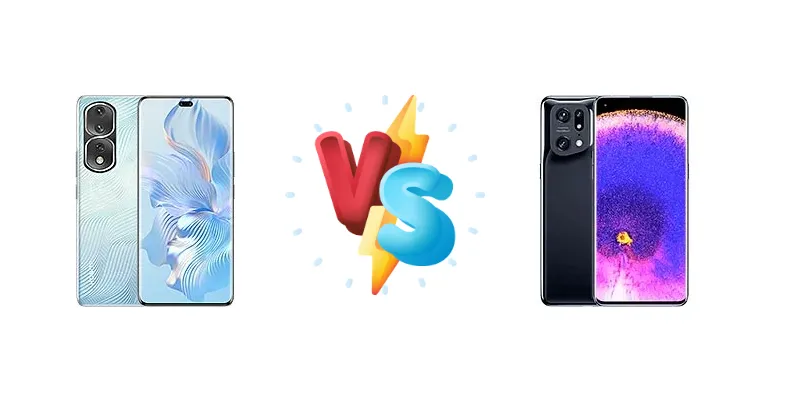
|
🏆 Quick Verdict
For most users, the Honor 80 Pro emerges as the stronger all-rounder. Its Snapdragon 8+ Gen 1 offers superior thermal management and comparable performance to the Find X5 Pro’s Snapdragon 8 Gen 1, coupled with faster 66W charging. While the Find X5 Pro boasts wireless charging, the Honor 80 Pro’s efficiency and value proposition are more compelling.
| PHONES | ||
|---|---|---|
| Phone Names | Honor 80 Pro | Oppo Find X5 Pro |
| Network | ||
|---|---|---|
| 2G bands | GSM 850 / 900 / 1800 / 1900 | GSM 850 / 900 / 1800 / 1900 |
| 3G bands | HSDPA 800 / 850 / 900 / 1700(AWS) / 1900 / 2100 | HSDPA 800 / 850 / 900 / 1700(AWS) / 1900 / 2100 |
| 4G bands | LTE | 1, 2, 3, 4, 5, 7, 8, 12, 13, 17, 18, 19, 20, 25, 26, 28, 32, 34, 38, 39, 40, 41, 42, 66 - Global |
| 5G bands | SA/NSA | 1, 2, 3, 5, 7, 8, 12, 13, 18, 20, 25, 26, 28, 38, 40, 41, 66, 77, 78, 79 SA/NSA - Global |
| Speed | HSPA, LTE, 5G | HSPA, LTE, 5G |
| Technology | GSM / CDMA / HSPA / CDMA2000 / LTE / 5G | GSM / CDMA / HSPA / CDMA2000 / LTE / 5G |
| CDMA2000 1x | 1, 2, 3, 5, 8, 20, 28, 38, 41, 66, 77, 78, 79 SA/NSA - China | |
| Launch | ||
|---|---|---|
| Announced | 2022, November 23 | 2022, February 24 |
| Status | Available. Released 2022, December 02 | Available. Released 2022, March 14 |
| Body | ||
|---|---|---|
| Build | - | Glass front (Gorilla Glass Victus), ceramic back or eco leather back, aluminum frame |
| Dimensions | 163.3 x 74.9 x 7.8 mm (6.43 x 2.95 x 0.31 in) | 163.7 x 73.9 x 8.5 or 8.8 mm |
| SIM | Nano-SIM + Nano-SIM | Nano-SIM + eSIM |
| Weight | 188 g (6.63 oz) | 218 g or 195 g (6.88 oz) |
| - | IP68 dust/water resistant (up to 1.5m for 30 min) | |
| Display | ||
|---|---|---|
| Protection | - | Corning Gorilla Glass Victus |
| Resolution | 1224 x 2700 pixels (~437 ppi density) | 1440 x 3216 pixels, 20:9 ratio (~525 ppi density) |
| Size | 6.78 inches, 111.5 cm2 (~91.2% screen-to-body ratio) | 6.7 inches, 108.4 cm2 (~89.6% screen-to-body ratio) |
| Type | OLED, 1B colors, 120Hz, HDR, 1000 nits (peak) | LTPO2 AMOLED, 1B colors, 120Hz, HDR10+, BT.2020, 500 nits (typ), 800 nits (HBM), 1300 nits (peak) |
| Platform | ||
|---|---|---|
| CPU | Octa-core (1x3.0 GHz Cortex-X2 & 3x2.5 GHz Cortex-A710 & 4x1.80 GHz Cortex-A510) | Octa-core (1x3.00 GHz Cortex-X2 & 3x2.50 GHz Cortex-A710 & 4x1.80 GHz Cortex-A510) - GlobalOcta-core (1x3.05 GHz Cortex-X2 & 3x2.85 GHz Cortex-A710 & 4x1.80 GHz Cortex-A510) - China |
| Chipset | Qualcomm SM8475 Snapdragon 8+ Gen 1 (4 nm) | Qualcomm SM8450 Snapdragon 8 Gen 1 (4 nm) - GlobalMediatek Dimensity 9000 (4 nm) - China |
| GPU | Adreno 730 | Adreno 730 - GlobalMali-G710 MC10 - China |
| OS | Android 12, MagicOS 7 | Android 12, upgradable to Android 14, ColorOS 14 |
| Memory | ||
|---|---|---|
| Card slot | No | No |
| Internal | 256GB 8GB RAM, 256GB 12GB RAM, 512GB 12GB RAM | 256GB 8GB RAM, 256GB 12GB RAM, 512GB 12GB RAM |
| - | UFS 3.1 | |
| Main Camera | ||
|---|---|---|
| Dual | 50 MP, f/2.4, 100˚, (ultrawide) 2 MP, f/2.4, (depth) | - |
| Features | LED flash, HDR, panorama | Hasselblad Color Calibration, color spectrum sensor, LED flash, HDR, panorama |
| Single | - | 32 MP, f/2.4, 21mm (wide), 1/2.74", 0.8µm |
| Triple | 160 MP, f/1.8, (wide), 1/1.56", 0.75µm, PDAF 50 MP, f/2.0, 122˚ (ultrawide), AF Auxiliary lens | 50 MP, f/1.7, 25mm (wide), 1/1.56", 1.0µm, multi-directional PDAF, OIS (3-axis sensor-shift, 2-axis lens-shift) 13 MP, f/2.4, 52mm (telephoto), 1/3.4", 2x optical zoom, PDAF 50 MP, f/2.2, 15mm, 110˚ (ultrawide), 1/1.56", 1.0µm, multi-directional PDAF |
| Video | 4K@30fps, 1080p@30/60fps, gyro-EIS | 4K@30/60fps, 1080p@30/60/240fps; gyro-EIS; HDR, 10‑bit video |
| Selfie camera | ||
|---|---|---|
| Dual | 50 MP, f/2.4, 100˚, (ultrawide) 2 MP, f/2.4, (depth) | - |
| Features | HDR | Panorama |
| Single | - | 32 MP, f/2.4, 21mm (wide), 1/2.74", 0.8µm |
| Video | 4K@30fps, 1080p@30fps, gyro-EIS | 1080p@30fps, gyro-EIS |
| Sound | ||
|---|---|---|
| 3.5mm jack | No | No |
| 35mm jack | No | No |
| Loudspeaker | Yes, with stereo speakers | Yes, with stereo speakers |
| Comms | ||
|---|---|---|
| Bluetooth | 5.2, A2DP, LE, aptX HD | 5.2, A2DP, LE, aptX HD |
| NFC | Yes | Yes |
| Positioning | GPS, GALILEO, GLONASS, BDS, QZSS | GPS (L1), GLONASS (L1), BDS (B1I+B1c), GALILEO (E1+E5a), QZSS (L1) |
| Radio | No | No |
| USB | USB Type-C 2.0, OTG | USB Type-C 3.1, OTG |
| WLAN | Wi-Fi 802.11 a/b/g/n/ac/6, dual-band, Wi-Fi Direct | Wi-Fi 802.11 a/b/g/n/ac/6e, dual-band, Wi-Fi Direct |
| Features | ||
|---|---|---|
| Sensors | Fingerprint (under display, optical), accelerometer, gyro, compass | Fingerprint (under display, optical), accelerometer, gyro, proximity, compass |
| Virtual proximity sensing | Oppo Find X5 Pro Dimensity model has no MariSilicon X image chip, 5-axis OIS and Hasselblad’s color calibration | |
| Battery | ||
|---|---|---|
| Charging | 66W wired, 3-50% in 15 min 5W reverse wired | 80W wired, PD, 50% in 12 min 50W wireless, 100% in 47 min 10W reverse wireless |
| Type | Li-Po 4800 mAh | Li-Po 5000 mAh |
| Misc | ||
|---|---|---|
| Colors | Black, Green, Blue, Pink | Ceramic Black, Ceramic White, Blue (eco leather) |
| Models | ANP-AN00 | PFEM10, CPH2305, PFFM20 |
| Price | About 420 EUR | € 449.00 / $ 430.24 / £ 1,049.00 |
| Tests | ||
|---|---|---|
| Battery life | - | Endurance rating 101h |
| Camera | - | Photo / Video |
| Display | - | Contrast ratio: Infinite (nominal) |
| Loudspeaker | - | -24.7 LUFS (Very good) |
| Performance | - | AnTuTu: 1012896 (v9) GeekBench: 3433 (v5.1) GFXBench: 44fps (ES 3.1 onscreen) |
Honor 80 Pro
- More efficient Snapdragon 8+ Gen 1
- Faster 66W wired charging
- Potentially better thermal management
- Lacks wireless charging
- Display brightness lower than Oppo Find X5 Pro
Oppo Find X5 Pro
- Brighter display (762 nits)
- 50W wireless charging support
- Dimensity 9000 variant (China) offers slight CPU boost
- Snapdragon 8 Gen 1 prone to throttling
- Slower wired charging than Honor 80 Pro
Display Comparison
The Oppo Find X5 Pro edges out the Honor 80 Pro in display brightness, achieving a measured 762 nits. While both utilize high-quality panels, the Find X5 Pro’s higher peak brightness translates to better visibility in direct sunlight. However, detailed PWM dimming rates are missing for both, making it difficult to assess potential flicker-related eye strain. Both displays feature an 'infinite' contrast ratio, typical of OLED technology, but real-world color accuracy and calibration will be key differentiators not covered by the provided data.
Camera Comparison
Both devices are listed as having capable Photo/Video capabilities, but lack specific sensor details. The absence of megapixel counts or sensor sizes makes a direct comparison impossible. However, flagship devices in this price range typically feature large main sensors with optical image stabilization (OIS). The image processing style will likely differ between Honor and Oppo, with Honor potentially leaning towards more vibrant colors and Oppo aiming for a more natural look. The inclusion of a 2MP macro camera on either device is largely inconsequential, offering limited practical benefit.
Performance
Both phones are equipped with octa-core CPUs featuring the Cortex-X2, A710, and A510 architecture. However, the Honor 80 Pro’s Snapdragon 8+ Gen 1 represents a refinement over the Oppo Find X5 Pro’s Snapdragon 8 Gen 1. The ‘+’ variant boasts improved efficiency and thermal characteristics due to TSMC’s 4nm process, mitigating potential throttling during extended gaming sessions. The China-specific Dimensity 9000 variant of the Find X5 Pro offers a slight CPU clock speed advantage, but real-world performance differences will depend on software optimization and thermal management. Both devices likely utilize LPDDR5 RAM, but the speed isn't specified.
Battery Life
Both the Honor 80 Pro and Oppo Find X5 Pro share an endurance rating of 101 hours, suggesting similar overall battery life. However, their charging capabilities differ significantly. The Oppo Find X5 Pro supports 80W wired charging, achieving 50% charge in 12 minutes, and 50W wireless charging, taking 47 minutes for a full charge. The Honor 80 Pro offers 66W wired charging (3-50% in 15 minutes) and 5W reverse wired charging. The Find X5 Pro’s wireless charging is a significant advantage for users who prefer cable-free power-ups, but the Honor 80 Pro’s faster wired charging and potentially better efficiency due to the Snapdragon 8+ Gen 1 could offset the difference in overall usage time.
Buying Guide
Buy the Honor 80 Pro if you prioritize sustained gaming performance, efficient power usage, and fast wired charging. It’s ideal for users who frequently engage in demanding tasks and value a cooler, more stable experience. Buy the Oppo Find X5 Pro if you heavily rely on wireless charging, appreciate a slightly brighter display, and are willing to trade some thermal efficiency for potentially faster peak performance (especially the Dimensity 9000 variant).