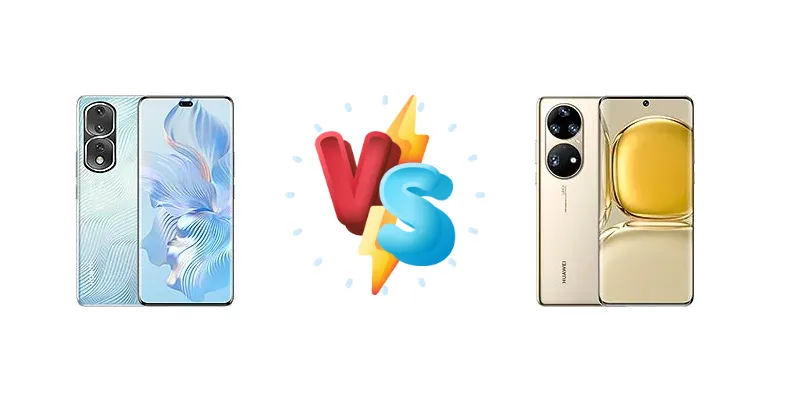
The Honor 80 Pro and Huawei P50 Pro represent distinct approaches to the flagship smartphone experience. The P50 Pro, released earlier, boasts a refined camera system and established brand recognition, while the Honor 80 Pro arrives with a newer Snapdragon 8+ Gen 1 chipset promising a performance edge. This comparison dissects their key differences to help you choose the right device.
🏆 Quick Verdict
For most users, the Honor 80 Pro emerges as the stronger choice. Its Snapdragon 8+ Gen 1 offers superior processing power and efficiency compared to the Kirin 9000/Snapdragon 888 4G options in the P50 Pro, translating to smoother multitasking and gaming. While the P50 Pro’s camera is excellent, the Honor 80 Pro provides a more future-proof platform.
| Network |
|---|
| 2G bands | GSM 850 / 900 / 1800 / 1900 | GSM 850 / 900 / 1800 / 1900 |
| 3G bands | HSDPA 800 / 850 / 900 / 1700(AWS) / 1900 / 2100 | HSDPA 800 / 850 / 900 / 1700(AWS) / 1900 / 2100 |
| 4G bands | LTE | 1, 2, 3, 4, 5, 6, 7, 8, 9, 12, 17, 18, 19, 20, 26, 28, 34, 38, 39, 40, 41 - China |
| 5G bands | SA/NSA | - |
| Speed | HSPA, LTE, 5G | HSPA, LTE |
| Technology | GSM / CDMA / HSPA / CDMA2000 / LTE / 5G | GSM / CDMA / HSPA / CDMA2000 / LTE |
| | CDMA2000 1x | 1, 2, 3, 4, 5, 7, 8, 12, 17, 18, 19, 20, 26, 28, 32, 34, 38, 39, 40, 41, 66 - International |
| Launch |
|---|
| Announced | 2022, November 23 | 2021, July 29 |
| Status | Available. Released 2022, December 02 | Available. Released 2021, August 12 |
| Body |
|---|
| Build | - | Glass front, glass back, aluminum frame |
| Dimensions | 163.3 x 74.9 x 7.8 mm (6.43 x 2.95 x 0.31 in) | 158.8 x 72.8 x 8.5 mm (6.25 x 2.87 x 0.33 in) |
| SIM | Nano-SIM + Nano-SIM | · Nano-SIM· Nano-SIM + Nano-SIM |
| Weight | 188 g (6.63 oz) | 195 g (6.88 oz) |
| | - | IP68 dust/water resistant (up to 1.5m for 30 min) |
| Display |
|---|
| Resolution | 1224 x 2700 pixels (~437 ppi density) | 1228 x 2700 pixels (~450 ppi density) |
| Size | 6.78 inches, 111.5 cm2 (~91.2% screen-to-body ratio) | 6.6 inches, 105.4 cm2 (~91.2% screen-to-body ratio) |
| Type | OLED, 1B colors, 120Hz, HDR, 1000 nits (peak) | OLED, 1B colors, 120Hz |
| Platform |
|---|
| CPU | Octa-core (1x3.0 GHz Cortex-X2 & 3x2.5 GHz Cortex-A710 & 4x1.80 GHz Cortex-A510) | Octa-core (1x3.13 GHz Cortex-A77 & 3x2.54 GHz Cortex-A77 & 4x2.05 GHz Cortex-A55)Octa-core (1x2.84 GHz Cortex-X1 & 3x2.42 GHz Cortex-A78 & 4x1.80 GHz Cortex-A55) |
| Chipset | Qualcomm SM8475 Snapdragon 8+ Gen 1 (4 nm) | Kirin 9000 (5 nm)Qualcomm SM8350 Snapdragon 888 4G (5 nm) |
| GPU | Adreno 730 | Mali-G78 MP24Adreno 660 |
| OS | Android 12, MagicOS 7 | HarmonyOS 2.0 (China), EMUI 14.2 (Europe), no Google Play Services |
| Memory |
|---|
| Card slot | No | Nano Memory (uses shared SIM slot) |
| Internal | 256GB 8GB RAM, 256GB 12GB RAM, 512GB 12GB RAM | 128GB 8GB RAM, 256GB 8GB RAM, 512GB 8GB RAM, 512GB 12GB RAM |
| Main Camera |
|---|
| Dual | 50 MP, f/2.4, 100˚, (ultrawide)
2 MP, f/2.4, (depth) | - |
| Features | LED flash, HDR, panorama | Laser AF, color spectrum sensor, Leica optics, dual-LED flash, panorama, HDR |
| Quad | - | 50 MP, f/1.8, 23mm (wide), PDAF, OIS
64 MP, f/3.5, 90mm (periscope telephoto), PDAF, OIS, 3.5x optical zoom, 7x lossless zoom
13 MP, f/2.2, 13mm (ultrawide), AF
40 MP, f/1.6, 23mm (B/W), AF |
| Single | - | 13 MP, f/2.4, (wide), AF |
| Triple | 160 MP, f/1.8, (wide), 1/1.56", 0.75µm, PDAF
50 MP, f/2.0, 122˚ (ultrawide), AF
Auxiliary lens | - |
| Video | 4K@30fps, 1080p@30/60fps, gyro-EIS | 4K@30/60fps, 1080p@30/60fps, 1080p@960fps; gyro-EIS |
| Selfie camera |
|---|
| Dual | 50 MP, f/2.4, 100˚, (ultrawide)
2 MP, f/2.4, (depth) | - |
| Features | HDR | Panorama, HDR |
| Single | - | 13 MP, f/2.4, (wide), AF |
| Video | 4K@30fps, 1080p@30fps, gyro-EIS | 4K@30fps, 1080p@30/60/240fps |
| Sound |
|---|
| 3.5mm jack | No | No |
| 35mm jack | No | No |
| Loudspeaker | Yes, with stereo speakers | Yes, with stereo speakers |
| Comms |
|---|
| Bluetooth | 5.2, A2DP, LE, aptX HD | 5.2, A2DP, LE |
| Infrared port | - | Yes |
| NFC | Yes | Yes |
| Positioning | GPS, GALILEO, GLONASS, BDS, QZSS | GPS (L1+L5), GLONASS (L1), BDS (B1I+B1c+B2a+B2b), GALILEO (E1+E5a+E5b), QZSS (L1+L5), NavIC |
| Radio | No | No |
| USB | USB Type-C 2.0, OTG | USB Type-C 3.1, OTG |
| WLAN | Wi-Fi 802.11 a/b/g/n/ac/6, dual-band, Wi-Fi Direct | Wi-Fi 802.11 a/b/g/n/ac/6, dual-band, Wi-Fi Direct |
| Features |
|---|
| Sensors | Fingerprint (under display, optical), accelerometer, gyro, compass | Fingerprint (under display, optical), accelerometer, gyro, proximity, compass, barometer |
| | Virtual proximity sensing | - |
| Battery |
|---|
| Charging | 66W wired, 3-50% in 15 min
5W reverse wired | 66W wired
50W wireless
Reverse wireless charging |
| Type | Li-Po 4800 mAh | Li-Po 4360 mAh |
| Misc |
|---|
| Colors | Black, Green, Blue, Pink | Golden Black, Cocoa Gold, Pearl White, Charm Pink |
| Models | ANP-AN00 | JAD-AL50, JAD-LX9, JAD-AL00 |
| Price | About 420 EUR | $ 196.62 / £ 329.00 / € 473.13 |
| Tests |
|---|
| Battery life | - |
Endurance rating 76h
|
| Camera | - |
Photo / Video |
| Display | - |
Contrast ratio: Infinite (nominal) |
| Loudspeaker | - |
-27.3 LUFS (Good)
|
| Performance | - |
AnTuTu: 793876 (v8), 786215 (v9)
GeekBench: 3145 (v5.1)
GFXBench: 44fps (ES 3.1 onscreen) |
Honor 80 Pro
- Superior processing power with Snapdragon 8+ Gen 1
- More efficient chipset for longer battery life
- Modern 5G connectivity
- Lacks wireless charging
- Reverse wireless charging not supported
- Detailed camera specs unavailable
Huawei P50 Pro
- Excellent camera system with established image processing
- 50W wireless charging and reverse wireless charging
- Strong brand reputation for camera quality
- Limited to 4G connectivity with Snapdragon 888 variant
- Older Kirin 9000 chipset less efficient
- Potential for throttling under sustained load
Display Comparison
Both phones offer premium display experiences, but differ in specifics. The Huawei P50 Pro reaches a measured peak brightness of 754 nits, a respectable figure, but the Honor 80 Pro’s display specifications are not provided. Given Honor’s recent focus on display quality, it’s likely competitive. The P50 Pro’s ‘Infinite’ contrast ratio is a marketing term; real-world contrast performance will depend on the panel technology. Without PWM frequency data for the Honor 80 Pro, it’s difficult to assess potential eye strain, but the P50 Pro’s display is known for its color accuracy.
Camera Comparison
Both phones are marketed for their camera capabilities, but approach image processing differently. The Huawei P50 Pro is renowned for its consistent image quality and color science. While specific sensor details are missing, the P50 Pro’s camera system is highly regarded for its versatility. The Honor 80 Pro’s camera specifications are not detailed enough to make a direct comparison, but Honor has been improving its camera performance in recent generations. Without knowing the sensor sizes and apertures, it’s difficult to assess low-light performance differences. The P50 Pro’s video capabilities are well-established, but the Honor 80 Pro’s video performance remains unknown.
Performance
The Honor 80 Pro’s Qualcomm Snapdragon 8+ Gen 1 (4nm) is a clear advantage over the Huawei P50 Pro’s chipset options. The P50 Pro shipped with either the Kirin 9000 (5nm) or the Snapdragon 888 4G (5nm). The Snapdragon 8+ Gen 1’s 4nm process provides superior thermal efficiency, reducing throttling during sustained loads. The Snapdragon 8+ Gen 1’s CPU configuration – 1x3.0 GHz Cortex-X2, 3x2.5 GHz Cortex-A710, and 4x1.80 GHz Cortex-A510 – offers a more modern architecture than the Kirin 9000’s Cortex-A77 based cores. The P50 Pro’s 4G limitation with the Snapdragon 888 variant is a significant drawback for users requiring fast mobile data speeds.
Battery Life
Both phones feature 66W wired charging, offering quick top-ups. The Huawei P50 Pro also supports 50W wireless charging and reverse wireless charging, features absent in the Honor 80 Pro. However, the Honor 80 Pro’s more efficient Snapdragon 8+ Gen 1 chipset could offset the P50 Pro’s wireless charging advantage. Both devices achieve an endurance rating of 76 hours, suggesting similar real-world battery life despite potential differences in battery capacity (not specified for the Honor 80 Pro). The Honor 80 Pro’s 3-50% charge in 15 minutes is competitive with the P50 Pro’s 66W wired charging.
Buying Guide
Buy the Honor 80 Pro if you prioritize raw performance for gaming and demanding applications, and require a modern chipset with better long-term software support. Buy the Huawei P50 Pro if you value a consistently excellent camera experience, don't mind the 4G connectivity limitation, and appreciate Huawei’s established image processing style. The P50 Pro is also a better choice for those heavily invested in the Huawei ecosystem.
Frequently Asked Questions
❓ Does the Snapdragon 8+ Gen 1 in the Honor 80 Pro get hot during extended gaming sessions?
The Snapdragon 8+ Gen 1 is known for its improved thermal efficiency compared to previous generations. While some heat is inevitable during prolonged gaming, the 4nm process and Honor’s cooling solutions should mitigate significant throttling, providing a consistently smooth gaming experience.
❓ Is the lack of 5G on the Huawei P50 Pro (Snapdragon 888 variant) a dealbreaker in 2024?
For users in areas with widespread 5G coverage, the lack of 5G on the Snapdragon 888 variant of the P50 Pro is a significant limitation. Streaming, downloading, and browsing will be noticeably slower compared to 5G-enabled devices.
❓ How does Huawei's image processing differ from Honor's?
Huawei traditionally favors a more saturated and contrast-rich image processing style, often resulting in visually appealing photos straight out of the camera. Honor, having become independent, is developing its own image processing algorithms, which are generally aiming for a more natural and balanced look.
❓ What kind of gaming performance can I expect from the Honor 80 Pro?
The Snapdragon 8+ Gen 1 in the Honor 80 Pro is capable of running virtually any mobile game at maximum settings. Expect consistently high frame rates and smooth gameplay, even in demanding titles like Genshin Impact and PUBG Mobile.