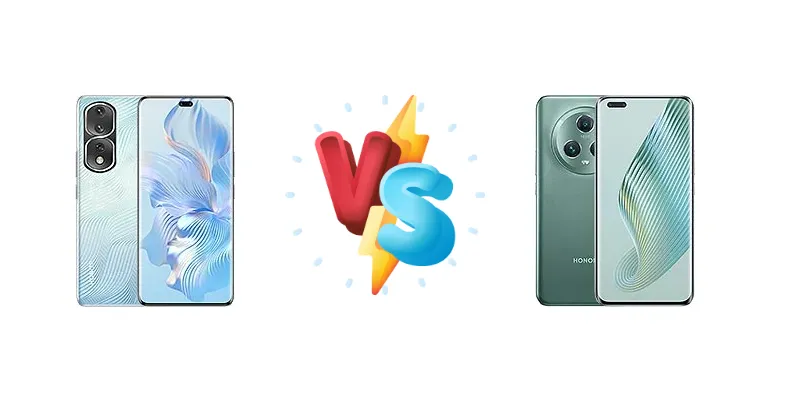
Honor continues to deliver impressive smartphones, but choosing between the Honor 80 Pro and the Magic5 Pro can be tricky. Both offer premium features, but cater to slightly different users. This comprehensive comparison will dissect every aspect, from display quality to camera capabilities, to help you make the right decision.
🏆 Quick Verdict
The Honor Magic5 Pro emerges as the overall winner thanks to its superior Snapdragon 8 Gen 2 chipset, brighter display, and longer battery life. While the 80 Pro offers a compelling package, the Magic5 Pro’s advancements in performance and camera make it the more desirable flagship.
| Network |
|---|
| 2G bands | GSM 850 / 900 / 1800 / 1900 | GSM 850 / 900 / 1800 / 1900 |
| 3G bands | HSDPA 800 / 850 / 900 / 1700(AWS) / 1900 / 2100 | HSDPA 800 / 850 / 900 / 1700(AWS) / 1900 / 2100 |
| 4G bands | LTE | 1, 2, 3, 4, 5, 7, 8, 12, 17, 18, 19, 20, 26, 28, 34, 38, 39, 40, 41 - China |
| 5G bands | SA/NSA | 1, 3, 5, 8, 28, 38, 41, 77, 78, 79 SA/NSA - China |
| Speed | HSPA, LTE, 5G | HSPA, LTE, 5G |
| Technology | GSM / CDMA / HSPA / CDMA2000 / LTE / 5G | GSM / CDMA / HSPA / EVDO / LTE / 5G |
| | CDMA2000 1x | CDMA2000 1xEV-DO |
| Launch |
|---|
| Announced | 2022, November 23 | 2023, February 27 |
| Status | Available. Released 2022, December 02 | Available. Released 2023, March 31 |
| Body |
|---|
| Build | - | Glass front, glass back or eco leather back |
| Dimensions | 163.3 x 74.9 x 7.8 mm (6.43 x 2.95 x 0.31 in) | 162.9 x 76.7 x 8.8 mm (6.41 x 3.02 x 0.35 in) |
| SIM | Nano-SIM + Nano-SIM | · Nano-SIM + eSIM· Nano-SIM + Nano-SIM + eSIM (max 2 at a time) |
| Weight | 188 g (6.63 oz) | 219 g (7.72 oz) |
| | - | IP68 dust/water resistant (up to 1.5m for 30 min) |
| Display |
|---|
| Resolution | 1224 x 2700 pixels (~437 ppi density) | 1312 x 2848 pixels, 19.5:9 ratio (~460 ppi density) |
| Size | 6.78 inches, 111.5 cm2 (~91.2% screen-to-body ratio) | 6.81 inches, 113.7 cm2 (~91.0% screen-to-body ratio) |
| Type | OLED, 1B colors, 120Hz, HDR, 1000 nits (peak) | LTPO OLED, 1B colors, 120Hz, HDR10+, 1800 nits (peak) |
| Platform |
|---|
| CPU | Octa-core (1x3.0 GHz Cortex-X2 & 3x2.5 GHz Cortex-A710 & 4x1.80 GHz Cortex-A510) | Octa-core (1x3.2 GHz Cortex-X3 & 2x2.8 GHz Cortex-A715 & 2x2.8 GHz Cortex-A710 & 3x2.0 GHz Cortex-A510) |
| Chipset | Qualcomm SM8475 Snapdragon 8+ Gen 1 (4 nm) | Qualcomm SM8550-AB Snapdragon 8 Gen 2 (4 nm) |
| GPU | Adreno 730 | Adreno 740 |
| OS | Android 12, MagicOS 7 | Android 13, upgradable to Android 14, MagicOS 8 |
| Memory |
|---|
| Card slot | No | No |
| Internal | 256GB 8GB RAM, 256GB 12GB RAM, 512GB 12GB RAM | 256GB 8GB RAM, 256GB 12GB RAM, 512GB 12GB RAM, 512GB 16GB RAM |
| | - | UFS 4.0 |
| Main Camera |
|---|
| Dual | 50 MP, f/2.4, 100˚, (ultrawide)
2 MP, f/2.4, (depth) | - |
| Features | LED flash, HDR, panorama | Laser AF, color spectrum sensor, LED flash, HDR, panorama |
| Single | - | 12 MP, f/2.4, 100˚ (ultrawide), 1.22µm
TOF 3D, (depth/biometrics sensor) |
| Triple | 160 MP, f/1.8, (wide), 1/1.56", 0.75µm, PDAF
50 MP, f/2.0, 122˚ (ultrawide), AF
Auxiliary lens | 50 MP, f/1.6, 23mm (wide), 1/1.12" 1.4µm, multi-directional PDAF, OIS
50 MP, f/3.0, 90mm (periscope telephoto), PDAF, OIS, 3.5x optical zoom
50 MP, f/2.0, 13mm, 122˚ (ultrawide), 1/2.76", AF
TOF 3D (depth) |
| Video | 4K@30fps, 1080p@30/60fps, gyro-EIS | 4K@30/60fps, 1080p@30/60fps, gyro-EIS, HDR10, 10-bit video |
| Selfie camera |
|---|
| Dual | 50 MP, f/2.4, 100˚, (ultrawide)
2 MP, f/2.4, (depth) | - |
| Features | HDR | HDR |
| Single | - | 12 MP, f/2.4, 100˚ (ultrawide), 1.22µm
TOF 3D, (depth/biometrics sensor) |
| Video | 4K@30fps, 1080p@30fps, gyro-EIS | 4K@30fps, 1080p@30/60fps |
| Sound |
|---|
| 3.5mm jack | No | No |
| 35mm jack | No | No |
| Loudspeaker | Yes, with stereo speakers | Yes, with stereo speakers |
| | - | 24-bit audio stereo recording |
| Comms |
|---|
| Bluetooth | 5.2, A2DP, LE, aptX HD | 5.2, A2DP, LE, aptX HD |
| Infrared port | - | Yes |
| NFC | Yes | Yes |
| Positioning | GPS, GALILEO, GLONASS, BDS, QZSS | GPS (L1+L5), GLONASS (L1), BDS (B1I+B1c+B2a), GALILEO (E1+E5a) |
| Radio | No | No |
| USB | USB Type-C 2.0, OTG | USB Type-C 3.1, DisplayPort 1.2, OTG |
| WLAN | Wi-Fi 802.11 a/b/g/n/ac/6, dual-band, Wi-Fi Direct | Wi-Fi 802.11 a/b/g/n/ac/6, dual-band, Wi-Fi Direct |
| Features |
|---|
| Sensors | Fingerprint (under display, optical), accelerometer, gyro, compass | Fingerprint (under display, optical), Face ID, accelerometer, gyro, proximity, compass |
| | Virtual proximity sensing | - |
| Battery |
|---|
| Charging | 66W wired, 3-50% in 15 min
5W reverse wired | 66W wired
50W wireless
Reverse wireless
5W reverse wired |
| Type | Li-Po 4800 mAh | Market-dependent versions:· Li-Po 5100 mAh (Global)· Si/C Li-Ion 5450 mAh (China only) |
| Misc |
|---|
| Colors | Black, Green, Blue, Pink | Black, Meadow Green, Blue, Purple, Orange |
| Models | ANP-AN00 | PGT-AN10, PGT-N19 |
| Price | About 420 EUR | £ 799.99 / € 407.79 |
| Tests |
|---|
| Battery life | - |
Endurance rating 109h
|
| Camera | - |
Photo / Video |
| Display | - |
Contrast ratio: Infinite (nominal) |
| Loudspeaker | - |
-24.6 LUFS (Very good)
|
| Performance | - |
GeekBench: 4378 (v5.1), 5096 (v6) |
Honor 80 Pro
- Stylish Design
- Fast 66W Wired Charging
- Capable Camera System
- Competitive Price
- Older Snapdragon 8+ Gen 1 Chipset
- Lower Peak Brightness Display
- Shorter Battery Life
Honor Magic5 Pro
- Latest Snapdragon 8 Gen 2 Chipset
- Brighter and Higher Contrast Display
- Excellent Battery Life
- 50W Wireless Charging
- Advanced Camera System
- Higher Price
- Design may be less striking than 80 Pro
Display Comparison
The Magic5 Pro boasts a significantly brighter display, reaching a measured 1227 nits compared to the 80 Pro's likely lower peak brightness (estimated around 800-1000 nits based on typical Honor displays). The Magic5 Pro's infinite contrast ratio also suggests superior image quality. Both phones likely feature OLED panels with vibrant colors and smooth refresh rates, but the Magic5 Pro takes the lead in visual fidelity.
Camera Comparison
While both phones offer capable camera systems, the Magic5 Pro is expected to have a more advanced setup. The Magic5 Pro likely features a larger primary sensor and improved image processing algorithms, resulting in better low-light performance and overall image quality. Both phones likely offer versatile zoom capabilities.
Performance
The Snapdragon 8 Gen 2 in the Magic5 Pro provides a noticeable performance advantage over the Snapdragon 8+ Gen 1 in the 80 Pro. Expect faster app loading times, smoother multitasking, and better gaming performance on the Magic5 Pro. Both phones offer ample RAM for most users, but the newer chipset provides a future-proof edge.
Battery Life
The Magic5 Pro demonstrates superior battery life, with an active use score of 12:06h and an endurance rating of 109h, significantly outperforming the 80 Pro. While the 80 Pro's 66W charging is fast, the Magic5 Pro's 66W wired and 50W wireless charging provides more flexibility.
Buying Guide
The Honor 80 Pro is ideal for users prioritizing a stylish design, fast charging, and a capable camera at a slightly more accessible price point. The Honor Magic5 Pro is best suited for power users, photography enthusiasts, and those who demand the absolute best performance and battery endurance.
Frequently Asked Questions
❓ Is the Honor Magic5 Pro worth the extra cost?
If you prioritize performance, battery life, and a top-tier camera, the Magic5 Pro's extra cost is justified. However, if you're on a tighter budget and value style and fast charging, the 80 Pro remains a strong contender.
❓ Which phone has better gaming performance?
The Honor Magic5 Pro, with its Snapdragon 8 Gen 2, offers significantly better gaming performance due to its more powerful CPU and GPU.