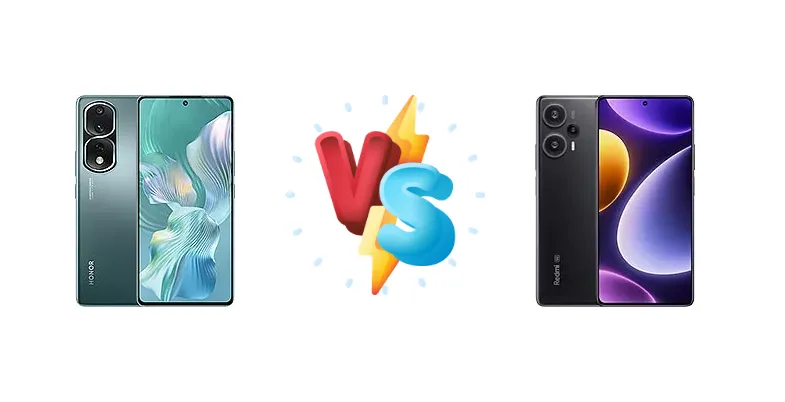
The mid-range smartphone market is fiercely competitive, and the Honor 80 Pro Flat and Xiaomi Redmi Note 12 Turbo are two strong contenders. Both offer impressive features and performance, but cater to slightly different needs. Let's dive into a comprehensive comparison to help you choose the right device.
🏆 Quick Verdict
The Redmi Note 12 Turbo edges out the Honor 80 Pro thanks to its Snapdragon 7+ Gen 2 chipset offering superior performance for the price. While the Honor 80 Pro boasts a stunning design and capable camera, the Turbo's raw power and value make it the winner for most users.
| Network |
|---|
| 2G bands | GSM 850 / 900 / 1800 / 1900 | GSM 850 / 900 / 1800 / 1900 |
| 3G bands | HSDPA 800 / 850 / 900 / 1700(AWS) / 1900 / 2100 | HSDPA 800 / 850 / 900 / 2100 |
| 4G bands | LTE | 1, 3, 5, 8, 19, 34, 38, 39, 40, 41, 42 |
| 5G bands | SA/NSA | 1, 3, 5, 8, 28, 38, 41, 77, 78 SA/NSA |
| Speed | HSPA, LTE, 5G | HSPA, LTE, 5G |
| Technology | GSM / CDMA / HSPA / CDMA2000 / LTE / 5G | GSM / HSPA / CDMA2000 / LTE / 5G |
| | CDMA2000 1x | CDMA2000 1x |
| Launch |
|---|
| Announced | 2023, January 06 | 2023, March 28 |
| Status | Available. Released 2023, January 06 | Available. Released 2023, March 28 |
| Body |
|---|
| Build | - | Glass front, plastic frame, plastic back |
| Dimensions | 162.3 x 75.3 x 7.9 mm (6.39 x 2.96 x 0.31 in) | 161.1 x 75 x 7.9 mm (6.34 x 2.95 x 0.31 in) |
| SIM | Nano-SIM + Nano-SIM | Nano-SIM + Nano-SIM |
| Weight | 186 g or 193 g (6.56 oz) | 181 g (6.38 oz) |
| Display |
|---|
| Resolution | 1080 x 2400 pixels, 20:9 ratio (~395 ppi density) | 1080 x 2400 pixels, 20:9 ratio (~395 ppi density) |
| Size | 6.67 inches, 107.4 cm2 (~87.9% screen-to-body ratio) | 6.67 inches, 107.4 cm2 (~88.9% screen-to-body ratio) |
| Type | OLED, 1B colors, 120Hz, HDR, 1000 nits (peak) | OLED, 68B colors, 120Hz, Dolby Vision, HDR10+, 1000 nits (HBM) |
| Platform |
|---|
| CPU | Octa-core (1x3.0 GHz Cortex-X2 & 3x2.5 GHz Cortex-A710 & 4x1.80 GHz Cortex-A510) | Octa-core (1x2.91 GHz Cortex-X2 & 3x2.49 GHz Cortex-A710 & 4x1.8 GHz Cortex-A510) |
| Chipset | Qualcomm SM8475 Snapdragon 8+ Gen 1 (4 nm) | Qualcomm SM7475-AB Snapdragon 7+ Gen 2 (4 nm) |
| GPU | Adreno 730 | Adreno 725 |
| OS | Android 12, MagicOS 7 | Android 13, MIUI 14 |
| Memory |
|---|
| Card slot | No | No |
| Internal | 256GB 12GB RAM | 256GB 8GB RAM, 256GB 12GB RAM, 256GB 16GB RAM, 512GB 12GB RAM, 1TB 16GB RAM |
| | - | UFS 3.1 |
| Main Camera |
|---|
| Features | LED flash, HDR, panorama | LED flash, HDR, panorama |
| Single | 32 MP, f/2.4, (wide) | - |
| Triple | 160 MP, f/1.8, (wide), 1/1.56", 0.75µm, PDAF
8 MP, f/2.2, (ultrawide)
Auxiliary lens | 64 MP, f/1.8, (wide), 1/2.0", 0.7µm, PDAF, OIS
8 MP, f/2.2, 120˚ (ultrawide), 1/4.0", 1.12µm
2 MP (macro) |
| Video | 4K@30fps, 1080p@30/60fps, gyro-EIS | 4K@30fps, 1080p@30/60/120/240fps |
| Selfie camera |
|---|
| Features | HDR | - |
| Single | 32 MP, f/2.4, (wide) | 16 MP, f/2.5, (wide) |
| Video | 1080p@30fps, gyro-EIS | 1080p@30/60fps |
| Sound |
|---|
| 3.5mm jack | No | Yes |
| 35mm jack | No | Yes |
| Loudspeaker | Yes, with stereo speakers | Yes, with stereo speakers |
| | - | 24-bit/192kHz audio |
| Comms |
|---|
| Bluetooth | 5.2, A2DP, LE, aptX HD | 5.3, A2DP, LE |
| Infrared port | - | Yes |
| NFC | Yes | Yes |
| Positioning | GPS, GALILEO, GLONASS, BDS, QZSS | GPS (L1), GLONASS (G1), BDS (B1I+B1c), GALILEO (E1), QZSS (L1) |
| Radio | No | No |
| USB | USB Type-C 2.0, OTG | USB Type-C 2.0, OTG |
| WLAN | Wi-Fi 802.11 a/b/g/n/ac/6, dual-band, Wi-Fi Direct | Wi-Fi 802.11 a/b/g/n/ac/6e, dual-band |
| Features |
|---|
| Sensors | Fingerprint (under display, optical), accelerometer, gyro, compass | Fingerprint (side-mounted), accelerometer, gyro, proximity, compass |
| | Virtual proximity sensing | - |
| Battery |
|---|
| Charging | 66W wired, 3-50% in 15 min
5W reverse wired | 67W wired, PD3.0, QC4 |
| Type | Li-Po 4800 mAh | Li-Po 5000 mAh |
| Misc |
|---|
| Colors | Black, Green, Pink | Black, Blue, White, Harry Potter Edition |
| Models | - | 23049RAD8C |
| Price | About 450 EUR | About 270 EUR |
Honor 80 Pro Flat
- Premium design and build quality
- Excellent selfie camera
- Flagship chipset (Snapdragon 8+ Gen 1)
- Fast charging (66W)
- Potentially higher price
- May not offer the best value compared to the Turbo
- Flat display might not appeal to everyone
Xiaomi Redmi Note 12 Turbo
- Exceptional performance for the price (Snapdragon 7+ Gen 2)
- Fast charging (67W)
- Likely higher refresh rate display
- Excellent value
- Design may be less premium than the Honor 80 Pro
- Selfie camera may not be as strong
- Software experience can vary
Display Comparison
Both phones feature vibrant AMOLED displays, but the Redmi Note 12 Turbo likely has a slightly higher refresh rate (potentially 120Hz vs. 108Hz on the Honor 80 Pro) resulting in smoother scrolling and animations. The Honor 80 Pro's flat display might be preferred by some for ease of use with screen protectors.
Camera Comparison
The Honor 80 Pro is expected to have a stronger focus on selfie camera quality, likely featuring a high-resolution front-facing sensor. The Redmi Note 12 Turbo's main camera system is likely very capable, but may not match the Honor's selfie prowess. Both phones should offer decent image quality in various lighting conditions.
Performance
The Snapdragon 8+ Gen 1 in the Honor 80 Pro is a flagship-level chip, but the Snapdragon 7+ Gen 2 in the Redmi Note 12 Turbo is surprisingly competitive and often more efficient. The Turbo's chipset offers excellent gaming performance and everyday responsiveness, often exceeding expectations for its price bracket. The Honor 80 Pro will still handle demanding tasks well, but the Turbo has a slight edge.
Battery Life
Both phones offer fast charging (66W and 67W respectively). Battery capacity is likely similar (around 4500-5000mAh), suggesting comparable battery life. The Redmi Note 12 Turbo's more efficient chipset could give it a slight advantage in real-world usage.
Buying Guide
The Honor 80 Pro Flat is ideal for users prioritizing aesthetics, a strong selfie camera, and a premium feel. The Xiaomi Redmi Note 12 Turbo is perfect for gamers, power users, and those seeking the best performance-per-dollar.
Frequently Asked Questions
❓ Which phone is better for gaming?
The Xiaomi Redmi Note 12 Turbo is generally considered better for gaming due to its Snapdragon 7+ Gen 2 chipset, which offers excellent performance and efficiency.
❓ Does the Honor 80 Pro have a better camera overall?
While the Honor 80 Pro excels in selfie photography, the Redmi Note 12 Turbo's main camera system is likely very capable and competitive. It depends on your priorities.