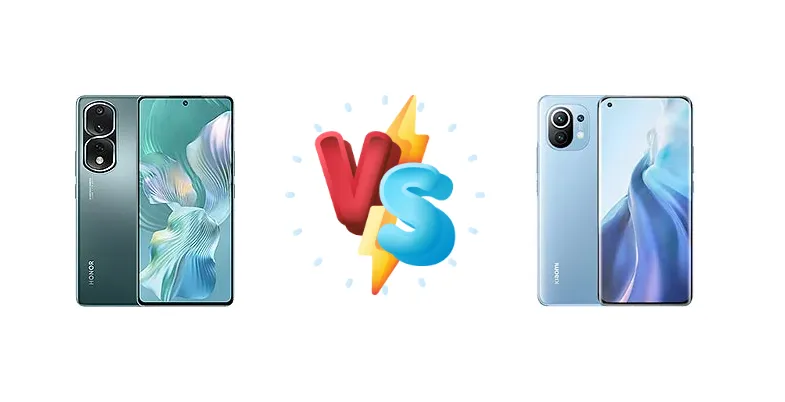
The smartphone market is brimming with options, making it tough to choose. Today, we pit two compelling contenders against each other: the Honor 80 Pro Flat and the Xiaomi Mi 11. Both offer premium features, but cater to slightly different needs. Let's dive into a comprehensive comparison to help you decide which one is right for you.
🏆 Quick Verdict
The Honor 80 Pro Flat boasts a significantly faster Snapdragon 8+ Gen 1 chipset and faster wired charging. However, the Xiaomi Mi 11 offers a longer-lasting battery (based on endurance rating) and wireless charging capabilities. Ultimately, the Honor wins for raw power, while the Mi 11 provides more versatility.
| Network |
|---|
| 2G bands | GSM 850 / 900 / 1800 / 1900 | GSM 850 / 900 / 1800 / 1900 |
| 3G bands | HSDPA 800 / 850 / 900 / 1700(AWS) / 1900 / 2100 | HSDPA 850 / 900 / 1700(AWS) / 1900 / 2100 |
| 4G bands | LTE | 1, 2, 3, 4, 5, 7, 8, 12, 17, 20, 28, 32, 38, 40, 41, 42, 66 - International |
| 5G bands | SA/NSA | 1, 3, 5, 7, 8, 20, 28, 38, 41, 77, 78, 79 SA/NSA - International |
| Speed | HSPA, LTE, 5G | HSPA, LTE, 5G |
| Technology | GSM / CDMA / HSPA / CDMA2000 / LTE / 5G | GSM / CDMA / HSPA / EVDO / LTE / 5G |
| | CDMA2000 1x | 1, 3, 28, 41, 77, 78, 79 SA/NSA - China |
| Launch |
|---|
| Announced | 2023, January 06 | 2020, December 28. Released 2021, January 01 |
| Status | Available. Released 2023, January 06 | Discontinued |
| Body |
|---|
| Build | - | Glass front (Gorilla Glass Victus), glass back (Gorilla Glass 5) or eco leather back, aluminum frame |
| Dimensions | 162.3 x 75.3 x 7.9 mm (6.39 x 2.96 x 0.31 in) | 164.3 x 74.6 x 8.1 mm (Glass) / 8.6 mm (Leather) |
| SIM | Nano-SIM + Nano-SIM | Nano-SIM + Nano-SIM |
| Weight | 186 g or 193 g (6.56 oz) | 196 g (Glass) / 194 g (Leather) (6.84 oz) |
| Display |
|---|
| Protection | - | Corning Gorilla Glass Victus |
| Resolution | 1080 x 2400 pixels, 20:9 ratio (~395 ppi density) | 1440 x 3200 pixels, 20:9 ratio (~515 ppi density) |
| Size | 6.67 inches, 107.4 cm2 (~87.9% screen-to-body ratio) | 6.81 inches, 112.0 cm2 (~91.4% screen-to-body ratio) |
| Type | OLED, 1B colors, 120Hz, HDR, 1000 nits (peak) | AMOLED, 1B colors, 120Hz, HDR10+, 1500 nits (peak) |
| Platform |
|---|
| CPU | Octa-core (1x3.0 GHz Cortex-X2 & 3x2.5 GHz Cortex-A710 & 4x1.80 GHz Cortex-A510) | Octa-core (1x2.84 GHz Cortex-X1 & 3x2.42 GHz Cortex-A78 & 4x1.80 GHz Cortex-A55 |
| Chipset | Qualcomm SM8475 Snapdragon 8+ Gen 1 (4 nm) | Qualcomm SM8350 Snapdragon 888 5G (5 nm) |
| GPU | Adreno 730 | Adreno 660 |
| OS | Android 12, MagicOS 7 | Android 11, upgradable to Android 14, HyperOS |
| Memory |
|---|
| Card slot | No | No |
| Internal | 256GB 12GB RAM | 128GB 6GB RAM, 128GB 8GB RAM, 256GB 8GB RAM, 256GB 12GB RAM |
| | - | UFS 3.1 |
| Main Camera |
|---|
| Features | LED flash, HDR, panorama | Dual-LED dual-tone flash, HDR, panorama |
| Single | 32 MP, f/2.4, (wide) | - |
| Triple | 160 MP, f/1.8, (wide), 1/1.56", 0.75µm, PDAF
8 MP, f/2.2, (ultrawide)
Auxiliary lens | 108 MP, f/1.9, 26mm (wide), 1/1.33", 0.8µm, PDAF, OIS
13 MP, f/2.4, 123˚ (ultrawide), 1/3.06", 1.12µm
5 MP (macro) |
| Video | 4K@30fps, 1080p@30/60fps, gyro-EIS | 8K@24/30fps, 4K@30/60fps, 1080p@30/60/120/240fps; gyro-EIS, HDR10+ |
| Selfie camera |
|---|
| Features | HDR | HDR |
| Single | 32 MP, f/2.4, (wide) | 20 MP, f/2.2, 27mm (wide), 1/3.4", 0.8µm |
| Video | 1080p@30fps, gyro-EIS | 1080p@30/60fps, 720p@120fps |
| Sound |
|---|
| 3.5mm jack | No | No |
| 35mm jack | No | No |
| Loudspeaker | Yes, with stereo speakers | Yes, with stereo speakers |
| | - | 24-bit/192kHz audio |
| Comms |
|---|
| Bluetooth | 5.2, A2DP, LE, aptX HD | 5.2, A2DP, LE, aptX HD, aptX Adaptive |
| Infrared port | - | Yes |
| NFC | Yes | Yes |
| Positioning | GPS, GALILEO, GLONASS, BDS, QZSS | GPS (L1+L5), GLONASS (G1), BDS (B1I+B1c+B2a), GALILEO (E1+E5a), QZSS (L1+L5), NavIC (L5) |
| Radio | No | No |
| USB | USB Type-C 2.0, OTG | USB Type-C 2.0, OTG |
| WLAN | Wi-Fi 802.11 a/b/g/n/ac/6, dual-band, Wi-Fi Direct | Wi-Fi 802.11 a/b/g/n/ac/6, dual-band, Wi-Fi Direct |
| Features |
|---|
| Sensors | Fingerprint (under display, optical), accelerometer, gyro, compass | Fingerprint (under display, optical), accelerometer, gyro, compass |
| | Virtual proximity sensing | Virtual proximity sensing |
| Battery |
|---|
| Charging | 66W wired, 3-50% in 15 min
5W reverse wired | 55W wired, PD3.0, QC4, 100% in 45 min
50W wireless, 100% in 53 min
10W reverse wireless |
| Type | Li-Po 4800 mAh | Li-Po 4600 mAh |
| Misc |
|---|
| Colors | Black, Green, Pink | Horizon Blue, Cloud White, Midnight Gray, Special Edition Blue, Gold, Violet |
| Models | - | M2011K2C, M2011K2G |
| Price | About 450 EUR | About 330 EUR |
| SAR | - | 0.95 W/kg (head) 0.65 W/kg (body) |
| SAR EU | - | 0.56 W/kg (head) 0.98 W/kg (body) |
| Tests |
|---|
| Battery life | - |
Endurance rating 89h
|
| Camera | - |
Photo / Video |
| Display | - |
Contrast ratio: Infinite (nominal) |
| Loudspeaker | - |
-24.2 LUFS (Very good)
|
| Performance | - |
AnTuTu: 668722 (v8)
GeekBench: 3489 (v5.1)
GFXBench: 33fps (ES 3.1 onscreen) |
Honor 80 Pro Flat
- Significantly faster chipset (Snapdragon 8+ Gen 1)
- Faster 66W wired charging
- Potentially brighter display
- Modern design
- No wireless charging
- Battery life potentially shorter than Mi 11
- Software experience may be less mature than Mi 11
Xiaomi Mi 11
- Longer battery life (89h endurance rating)
- Wireless charging support
- Mature software experience
- Excellent camera system
- Slower charging speeds
- Older chipset (Snapdragon 888)
- Potentially less bright display
Display Comparison
Both phones feature impressive displays with a nominal infinite contrast ratio, suggesting excellent blacks and vibrant colors. The Mi 11 likely has slightly better color accuracy due to its age and calibration. The Honor 80 Pro's display is expected to be brighter, offering better outdoor visibility. Resolution and refresh rate are likely comparable, providing a smooth and immersive viewing experience on both devices.
Camera Comparison
Both phones offer capable camera systems. The Mi 11's camera has been praised for its image quality and video recording capabilities. The Honor 80 Pro is expected to have a strong camera setup, likely with a focus on portrait photography and low-light performance. A direct comparison would require detailed testing, but both should deliver excellent results.
Performance
This is where the Honor 80 Pro shines. The Snapdragon 8+ Gen 1 is a substantial upgrade over the Mi 11's Snapdragon 888. Expect significantly faster app loading times, smoother multitasking, and superior gaming performance on the Honor. The Mi 11 is still capable, but the Honor takes the lead in raw processing power.
Battery Life
The Xiaomi Mi 11 holds a slight advantage here, boasting an endurance rating of 89 hours. While the Honor 80 Pro's 66W charging is faster, the Mi 11's larger battery capacity and efficient chipset contribute to longer battery life. The Mi 11 also offers wireless charging, a feature absent on the Honor.
Buying Guide
The Honor 80 Pro Flat is ideal for gamers and power users who prioritize performance and fast charging. The Xiaomi Mi 11 is a better choice for those who value battery life, wireless charging, and a slightly more mature software experience (though both are excellent).
Frequently Asked Questions
❓ Is the Honor 80 Pro worth buying over the Xiaomi Mi 11?
It depends on your priorities. If you need the absolute fastest performance, the Honor 80 Pro is the better choice. If battery life and wireless charging are more important, the Mi 11 remains a strong contender.
❓ Which phone has better software support?
The Xiaomi Mi 11 likely has more mature software support due to its longer lifespan. However, Honor has been improving its software experience.