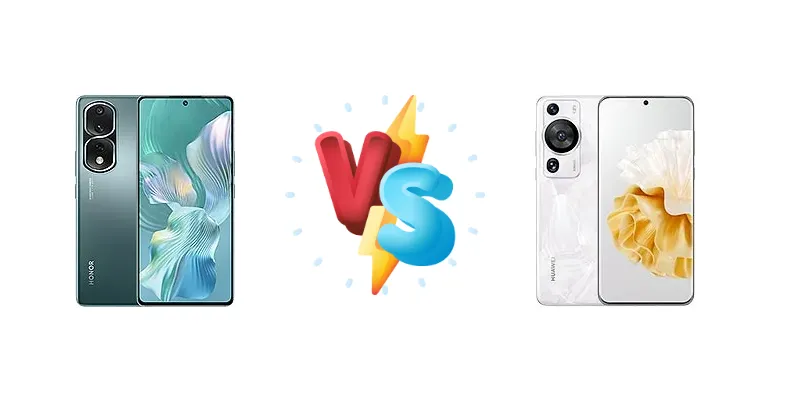
The smartphone landscape is fiercely competitive, and two contenders are vying for your attention: the Honor 80 Pro Flat and the Huawei P60 Pro. Both pack powerful Snapdragon 8+ Gen 1 chips, but their strengths lie in different areas. Let's dive into a comprehensive comparison to help you decide which one deserves a spot in your pocket.
🏆 Quick Verdict
The Huawei P60 Pro edges out the Honor 80 Pro with its superior camera system, faster wireless charging, and exceptional battery life. While the Honor 80 Pro offers a competitive price and sleek design, the P60 Pro’s overall package makes it the slightly better choice for most users.
| Network |
|---|
| 2G bands | GSM 850 / 900 / 1800 / 1900 | GSM 850 / 900 / 1800 / 1900 |
| 3G bands | HSDPA 800 / 850 / 900 / 1700(AWS) / 1900 / 2100 | HSDPA 800 / 850 / 900 / 1700(AWS) / 1900 / 2100 |
| 4G bands | LTE | 1, 2, 3, 4, 5, 7, 8, 12, 13, 17, 18, 19, 20, 26, 28, 32, 34, 38, 39, 40, 41, 66 - International |
| 5G bands | SA/NSA | - |
| Speed | HSPA, LTE, 5G | HSPA, LTE |
| Technology | GSM / CDMA / HSPA / CDMA2000 / LTE / 5G | GSM / CDMA / HSPA / CDMA2000 / LTE |
| | CDMA2000 1x | 1, 2, 3, 4, 5, 7, 8, 12, 17, 18, 19, 20, 26, 28, 34, 38, 39, 40, 41 - China |
| Launch |
|---|
| Announced | 2023, January 06 | 2023, March 23 |
| Status | Available. Released 2023, January 06 | Available. Released 2023, March 31 |
| Body |
|---|
| Dimensions | 162.3 x 75.3 x 7.9 mm (6.39 x 2.96 x 0.31 in) | 161 x 74.5 x 8.3 mm (6.34 x 2.93 x 0.33 in) |
| SIM | Nano-SIM + Nano-SIM | · Nano-SIM· Nano-SIM + Nano-SIM |
| Weight | 186 g or 193 g (6.56 oz) | 200 g (7.05 oz) |
| | - | IP68 dust/water resistant (up to 1.5m for 30 min) |
| Display |
|---|
| Protection | - | Kunlun Glass |
| Resolution | 1080 x 2400 pixels, 20:9 ratio (~395 ppi density) | 1220 x 2700 pixels (~444 ppi density) |
| Size | 6.67 inches, 107.4 cm2 (~87.9% screen-to-body ratio) | 6.67 inches, 107.7 cm2 (~89.8% screen-to-body ratio) |
| Type | OLED, 1B colors, 120Hz, HDR, 1000 nits (peak) | LTPO OLED, 1B colors, 120Hz |
| Platform |
|---|
| CPU | Octa-core (1x3.0 GHz Cortex-X2 & 3x2.5 GHz Cortex-A710 & 4x1.80 GHz Cortex-A510) | Octa-core (1x3.19 GHz Cortex-X2 & 3x2.75 GHz Cortex-A710 & 4x2.0 GHz Cortex-A510) |
| Chipset | Qualcomm SM8475 Snapdragon 8+ Gen 1 (4 nm) | Qualcomm SM8475 Snapdragon 8+ Gen 1 4G (4 nm) |
| GPU | Adreno 730 | Adreno 730 |
| OS | Android 12, MagicOS 7 | HarmonyOS 3.1 (China), EMUI 13.1 (Europe), no Google Play Services |
| Memory |
|---|
| Card slot | No | Nano Memory (uses shared SIM slot) |
| Internal | 256GB 12GB RAM | 256GB 8GB RAM, 256GB 12GB RAM, 512GB 12GB RAM |
| | - | UFS |
| Main Camera |
|---|
| Features | LED flash, HDR, panorama | Laser AF, color spectrum sensor, LED flash, HDR, panorama |
| Single | 32 MP, f/2.4, (wide) | - |
| Triple | 160 MP, f/1.8, (wide), 1/1.56", 0.75µm, PDAF
8 MP, f/2.2, (ultrawide)
Auxiliary lens | 48 MP, f/1.4-f/4.0, 25mm (wide), PDAF, OIS
48 MP, f/2.1, 90mm (telephoto), PDAF, sensor-shift OIS, 3.5x optical zoom
13 MP, f/2.2, 13mm (ultrawide), AF |
| Video | 4K@30fps, 1080p@30/60fps, gyro-EIS | 4K@30/60fps, 1080p@30/60fps, 1080p@960fps; gyro-EIS, HDR Vivid |
| Selfie camera |
|---|
| Features | HDR | Panorama, HDR |
| Single | 32 MP, f/2.4, (wide) | 13 MP, f/2.4, (ultrawide) |
| Video | 1080p@30fps, gyro-EIS | 4K@30/60fps, 1080p@30fps, HDR Vivid |
| Sound |
|---|
| 3.5mm jack | No | No |
| 35mm jack | No | No |
| Loudspeaker | Yes, with stereo speakers | Yes, with stereo speakers |
| Comms |
|---|
| Bluetooth | 5.2, A2DP, LE, aptX HD | 5.2, A2DP, LE |
| Infrared port | - | Yes |
| NFC | Yes | Yes |
| Positioning | GPS, GALILEO, GLONASS, BDS, QZSS | GPS (L1+L5), GLONASS (B1I+B1c+B2a), BDS (B1I+B1c+B2a), GALILEO (E1+E5a), QZSS (L1+L5), NavIC |
| Radio | No | No |
| USB | USB Type-C 2.0, OTG | USB Type-C 3.1, OTG |
| WLAN | Wi-Fi 802.11 a/b/g/n/ac/6, dual-band, Wi-Fi Direct | Wi-Fi 802.11 a/b/g/n/ac/6, dual-band, Wi-Fi Direct |
| Features |
|---|
| Sensors | Fingerprint (under display, optical), accelerometer, gyro, compass | Fingerprint (under display, optical), accelerometer, gyro, proximity, compass |
| | Virtual proximity sensing | BDS Satellite Message |
| Battery |
|---|
| Charging | 66W wired, 3-50% in 15 min
5W reverse wired | 88W wired
50W wireless
Reverse wireless |
| Type | Li-Po 4800 mAh | Li-Po 4815 mAh |
| Misc |
|---|
| Colors | Black, Green, Pink | Black, Green, Violet, Rococo Pearl |
| Models | - | MNA-AL00, MNA-LX9 |
| Price | About 450 EUR | € 738.50 |
| Tests |
|---|
| Battery life | - |
Endurance rating 96h
|
| Camera | - |
Photo / Video |
| Display | - |
Contrast ratio: Infinite (nominal) |
| Loudspeaker | - |
-27.3 LUFS (Good)
|
| Performance | - |
AnTuTu: 1030473 (v9)
GeekBench: 4422 (v6)
GFXBench: 65fps (ES 3.1 onscreen) |
Honor 80 Pro Flat
- Stylish Design
- Fast 66W Wired Charging
- Smooth Performance
- Competitive Price
- Less Impressive Camera
- No Wireless Charging
- Shorter Battery Life
Huawei P60 Pro
- Exceptional Camera System
- Outstanding Battery Life
- Fast 88W Wired Charging & 50W Wireless Charging
- Premium Build Quality
- Higher Price
- 4G Connectivity Only
- Potential Software Limitations (due to US sanctions)
Display Comparison
Both phones feature excellent OLED displays, but the Huawei P60 Pro boasts a significantly higher peak brightness of 1135 nits (measured) compared to the Honor 80 Pro's reported brightness. The P60 Pro's 'infinite' contrast ratio suggests deeper blacks and richer colors, though this is a nominal value. The Honor 80 Pro likely has a slightly curved display, which some users may prefer for aesthetics, while the P60 Pro may offer a flatter experience.
Camera Comparison
This is where the Huawei P60 Pro truly shines. While both offer capable camera systems, the P60 Pro is renowned for its exceptional image quality, particularly in low-light conditions. Huawei's computational photography is industry-leading. The Honor 80 Pro likely focuses on portrait photography and vibrant colors, but it won't match the P60 Pro's overall versatility and detail.
Performance
Both devices are powered by the Snapdragon 8+ Gen 1, ensuring flagship-level performance. The P60 Pro has a slightly higher CPU clock speed (3.19 GHz vs 3.0 GHz for Cortex-X2, 2.75 GHz vs 2.5 GHz for Cortex-A710), which *could* translate to marginally faster performance in demanding tasks, but real-world differences are likely to be minimal. Both should handle gaming and multitasking with ease.
Battery Life
The Huawei P60 Pro dominates in battery life, boasting an impressive endurance rating of 96 hours. The Honor 80 Pro's battery life is respectable, but falls short of the P60 Pro's longevity. The P60 Pro also offers 50W wireless charging, a feature absent on the Honor 80 Pro.
Buying Guide
The Honor 80 Pro Flat is ideal for users prioritizing a stylish design, fast wired charging, and a smooth overall experience at a slightly more accessible price point. The Huawei P60 Pro is perfect for photography enthusiasts, those needing exceptional battery endurance, and those who appreciate premium features like wireless charging and a top-tier camera.
Frequently Asked Questions
❓ Does the Huawei P60 Pro support 5G?
No, the Huawei P60 Pro is a 4G-only device due to restrictions on accessing 5G technology.
❓ Is the Honor 80 Pro a good value for money?
Yes, the Honor 80 Pro offers a compelling combination of features and performance at a more affordable price point than the Huawei P60 Pro.