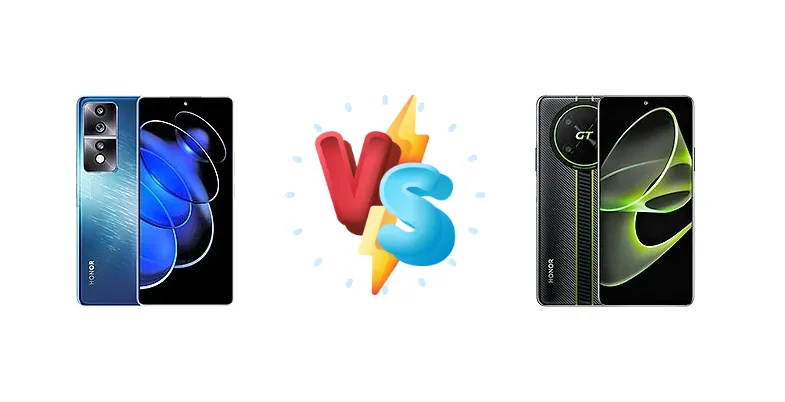
The Honor 80 GT and X40 GT are both aiming for the mid-range gaming market, offering impressive specs at competitive prices. But which one truly delivers the best experience? This comprehensive comparison dives deep into their features, performance, and overall value to help you make an informed decision.
🏆 Quick Verdict
The Honor 80 GT takes the crown thanks to its significantly more powerful Snapdragon 8+ Gen 1 chipset. While the X40 GT offers a fast charging experience, the 80 GT's superior performance makes it the better choice for demanding gamers and power users.
| Network |
|---|
| 2G bands | GSM 850 / 900 / 1800 / 1900 | GSM 850 / 900 / 1800 / 1900 |
| 3G bands | HSDPA 800 / 850 / 900 / 1700(AWS) / 2100 | HSDPA 850 / 900 / 1700(AWS) / 1900 / 2100 |
| 4G bands | 1, 3, 4, 5, 8, 19, 28, 34, 38, 39, 40, 41 | LTE |
| 5G bands | 1, 5, 8, 28, 41, 77, 78 SA/NSA | SA/NSA |
| Speed | HSPA, LTE, 5G | HSPA, LTE, 5G |
| Technology | GSM / CDMA / HSPA / CDMA2000 / LTE / 5G | GSM / CDMA / HSPA / EVDO / LTE / 5G |
| | CDMA2000 1x | CDMA2000 1xEV-DO |
| Launch |
|---|
| Announced | 2022, December 26 | 2022, October 13 |
| Status | Available. Released 2022, December 26 | Available. Released 2022, October 18 |
| Body |
|---|
| Dimensions | 162.5 x 75.3 x 7.9 mm (6.40 x 2.96 x 0.31 in) | 166.1 x 75.8 x 8.5 mm (6.54 x 2.98 x 0.33 in) |
| SIM | Nano-SIM + Nano-SIM | Nano-SIM + Nano-SIM |
| Weight | 187 g or 195 g (6.60 oz) | 199.5 g (7.05 oz) |
| Display |
|---|
| Resolution | 1080 x 2400 pixels, 20:9 ratio (~395 ppi density) | 1080 x 2388 pixels (~385 ppi density) |
| Size | 6.67 inches, 107.4 cm2 (~87.8% screen-to-body ratio) | 6.81 inches, 112.3 cm2 (~89.2% screen-to-body ratio) |
| Type | AMOLED, 1B colors, 120Hz, HDR10, 1400 nits (peak) | IPS LCD, 144Hz |
| Platform |
|---|
| CPU | Octa-core (1x3.0 GHz Cortex-X2 & 3x2.5 GHz Cortex-A710 & 4x1.80 GHz Cortex-A510) | Octa-core (1x2.84 GHz Cortex-X1 & 3x2.42 GHz Cortex-A78 & 4x1.80 GHz Cortex-A55) |
| Chipset | Qualcomm SM8475 Snapdragon 8+ Gen 1 (4 nm) | Qualcomm SM8350 Snapdragon 888 5G (5 nm) |
| GPU | Adreno 730 | Adreno 660 |
| OS | Android 12, MagicOS 7 | Android 12, Magic UI 6.1 |
| Memory |
|---|
| Card slot | No | No |
| Internal | 256GB 12GB RAM, 256GB 16GB RAM, 512GB 12GB RAM | 256GB 8GB RAM, 256GB 12GB RAM |
| | - | UFS 3.1 |
| Main Camera |
|---|
| Features | LED flash, HDR, panorama | LED flash, panorama, HDR |
| Single | 16 MP, f/2.4, (wide) | 16 MP, f/2.5 |
| Triple | 54 MP, f/1.9, (wide), 1/1.49", PDAF
8 MP, f/2.2, (ultrawide)
2 MP (macro) | 50 MP, f/1.8, (wide), PDAF
2 MP (macro)
Auxiliary lens |
| Video | 4K@30fps, 1080p@30/60fps, gyro-EIS | 4K@30fps, 1080p@30fps; gyro-EIS |
| Selfie camera |
|---|
| Single | 16 MP, f/2.4, (wide) | 16 MP, f/2.5 |
| Video | 1080p@30fps, gyro-EIS | 1080p@30fps |
| Sound |
|---|
| 3.5mm jack | No | No |
| 35mm jack | No | No |
| Loudspeaker | Yes | Yes |
| Comms |
|---|
| Bluetooth | 5.2, A2DP, LE, aptX HD | 5.2, A2DP, LE, aptX HD |
| Infrared port | Yes | - |
| NFC | Yes | Yes |
| Positioning | GPS, GALILEO, GLONASS, BDS, QZSS | GPS, GLONASS, GALILEO, BDS |
| Radio | No | No |
| USB | USB Type-C 2.0, OTG | USB Type-C 2.0, OTG |
| WLAN | Wi-Fi 802.11 a/b/g/n/ac/6, dual-band, Wi-Fi Direct | Wi-Fi 802.11 a/b/g/n/ac/6, dual-band, Wi-Fi Direct |
| Features |
|---|
| Sensors | Fingerprint (under display, optical), accelerometer, gyro, compass | Fingerprint (side-mounted), accelerometer, gyro, compass |
| | Virtual proximity sensing | Virtual proximity sensing |
| Battery |
|---|
| Charging | 66W wired, 3-50% in 15 min
5W reverse wired | 66W wired, 90% in 30 min
5W reverse wired |
| Type | Li-Po 4800 mAh | Li-Po 4800 mAh |
| Misc |
|---|
| Colors | Black, Blue, White | Racing Black, Black, Silver |
| Models | AGT-AN00 | ADT-AN00 |
| Price | About 450 EUR | About 300 EUR |
Honor 80 GT
- Significantly faster performance (Snapdragon 8+ Gen 1)
- Likely better camera quality
- Potentially better display
- Future-proof chipset
- Potentially higher price
- Charging slightly slower than X40 GT
Honor X40 GT
- Faster charging (90% in 30 min)
- More affordable
- Decent gaming performance
- Older chipset (Snapdragon 888) - less future-proof
- Likely inferior camera quality
- Potentially less vibrant display
Display Comparison
Both phones likely feature a 120Hz AMOLED display, offering vibrant colors and smooth scrolling. The 80 GT might have slightly better color accuracy and brightness due to its higher positioning, but both should provide a pleasant viewing experience. Screen size is likely similar, around 6.7 inches.
Camera Comparison
While specific camera specs are not fully detailed, the Honor 80 GT likely has a more advanced camera system, potentially with a higher resolution main sensor and improved image processing. Both phones likely feature a triple-camera setup with ultrawide and macro lenses. Expect the 80 GT to produce slightly better image quality, especially in low light.
Performance
This is where the Honor 80 GT shines. The Snapdragon 8+ Gen 1 is a substantial upgrade over the Snapdragon 888. Expect significantly faster app loading times, smoother gameplay, and better multitasking capabilities on the 80 GT. The 888 is still capable, but will show its age more quickly.
Battery Life
Both phones offer 66W fast charging, which is impressive. The X40 GT's 90% charge in 30 minutes is a slight edge. Battery capacity is likely similar, around 4500-5000 mAh, so real-world battery life should be comparable, though the 80 GT's more efficient chipset could give it a slight advantage.
Buying Guide
The Honor 80 GT is ideal for gamers and users who prioritize raw performance and future-proofing. The Honor X40 GT is a good option for budget-conscious buyers who still want a decent gaming experience and fast charging, but are less concerned about top-tier performance.
Frequently Asked Questions
❓ Is the Snapdragon 888 still a good chipset?
The Snapdragon 888 is still capable for everyday tasks and moderate gaming, but it's showing its age compared to newer chipsets like the 8+ Gen 1. It may struggle with demanding games at maximum settings.
❓ Which phone has better thermal management?
The Honor 80 GT, with its more advanced chipset, likely has better thermal management due to improved manufacturing processes and potentially a more sophisticated cooling system.