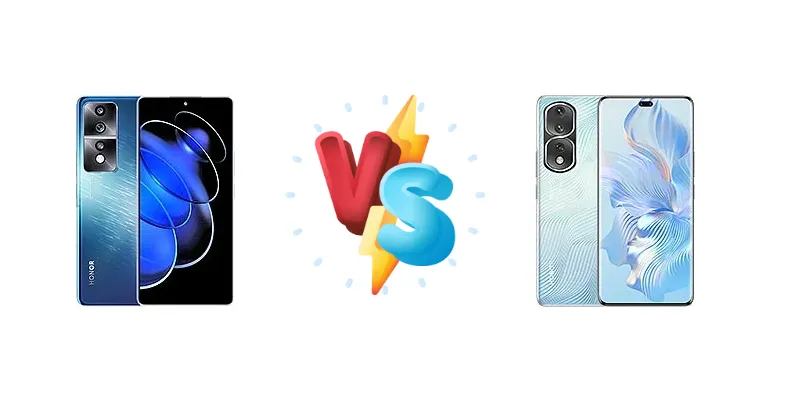
The Honor 80 series has arrived, offering compelling mid-range options. Two models stand out: the Honor 80 GT and the Honor 80 Pro. Both pack the Snapdragon 8+ Gen 1, but subtle differences in design, camera features, and potentially software experience could sway your decision. Let's dive into a comprehensive comparison.
🏆 Quick Verdict
Both phones offer flagship-level performance thanks to the Snapdragon 8+ Gen 1. The Honor 80 GT likely focuses on a more gaming-centric experience with potential software optimizations, while the Honor 80 Pro might prioritize camera versatility and a refined design. It's a close call, depending on your priorities.
| Network |
|---|
| 2G bands | GSM 850 / 900 / 1800 / 1900 | GSM 850 / 900 / 1800 / 1900 |
| 3G bands | HSDPA 800 / 850 / 900 / 1700(AWS) / 2100 | HSDPA 800 / 850 / 900 / 1700(AWS) / 1900 / 2100 |
| 4G bands | 1, 3, 4, 5, 8, 19, 28, 34, 38, 39, 40, 41 | LTE |
| 5G bands | 1, 5, 8, 28, 41, 77, 78 SA/NSA | SA/NSA |
| Speed | HSPA, LTE, 5G | HSPA, LTE, 5G |
| Technology | GSM / CDMA / HSPA / CDMA2000 / LTE / 5G | GSM / CDMA / HSPA / CDMA2000 / LTE / 5G |
| | CDMA2000 1x | CDMA2000 1x |
| Launch |
|---|
| Announced | 2022, December 26 | 2022, November 23 |
| Status | Available. Released 2022, December 26 | Available. Released 2022, December 02 |
| Body |
|---|
| Dimensions | 162.5 x 75.3 x 7.9 mm (6.40 x 2.96 x 0.31 in) | 163.3 x 74.9 x 7.8 mm (6.43 x 2.95 x 0.31 in) |
| SIM | Nano-SIM + Nano-SIM | Nano-SIM + Nano-SIM |
| Weight | 187 g or 195 g (6.60 oz) | 188 g (6.63 oz) |
| Display |
|---|
| Resolution | 1080 x 2400 pixels, 20:9 ratio (~395 ppi density) | 1224 x 2700 pixels (~437 ppi density) |
| Size | 6.67 inches, 107.4 cm2 (~87.8% screen-to-body ratio) | 6.78 inches, 111.5 cm2 (~91.2% screen-to-body ratio) |
| Type | AMOLED, 1B colors, 120Hz, HDR10, 1400 nits (peak) | OLED, 1B colors, 120Hz, HDR, 1000 nits (peak) |
| Platform |
|---|
| CPU | Octa-core (1x3.0 GHz Cortex-X2 & 3x2.5 GHz Cortex-A710 & 4x1.80 GHz Cortex-A510) | Octa-core (1x3.0 GHz Cortex-X2 & 3x2.5 GHz Cortex-A710 & 4x1.80 GHz Cortex-A510) |
| Chipset | Qualcomm SM8475 Snapdragon 8+ Gen 1 (4 nm) | Qualcomm SM8475 Snapdragon 8+ Gen 1 (4 nm) |
| GPU | Adreno 730 | Adreno 730 |
| OS | Android 12, MagicOS 7 | Android 12, MagicOS 7 |
| Memory |
|---|
| Card slot | No | No |
| Internal | 256GB 12GB RAM, 256GB 16GB RAM, 512GB 12GB RAM | 256GB 8GB RAM, 256GB 12GB RAM, 512GB 12GB RAM |
| Main Camera |
|---|
| Dual | - | 50 MP, f/2.4, 100˚, (ultrawide)
2 MP, f/2.4, (depth) |
| Features | LED flash, HDR, panorama | LED flash, HDR, panorama |
| Single | 16 MP, f/2.4, (wide) | - |
| Triple | 54 MP, f/1.9, (wide), 1/1.49", PDAF
8 MP, f/2.2, (ultrawide)
2 MP (macro) | 160 MP, f/1.8, (wide), 1/1.56", 0.75µm, PDAF
50 MP, f/2.0, 122˚ (ultrawide), AF
Auxiliary lens |
| Video | 4K@30fps, 1080p@30/60fps, gyro-EIS | 4K@30fps, 1080p@30/60fps, gyro-EIS |
| Selfie camera |
|---|
| Dual | - | 50 MP, f/2.4, 100˚, (ultrawide)
2 MP, f/2.4, (depth) |
| Features | - | HDR |
| Single | 16 MP, f/2.4, (wide) | - |
| Video | 1080p@30fps, gyro-EIS | 4K@30fps, 1080p@30fps, gyro-EIS |
| Sound |
|---|
| 3.5mm jack | No | No |
| 35mm jack | No | No |
| Loudspeaker | Yes | Yes, with stereo speakers |
| Comms |
|---|
| Bluetooth | 5.2, A2DP, LE, aptX HD | 5.2, A2DP, LE, aptX HD |
| Infrared port | Yes | - |
| NFC | Yes | Yes |
| Positioning | GPS, GALILEO, GLONASS, BDS, QZSS | GPS, GALILEO, GLONASS, BDS, QZSS |
| Radio | No | No |
| USB | USB Type-C 2.0, OTG | USB Type-C 2.0, OTG |
| WLAN | Wi-Fi 802.11 a/b/g/n/ac/6, dual-band, Wi-Fi Direct | Wi-Fi 802.11 a/b/g/n/ac/6, dual-band, Wi-Fi Direct |
| Features |
|---|
| Sensors | Fingerprint (under display, optical), accelerometer, gyro, compass | Fingerprint (under display, optical), accelerometer, gyro, compass |
| | Virtual proximity sensing | Virtual proximity sensing |
| Battery |
|---|
| Charging | 66W wired, 3-50% in 15 min
5W reverse wired | 66W wired, 3-50% in 15 min
5W reverse wired |
| Type | Li-Po 4800 mAh | Li-Po 4800 mAh |
| Misc |
|---|
| Colors | Black, Blue, White | Black, Green, Blue, Pink |
| Models | AGT-AN00 | ANP-AN00 |
| Price | About 450 EUR | About 420 EUR |
Honor 80 GT
- Potentially better gaming performance
- Sporty design
- Fast charging (66W)
- Snapdragon 8+ Gen 1
- Camera versatility might be limited
- Design might not appeal to everyone
- Potential for higher battery drain during gaming
Honor 80 Pro
- More versatile camera system (likely telephoto)
- Potentially larger and higher-resolution display
- Premium design
- Fast charging (66W)
- Snapdragon 8+ Gen 1
- Gaming performance might be slightly less optimized than GT
- Potentially larger and heavier
- Price might be higher
Display Comparison
While both likely feature OLED displays with a 120Hz refresh rate, the Honor 80 Pro is expected to have a slightly larger screen size and potentially higher resolution. The GT might prioritize a more compact form factor for better handling during gaming. We'll need to confirm specific panel details (brightness, color accuracy) for a definitive comparison.
Camera Comparison
The Honor 80 Pro is expected to have a more versatile camera system, potentially including a telephoto lens for improved zoom capabilities. The Honor 80 GT might focus on a primary sensor with larger pixel size for better low-light performance. Software processing and image tuning will also play a significant role in the final image quality.
Performance
Both devices share the same Snapdragon 8+ Gen 1 chipset and CPU configuration, guaranteeing excellent performance. The Honor 80 GT might have slightly better thermal management or software optimizations geared towards gaming, potentially leading to sustained performance advantages during extended gaming sessions. However, day-to-day performance should be virtually identical.
Battery Life
Both phones offer 66W fast charging, promising a 0-50% charge in approximately 15 minutes. Battery capacity is likely similar, but software optimization could impact real-world battery life. The GT's gaming focus might lead to higher battery drain under heavy load.
Buying Guide
The Honor 80 GT is ideal for gamers and users who prioritize raw performance and potentially a more aggressive, sporty design. The Honor 80 Pro is a better choice for those who value a more premium design, a versatile camera system, and a potentially more polished software experience.
Frequently Asked Questions
❓ What is the difference between the Honor 80 GT and Honor 80?
The Honor 80 GT is a performance-focused variant, likely optimized for gaming, while the Honor 80 Pro prioritizes camera versatility and a more premium design. Both share the same core chipset.
❓ Is the Snapdragon 8+ Gen 1 good for gaming?
Absolutely! The Snapdragon 8+ Gen 1 is a flagship-level chipset that delivers excellent gaming performance, capable of handling even the most demanding mobile games.