
Honor 80 GT vs Asus ROG Phone 6D: The Ultimate Gaming Phone Battle
| Phones Images | |||||
|---|---|---|---|---|---|
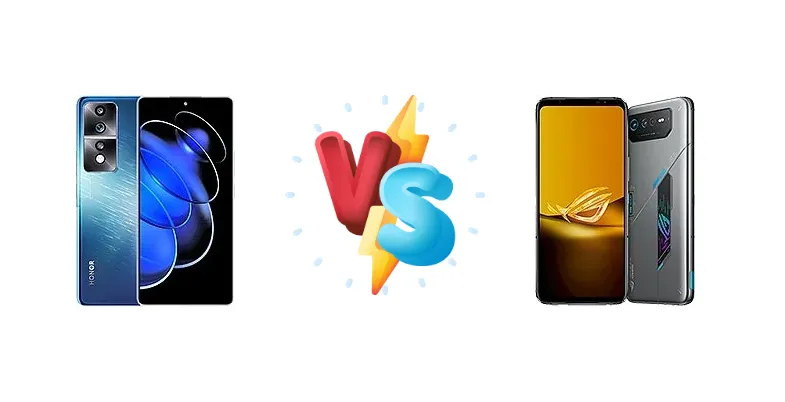
|
🏆 Quick Verdict
The Asus ROG Phone 6D takes the crown for dedicated gamers, offering superior cooling, gaming-specific features, and a slightly more powerful chipset. However, the Honor 80 GT provides a compelling alternative with a stylish design and excellent performance at a potentially lower price point.
| PHONES | ||
|---|---|---|
| Phone Names | Honor 80 GT | Asus ROG Phone 6D |
| Network | ||
|---|---|---|
| 2G bands | GSM 850 / 900 / 1800 / 1900 | GSM 850 / 900 / 1800 / 1900 |
| 3G bands | HSDPA 800 / 850 / 900 / 1700(AWS) / 2100 | HSDPA 800 / 850 / 900 / 1700(AWS) / 1900 / 2100 |
| 4G bands | 1, 3, 4, 5, 8, 19, 28, 34, 38, 39, 40, 41 | 1, 2, 3, 4, 5, 7, 8, 12, 17, 18, 19, 20, 26, 28, 32, 34, 38, 39, 40, 41, 42, 43, 48 - A version |
| 5G bands | 1, 5, 8, 28, 41, 77, 78 SA/NSA | 1, 2, 3, 5, 7, 8, 12, 18, 20, 26, 28, 38, 40, 41, 48, 77, 78, 79 SA/NSA/Sub6 - A version |
| Speed | HSPA, LTE, 5G | HSPA 42.2/11.5 Mbps, LTE (5CA) Cat19 1600/210 Mbps, 5G |
| Technology | GSM / CDMA / HSPA / CDMA2000 / LTE / 5G | GSM / CDMA / HSPA / LTE / 5G |
| CDMA2000 1x | 1, 3, 5, 8, 28, 41, 77, 78, 79 SA/NSA/Sub6 - B version | |
| Launch | ||
|---|---|---|
| Announced | 2022, December 26 | 2022, September 19 |
| Status | Available. Released 2022, December 26 | Available. Released 2022, October 11 |
| Body | ||
|---|---|---|
| Build | - | Glass front (Gorilla Glass Victus), glass back (Gorilla Glass 3), aluminum frame |
| Dimensions | 162.5 x 75.3 x 7.9 mm (6.40 x 2.96 x 0.31 in) | 173 x 77 x 10.4 mm (6.81 x 3.03 x 0.41 in) |
| SIM | Nano-SIM + Nano-SIM | Nano-SIM + Nano-SIM |
| Weight | 187 g or 195 g (6.60 oz) | 239 g (8.43 oz) |
| - | IPX4 water resistant Illuminated RGB logo (on the back) Pressure sensitive zones (Gaming triggers) | |
| Display | ||
|---|---|---|
| Protection | - | Corning Gorilla Glass Victus |
| Resolution | 1080 x 2400 pixels, 20:9 ratio (~395 ppi density) | 1080 x 2448 pixels (~395 ppi density) |
| Size | 6.67 inches, 107.4 cm2 (~87.8% screen-to-body ratio) | 6.78 inches, 109.5 cm2 (~82.2% screen-to-body ratio) |
| Type | AMOLED, 1B colors, 120Hz, HDR10, 1400 nits (peak) | AMOLED, 1B colors, 165Hz, HDR10+, 800 nits (typ), 1200 nits (peak) |
| Platform | ||
|---|---|---|
| CPU | Octa-core (1x3.0 GHz Cortex-X2 & 3x2.5 GHz Cortex-A710 & 4x1.80 GHz Cortex-A510) | Octa-core (1x3.35 GHz Cortex-X2 & 3x2.85 GHz Cortex-A710 & 4x1.80 GHz Cortex-A510) |
| Chipset | Qualcomm SM8475 Snapdragon 8+ Gen 1 (4 nm) | Mediatek Dimensity 9000+ (4 nm) |
| GPU | Adreno 730 | Mali-G710 MC10 |
| OS | Android 12, MagicOS 7 | Android 12 |
| Memory | ||
|---|---|---|
| Card slot | No | No |
| Internal | 256GB 12GB RAM, 256GB 16GB RAM, 512GB 12GB RAM | 256GB 12GB RAM, 256GB 16GB RAM |
| - | UFS 3.1 NTFS support for external storage | |
| Main Camera | ||
|---|---|---|
| Features | LED flash, HDR, panorama | LED flash, HDR, panorama |
| Single | 16 MP, f/2.4, (wide) | - |
| Triple | 54 MP, f/1.9, (wide), 1/1.49", PDAF 8 MP, f/2.2, (ultrawide) 2 MP (macro) | 50 MP, f/1.9, 24mm (wide), 1/1.56", 1.0µm, PDAF 13 MP, f/2.2, 13mm (ultrawide) 5 MP (macro) |
| Video | 4K@30fps, 1080p@30/60fps, gyro-EIS | 8K@24fps, 4K@30/60fps, 1080p@30/60/120/240fps, 720p@480fps; gyro-EIS, HDR10+ |
| Selfie camera | ||
|---|---|---|
| Features | - | Panorama, HDR |
| Single | 16 MP, f/2.4, (wide) | 12 MP, 28mm (wide) |
| Video | 1080p@30fps, gyro-EIS | 1080p@30fps |
| Sound | ||
|---|---|---|
| 3.5mm jack | No | Yes |
| 35mm jack | No | Yes |
| Loudspeaker | Yes | Yes, with stereo speakers (2 amplifiers) |
| - | 24-bit/192kHz audio | |
| Comms | ||
|---|---|---|
| Bluetooth | 5.2, A2DP, LE, aptX HD | 5.3, A2DP, LE, aptX HD, aptX Adaptive |
| Infrared port | Yes | - |
| NFC | Yes | Yes |
| Positioning | GPS, GALILEO, GLONASS, BDS, QZSS | GPS (L1+L5), GLONASS (L1), BDS (B1I+B1c+B2a), GALILEO (E1+E5a), QZSS (L1), NavIC (L5) |
| Radio | No | No |
| USB | USB Type-C 2.0, OTG | USB Type-C 3.1 (side), USB Type-C 2.0 (bottom), OTG, accessory connector |
| WLAN | Wi-Fi 802.11 a/b/g/n/ac/6, dual-band, Wi-Fi Direct | Wi-Fi 802.11 a/b/g/n/ac/6e, tri-band, Wi-Fi Direct |
| Features | ||
|---|---|---|
| Sensors | Fingerprint (under display, optical), accelerometer, gyro, compass | Fingerprint (under display, optical), accelerometer, gyro, proximity, compass |
| Virtual proximity sensing | - | |
| Battery | ||
|---|---|---|
| Charging | 66W wired, 3-50% in 15 min 5W reverse wired | 65W wired, PD3.0 10W reverse wired |
| Type | Li-Po 4800 mAh | Li-Po 6000 mAh |
| Misc | ||
|---|---|---|
| Colors | Black, Blue, White | Space Gray |
| Models | AGT-AN00 | AI2203, AI2203_D |
| Price | About 450 EUR | About 690 EUR |
Honor 80 GT
- Stylish Design
- Excellent Performance
- Fast Charging (66W)
- Potentially Lower Price
- Cooling may not be as robust as ROG Phone 6D
- Gaming-specific features limited
- Camera performance less emphasized
Asus ROG Phone 6D
- Exceptional Gaming Performance
- Advanced Cooling System
- Gaming-Specific Features (AirTriggers, Armoury Crate)
- Slightly Higher CPU Performance
- Less Stylish Design (Gaming Aesthetic)
- Potentially Higher Price
- Camera not a primary focus
Display Comparison
Both phones feature excellent AMOLED displays with high refresh rates (likely 120Hz or higher, though specific details on the Honor 80 GT are less readily available). The ROG Phone 6D often boasts a slightly larger display and potentially higher peak brightness, making it better for outdoor visibility. Color accuracy and viewing angles should be excellent on both.
Camera Comparison
The Honor 80 GT is expected to have a strong camera system, likely featuring a high-resolution main sensor and advanced image processing. The ROG Phone 6D's camera is generally considered good but not its primary focus, often prioritizing performance over camera capabilities. Detailed camera comparisons would require extensive testing.
Performance
The ROG Phone 6D's Dimensity 9000+ holds a slight edge over the Snapdragon 8+ Gen 1 in raw CPU performance, particularly in sustained loads due to its superior cooling system. Both chipsets are incredibly powerful and will handle demanding games and applications with ease. The ROG Phone 6D's gaming-focused software optimizations further enhance its performance.
Battery Life
Both phones offer substantial battery capacities (likely around 4500-5000mAh). The ROG Phone 6D's 65W charging is competitive with the Honor 80 GT's 66W, and both offer reverse wired charging, though the ROG Phone 6D has a slightly faster reverse charging speed.
Buying Guide
The Honor 80 GT is ideal for users who want a stylish, high-performance phone for everyday use and occasional gaming. The Asus ROG Phone 6D is the clear choice for serious mobile gamers who prioritize performance, cooling, and gaming-centric features above all else.