
Honor 70 vs Xiaomi Redmi Note 12 Pro: A Detailed Showdown
| Phones Images | |||||
|---|---|---|---|---|---|
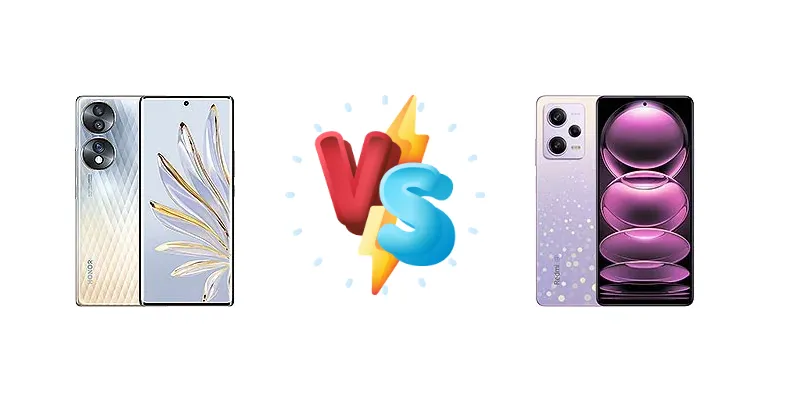
|
🏆 Quick Verdict
The Redmi Note 12 Pro edges out the Honor 70 thanks to its slightly brighter display, faster charging, and the Dimensity 1080 chipset which generally offers a bit more performance. However, the Honor 70's design and software experience are appealing, making it a close contest.
| PHONES | ||
|---|---|---|
| Phone Names | Honor 70 | Xiaomi Redmi Note 12 Pro |
| Network | ||
|---|---|---|
| 2G bands | GSM 850 / 900 / 1800 / 1900 | GSM 850 / 900 / 1800 / 1900 |
| 3G bands | HSDPA 800 / 850 / 900 / 1700(AWS) / 1900 / 2100 | HSDPA 800 / 850 / 900 / 1900 / 2100 |
| 4G bands | 1, 2, 3, 4, 5, 7, 8, 12, 13, 17, 18, 19, 20, 25, 26, 28, 32, 34, 38, 39, 40, 41, 66 - International | 1, 2, 3, 4, 5, 7, 8, 12, 13, 17, 18, 19, 20, 26, 28, 32, 38, 40, 41, 66 - International |
| 5G bands | 1, 3, 5, 7, 8, 20, 28, 38, 40, 41, 66, 77, 78 SA/NSA - International | 1, 3, 5, 7, 8, 20, 28, 38, 40, 41, 66, 77, 78 SA/NSA - International |
| Speed | HSPA, LTE, 5G | HSPA, LTE, 5G |
| Technology | GSM / CDMA / HSPA / CDMA2000 / LTE / 5G | GSM / CDMA / HSPA / EVDO / LTE / 5G |
| 1, 5, 8, 28, 41, 77, 78 SA/NSA - China | 1, 3, 5, 8, 28, 38, 41, 77, 78 SA/NSA - China | |
| Launch | ||
|---|---|---|
| Announced | 2022, May 30 | 2022, October 27 |
| Status | Available. Released 2022, June 02 | Available. Released 2022, November 01 |
| Body | ||
|---|---|---|
| Build | Glass front, plastic frame, plastic back | Glass front (Gorilla Glass 5), glass back, plastic frame |
| Dimensions | 161.4 x 73.3 x 7.9 mm (6.35 x 2.89 x 0.31 in) | 163 x 76 x 8 mm (6.42 x 2.99 x 0.31 in) |
| SIM | Nano-SIM + Nano-SIM | Nano-SIM + Nano-SIM |
| Weight | 178 g (6.28 oz) | 187 g (6.60 oz) |
| - | IP53, dust and splash resistant | |
| Display | ||
|---|---|---|
| Protection | - | Corning Gorilla Glass 5 |
| Resolution | 1080 x 2400 pixels, 20:9 ratio (~395 ppi density) | 1080 x 2400 pixels, 20:9 ratio (~395 ppi density) |
| Size | 6.67 inches, 107.4 cm2 (~90.8% screen-to-body ratio) | 6.67 inches, 107.4 cm2 (~86.7% screen-to-body ratio) |
| Type | OLED, 1B colors, 120Hz, HDR10+ | AMOLED, 1B colors, 120Hz, Dolby Vision, HDR10+, 500 nits (typ), 900 nits (HBM) |
| Platform | ||
|---|---|---|
| CPU | Octa-core (1x2.5 GHz Cortex-A78 & 3x2.4 GHz Cortex-A78 & 4x1.9 GHz Cortex-A55) | Octa-core (2x2.6 GHz Cortex-A78 & 6x2.0 GHz Cortex-A55) |
| Chipset | Qualcomm SM7325-AE Snapdragon 778G+ 5G (6 nm) | Mediatek Dimensity 1080 (6 nm) |
| GPU | Adreno 642L | Mali-G68 MC4 |
| OS | Android 12, Magic UI 6.1 | Android 12, MIUI 13 |
| Memory | ||
|---|---|---|
| Card slot | No | No |
| Internal | 128GB 8GB RAM, 256GB 8GB RAM, 256GB 12GB RAM, 512GB 12GB RAM | 128GB 6GB RAM, 128GB 8GB RAM, 256GB 8GB RAM, 256GB 12GB RAM |
| - | UFS 2.2 | |
| Main Camera | ||
|---|---|---|
| Features | Dual-LED flash, HDR, panorama | Dual-LED dual-tone flash, HDR, panorama |
| Single | 32 MP, f/2.4, (wide) | - |
| Triple | 54 MP, f/1.9, (wide), 1/1.49", PDAF 50 MP, f/2.2, 122˚ (ultrawide), AF Auxiliary lens | 50 MP, f/1.9, 24mm (wide), 1/1.56", 1.0µm, PDAF, OIS 8 MP, f/2.2, 120˚ (ultrawide), 1/4.0", 1.12µm 2 MP (macro) |
| Video | 4K@30fps, 1080p@30/60fps, gyro-EIS | 4K@30fps, 1080p@30/60/120fps, 720p@960fps |
| Selfie camera | ||
|---|---|---|
| Features | HDR | HDR |
| Single | 32 MP, f/2.4, (wide) | 16 MP, f/2.5, (wide), 1/3.06", 1.0µm |
| Video | 1080p@30fps, gyro-EIS | 1080p@30/60fps |
| Sound | ||
|---|---|---|
| 3.5mm jack | No | Yes |
| 35mm jack | No | Yes |
| Loudspeaker | Yes | Yes, with stereo speakers |
| - | 24-bit/192kHz audio | |
| Comms | ||
|---|---|---|
| Bluetooth | 5.2, A2DP, LE, aptX HD | 5.2, A2DP, LE |
| Infrared port | - | Yes |
| NFC | Yes | Yes (market/region dependent) |
| Positioning | GPS, GLONASS, BDS | GPS (L1), GLONASS (G1), BDS (B1I+B1c), GALILEO (E1), QZSS (L1) |
| Radio | No | No |
| USB | USB Type-C 2.0, OTG | USB Type-C 2.0, OTG |
| WLAN | Wi-Fi 802.11 a/b/g/n/ac/6, dual-band, Wi-Fi Direct | Wi-Fi 802.11 a/b/g/n/ac/6, dual-band, Wi-Fi Direct |
| Features | ||
|---|---|---|
| Sensors | Fingerprint (under display, optical), accelerometer, gyro, proximity, compass | Fingerprint (side-mounted), accelerometer, gyro, proximity, compass |
| Battery | ||
|---|---|---|
| Charging | 66W wired, 60% in 20 min 5W reverse wired | 67W wired, PD3.0, 50% in 15 min, 100% in 46 min |
| Type | Li-Po 4800 mAh | Li-Po 5000 mAh |
| Misc | ||
|---|---|---|
| Colors | Midnight Black, Emerald Green, Icelandic Frost, Crystal Silver | Frosted Blue (Sky Blue), Onyx Black (Midnight Black), Polar White, Stardust Purple |
| Models | FNE-AN00, FNE-NX9 | 22101316C, 22101316I, 23013RK75C, 22101316G |
| Price | £ 201.00 / € 189.90 | € 148.54 / $ 142.17 / £ 149.99 / ₹ 19,999 |
| SAR | - | 1.09 W/kg (head) 1.06 W/kg (body) |
| SAR EU | - | 0.99 W/kg (head) 0.99 W/kg (body) |
| Tests | ||
|---|---|---|
| Battery life | Endurance rating 100h | Endurance rating 97h |
| Camera | Photo / Video | Photo / Video |
| Display | Contrast ratio: Infinite (nominal) | Contrast ratio: Infinite (nominal) |
| Loudspeaker | -29.4 LUFS (Average) | -26.6 LUFS (Good) |
| Performance | - | AnTuTu: 490526 (v9) GeekBench: 2209 (v5.1), 2372 (v6) GFXBench: 22fps (ES 3.1 onscreen) |
Honor 70
- Stylish Design
- Smooth Software Experience (Magic UI)
- Good Camera for Portraits
- Excellent Battery Life
- Slightly Slower Charging
- Chipset Not as Powerful as Competitors
- Design can feel a bit generic
Xiaomi Redmi Note 12 Pro
- Brighter Display
- Faster Charging
- More Powerful Chipset (Dimensity 1080)
- Good Value for Money
- MIUI can be cluttered
- Design is less distinctive
- Camera can sometimes over-saturate colors
Display Comparison
Both phones feature vibrant displays, but the Redmi Note 12 Pro takes a slight lead with a measured peak brightness of 890 nits compared to the Honor 70's 790 nits. While both boast 'infinite' contrast ratios (a nominal value), the Redmi Note 12 Pro's higher brightness makes it more visible in direct sunlight. Both offer excellent color accuracy and sharpness for the price.
Camera Comparison
Both phones offer versatile camera setups, but the Redmi Note 12 Pro often produces slightly more detailed and vibrant photos, especially in well-lit conditions. The Honor 70's camera is known for its pleasing color science and portrait mode capabilities. Video recording quality is comparable on both devices, offering stable footage at 1080p and 4K resolutions.
Performance
The Redmi Note 12 Pro's Mediatek Dimensity 1080 generally outperforms the Honor 70's Snapdragon 778G+ in benchmarks and real-world usage. While both chipsets are capable of handling everyday tasks and moderate gaming, the Dimensity 1080 provides a smoother experience for more demanding games and multitasking. The CPU configurations are also slightly different, with the Redmi Note 12 Pro having two higher-clocked Cortex-A78 cores.
Battery Life
The Honor 70 boasts an impressive endurance rating of 100h, suggesting excellent battery life. The Redmi Note 12 Pro also scores well at 97h. However, the Redmi Note 12 Pro's 67W charging is significantly faster than the Honor 70's 66W, allowing it to reach 50% charge in just 15 minutes compared to 20 minutes for the Honor 70.
Buying Guide
The Honor 70 is ideal for users who prioritize a stylish design, a smooth software experience, and a good camera for everyday photography. The Xiaomi Redmi Note 12 Pro is a better choice for those seeking a brighter display, faster charging speeds, and a slightly more powerful processor for gaming and demanding tasks.