
Honor 70 vs Xiaomi 12 Lite: A Deep Dive into Mid-Range Contenders
| Phones Images | |||||
|---|---|---|---|---|---|
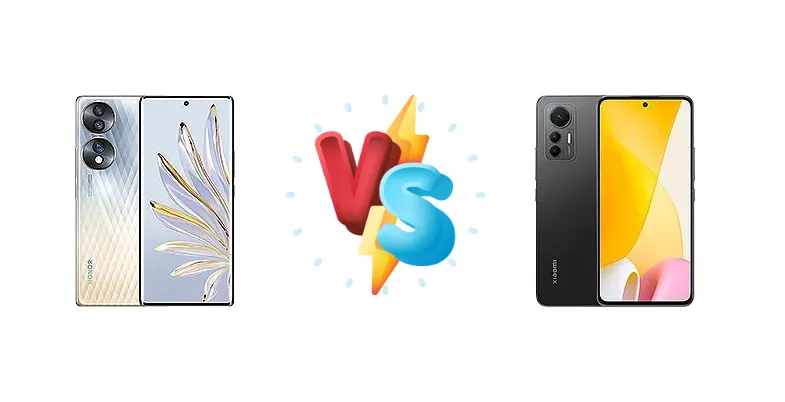
|
🏆 Quick Verdict
For most users, the Xiaomi 12 Lite edges out the Honor 70 thanks to its marginally brighter display and faster charging capabilities. While the Honor 70 offers a comparable experience, the 12 Lite’s quicker 50% charge time and slightly higher peak brightness provide a tangible advantage in daily use.
| PHONES | ||
|---|---|---|
| Phone Names | Honor 70 | Xiaomi 12 Lite |
| Network | ||
|---|---|---|
| 2G bands | GSM 850 / 900 / 1800 / 1900 | GSM 850 / 900 / 1800 / 1900 |
| 3G bands | HSDPA 800 / 850 / 900 / 1700(AWS) / 1900 / 2100 | HSDPA 850 / 900 / 1700(AWS) / 1900 / 2100 |
| 4G bands | 1, 2, 3, 4, 5, 7, 8, 12, 13, 17, 18, 19, 20, 25, 26, 28, 32, 34, 38, 39, 40, 41, 66 - International | 1, 2, 3, 4, 5, 7, 8, 12, 13, 17, 18, 19, 20, 26, 28, 32, 38, 40, 41, 42, 48, 66 |
| 5G bands | 1, 3, 5, 7, 8, 20, 28, 38, 40, 41, 66, 77, 78 SA/NSA - International | 1, 3, 5, 7, 8, 20, 28, 38, 40, 41, 66, 77, 78 SA/NSA |
| Speed | HSPA, LTE, 5G | HSPA, LTE, 5G |
| Technology | GSM / CDMA / HSPA / CDMA2000 / LTE / 5G | GSM / HSPA / LTE / 5G |
| 1, 5, 8, 28, 41, 77, 78 SA/NSA - China | - | |
| Launch | ||
|---|---|---|
| Announced | 2022, May 30 | 2022, July 09 |
| Status | Available. Released 2022, June 02 | Available. Released 2022, July 11 |
| Body | ||
|---|---|---|
| Build | Glass front, plastic frame, plastic back | Glass front (Gorilla Glass 5), glass back, plastic frame |
| Dimensions | 161.4 x 73.3 x 7.9 mm (6.35 x 2.89 x 0.31 in) | 159.3 x 73.7 x 7.3 mm (6.27 x 2.90 x 0.29 in) |
| SIM | Nano-SIM + Nano-SIM | Nano-SIM + Nano-SIM |
| Weight | 178 g (6.28 oz) | 173 g (6.10 oz) |
| Display | ||
|---|---|---|
| Protection | - | Corning Gorilla Glass 5 |
| Resolution | 1080 x 2400 pixels, 20:9 ratio (~395 ppi density) | 1080 x 2400 pixels, 20:9 ratio (~402 ppi density) |
| Size | 6.67 inches, 107.4 cm2 (~90.8% screen-to-body ratio) | 6.55 inches, 103.6 cm2 (~88.2% screen-to-body ratio) |
| Type | OLED, 1B colors, 120Hz, HDR10+ | AMOLED, 68B colors, 120Hz, Dolby Vision, HDR10+, 950 nits (peak) |
| Platform | ||
|---|---|---|
| CPU | Octa-core (1x2.5 GHz Cortex-A78 & 3x2.4 GHz Cortex-A78 & 4x1.9 GHz Cortex-A55) | Octa-core (1x2.4 GHz Cortex-A78 & 3x2.2 GHz Cortex-A78 & 4x1.9 GHz Cortex-A55) |
| Chipset | Qualcomm SM7325-AE Snapdragon 778G+ 5G (6 nm) | Qualcomm SM7325 Snapdragon 778G 5G (6 nm) |
| GPU | Adreno 642L | Adreno 642L |
| OS | Android 12, Magic UI 6.1 | Android 12, upgradable to Android 14, HyperOS |
| Memory | ||
|---|---|---|
| Card slot | No | No |
| Internal | 128GB 8GB RAM, 256GB 8GB RAM, 256GB 12GB RAM, 512GB 12GB RAM | 128GB 6GB RAM, 128GB 8GB RAM, 256GB 8GB RAM |
| - | UFS 2.2 | |
| Main Camera | ||
|---|---|---|
| Features | Dual-LED flash, HDR, panorama | Dual-LED dual-tone flash, HDR, panorama |
| Single | 32 MP, f/2.4, (wide) | 32 MP, f/2.5, (wide), 1/2.8", 0.8µm, AF |
| Triple | 54 MP, f/1.9, (wide), 1/1.49", PDAF 50 MP, f/2.2, 122˚ (ultrawide), AF Auxiliary lens | 108 MP, f/1.9, 26mm (wide), 1/1.52", 0.7µm, PDAF 8 MP, f/2.2, 120˚ (ultrawide), 1/4.0", 1.12µm 2 MP (macro) |
| Video | 4K@30fps, 1080p@30/60fps, gyro-EIS | 4K@30fps, 1080p@30/60/120fps; gyro-EIS |
| Selfie camera | ||
|---|---|---|
| Features | HDR | HDR, panorama |
| Single | 32 MP, f/2.4, (wide) | 32 MP, f/2.5, (wide), 1/2.8", 0.8µm, AF |
| Video | 1080p@30fps, gyro-EIS | 1080p@30/60fps, 720p@120fps |
| Sound | ||
|---|---|---|
| 3.5mm jack | No | No |
| 35mm jack | No | No |
| Loudspeaker | Yes | Yes, with dual speakers |
| - | 24-bit/192kHz audio | |
| Comms | ||
|---|---|---|
| Bluetooth | 5.2, A2DP, LE, aptX HD | 5.2, A2DP, LE, aptX HD, aptX Adaptive |
| Infrared port | - | Yes |
| NFC | Yes | Yes (market/region dependent) |
| Positioning | GPS, GLONASS, BDS | GPS (L1), GLONASS (G1), BDS (B1I+B1c), GALILEO (E1), QZSS (L1) |
| Radio | No | No |
| USB | USB Type-C 2.0, OTG | USB Type-C 2.0, OTG |
| WLAN | Wi-Fi 802.11 a/b/g/n/ac/6, dual-band, Wi-Fi Direct | Wi-Fi 802.11 a/b/g/n/ac/6, dual-band, Wi-Fi Direct |
| Features | ||
|---|---|---|
| Sensors | Fingerprint (under display, optical), accelerometer, gyro, proximity, compass | Fingerprint (under display, optical), accelerometer, gyro, compass |
| - | Virtual proximity sensing | |
| Battery | ||
|---|---|---|
| Charging | 66W wired, 60% in 20 min 5W reverse wired | 67W wired, PD3.0, QC4, 50% in 13 min |
| Type | Li-Po 4800 mAh | Li-Po 4300 mAh |
| Misc | ||
|---|---|---|
| Colors | Midnight Black, Emerald Green, Icelandic Frost, Crystal Silver | Black, Lite Green, Lite Pink |
| Models | FNE-AN00, FNE-NX9 | 2203129G |
| Price | £ 201.00 / € 189.90 | € 119.80 / $ 269.00 / £ 121.15 |
| SAR | - | 1.09 W/kg (head) 0.73 W/kg (body) |
| SAR EU | - | 0.60 W/kg (head) 1.00 W/kg (body) |
| Tests | ||
|---|---|---|
| Battery life | Endurance rating 100h | Endurance rating 100h |
| Camera | Photo / Video | Photo / Video |
| Display | Contrast ratio: Infinite (nominal) | Contrast ratio: Infinite (nominal) |
| Loudspeaker | -29.4 LUFS (Average) | -25.2 LUFS (Very good) |
| Performance | - | AnTuTu: 528905 (v9) GeekBench: 2943 (v5.1) GFXBench: 29fps (ES 3.1 onscreen) |
Honor 70
- Slightly faster CPU clock speeds with the Snapdragon 778G+
- Honor’s software optimizations may offer a smoother experience.
- Comparable battery endurance to the Xiaomi 12 Lite.
- Lower peak display brightness compared to the Xiaomi 12 Lite.
- Slower charging speed (60% in 20 minutes vs 50% in 13 minutes).
Xiaomi 12 Lite
- Brighter display for better outdoor visibility (824 nits).
- Faster 67W charging with PD3.0 and QC4 support.
- Potentially wider compatibility with fast charging accessories.
- Slightly slower CPU clock speeds compared to the Honor 70.
- MIUI software can be polarizing for some users.
Display Comparison
Both the Honor 70 and Xiaomi 12 Lite feature displays with an 'Infinite' (nominal) contrast ratio, suggesting excellent black levels. However, the Xiaomi 12 Lite boasts a measured peak brightness of 824 nits, surpassing the Honor 70’s 790 nits. This 34-nit difference, while not massive, translates to better visibility under direct sunlight. Both likely utilize AMOLED panels, common in this price bracket, but neither specification details refresh rate or HDR support, leaving those as potential differentiating factors based on regional variants. The brighter display on the Xiaomi 12 Lite will be more beneficial for users who consume a lot of content outdoors.
Camera Comparison
Both devices are listed as having 'Photo / Video' capabilities, lacking specific details. Without sensor size, aperture, or OIS information, a direct comparison is difficult. However, the omission of any mention of a telephoto lens on either device suggests a focus on wide and ultrawide photography. The image processing style will likely be a key differentiator, with Honor typically favoring more vibrant colors and Xiaomi leaning towards a more natural look. The lack of detail makes it impossible to determine a clear camera winner without further testing.
Performance
Both phones are powered by the Qualcomm SM7325 series chipset, but with a subtle difference: the Honor 70 utilizes the Snapdragon 778G+ 5G, while the Xiaomi 12 Lite uses the standard Snapdragon 778G 5G. The ‘+’ variant in the Honor 70 features slightly higher CPU clock speeds – 2.5 GHz Cortex-A78 vs 2.4 GHz in the 12 Lite, alongside 3x2.4GHz Cortex-A78 cores in the Honor 70 versus 3x2.2GHz in the Xiaomi 12 Lite. While this difference is unlikely to be noticeable in everyday tasks, it *could* translate to a marginal performance boost in demanding applications or sustained gaming. Both utilize a 6nm process, ensuring reasonable efficiency. Both phones likely pair the chipset with 8GB of RAM, though LPDDR5 or LPDDR4X specification is not provided.
Battery Life
Interestingly, both the Honor 70 and Xiaomi 12 Lite achieve the same Endurance rating of 100 hours, despite potentially different battery capacities (not specified). This suggests that software optimization and chipset efficiency play a significant role. However, the Xiaomi 12 Lite boasts a faster charging speed of 67W with support for PD3.0 and QC4, achieving 50% charge in just 13 minutes. The Honor 70’s 66W charging takes 20 minutes to reach 60%. This 7-minute difference in reaching a substantial charge level is a practical advantage for the Xiaomi 12 Lite, especially for users who frequently need a quick power boost. Both also offer 5W reverse wired charging.
Buying Guide
Buy the Honor 70 if you prioritize a consistently reliable experience and appreciate Honor’s software optimizations. It’s a solid all-rounder. Buy the Xiaomi 12 Lite if you value faster charging and a slightly brighter screen for outdoor visibility, and prefer Xiaomi’s MIUI software experience. It’s ideal for users who are frequently on the go.